
Here's an uncomfortable number: only 14% of marketers create bottom-of-funnel content, while 50% pour their effort into the top. Most teams are brilliant at attracting strangers and quietly terrible at converting them.
It's not a writing problem. The blog posts are well-researched, the videos are slick, the design is clean. The problem is aim. A piece of content can be excellent and still convert nobody — because it's answering a question the reader isn't asking yet, or pitching a sale to someone who's three weeks from being ready.
The fix isn't more content. It's content mapped deliberately to where the buyer actually is. That map is the marketing funnel — and businesses that use it across every stage see roughly 45% higher marketing ROI than those who optimize one stage in isolation.
This is the practitioner's version of that map: each stage, the mindset behind it, the content that fits, the metric that proves it's working, and the mistakes that quietly leak revenue.
In a Nutshell
- The funnel has four stages, not three. Awareness (TOFU), Consideration (MOFU), Decision (BOFU), and the one most guides skip — Retention & Advocacy after the sale.
- Match content to mindset, not to format. A buyer in Awareness wants to understand a problem; a buyer in Decision wants proof and a reason to act now. The same blog post can't do both.
- The bottom of the funnel is where the money is — and where the content isn't. Only ~14% of marketers produce BOFU content versus ~50% making TOFU. That gap is the single biggest content opportunity most teams have.
- Every stage has one metric that matters. TOFU = reach and engaged attention; MOFU = lead and engagement quality; BOFU = conversion rate, CPA and ROAS; Retention = repeat rate and LTV.
- A sane starting mix is roughly 50% TOFU / 30% MOFU / 20% BOFU — then rebalance toward the middle and bottom as soon as traffic outpaces pipeline.
- AI search is compressing the funnel. Buyers now move from "what is this" to "who should I buy from" inside a single ChatGPT conversation — which makes mapped, bottom-funnel content more valuable, not less.
Table of Contents
- Why "Good Content" Still Doesn't Convert
- The Four Funnel Stages (and the Mindset Behind Each)
- The Content Map: Stage by Stage
- Top of Funnel: Earn Attention
- Middle of Funnel: Earn Trust
- Bottom of Funnel: Earn the Sale
- After the Sale: Retention & Advocacy
- The Content Mix (and the BOFU Trap)
- How to Map Your Existing Content
- The Funnel in the AI-Search Era
- The Bottom Line
- Frequently Asked Questions
Why "Good Content" Still Doesn't Convert
Picture two readers landing on the same excellent 2,000-word guide.
The first typed "what is marketing attribution" into Google ten seconds ago. They want to understand a concept. Your guide is perfect for them.
The second has been comparing three attribution tools for a week and is ready to buy this quarter. They don't want a 101 explainer — they want to know why your solution beats the other two, what it costs, and whether it'll break their existing stack. Your guide bounces them.
Same content. Two completely different outcomes — because the readers are at different stages of intent. This is the core idea behind the funnel: as people move from stranger to customer, the questions they ask change, and the content that helps them has to change with it.
When teams ignore this, the symptoms are predictable. Traffic is healthy but leads are flat. The blog ranks but the demo calendar is empty. Sales complains that "marketing leads are junk." Nearly always, the cause is a funnel imbalance — a fat top and a starved bottom. Research-led nurturing that respects these stages can produce 50% more sales-ready leads, and a meaningful share of those go on to become higher-value customers. The funnel isn't theory. It's the difference between content that's busy and content that pays.
The Four Funnel Stages (and the Mindset Behind Each)
Most guides stop at three stages. That's a mistake — it treats the sale as the finish line when, for any business with repeat revenue, it's the starting line.
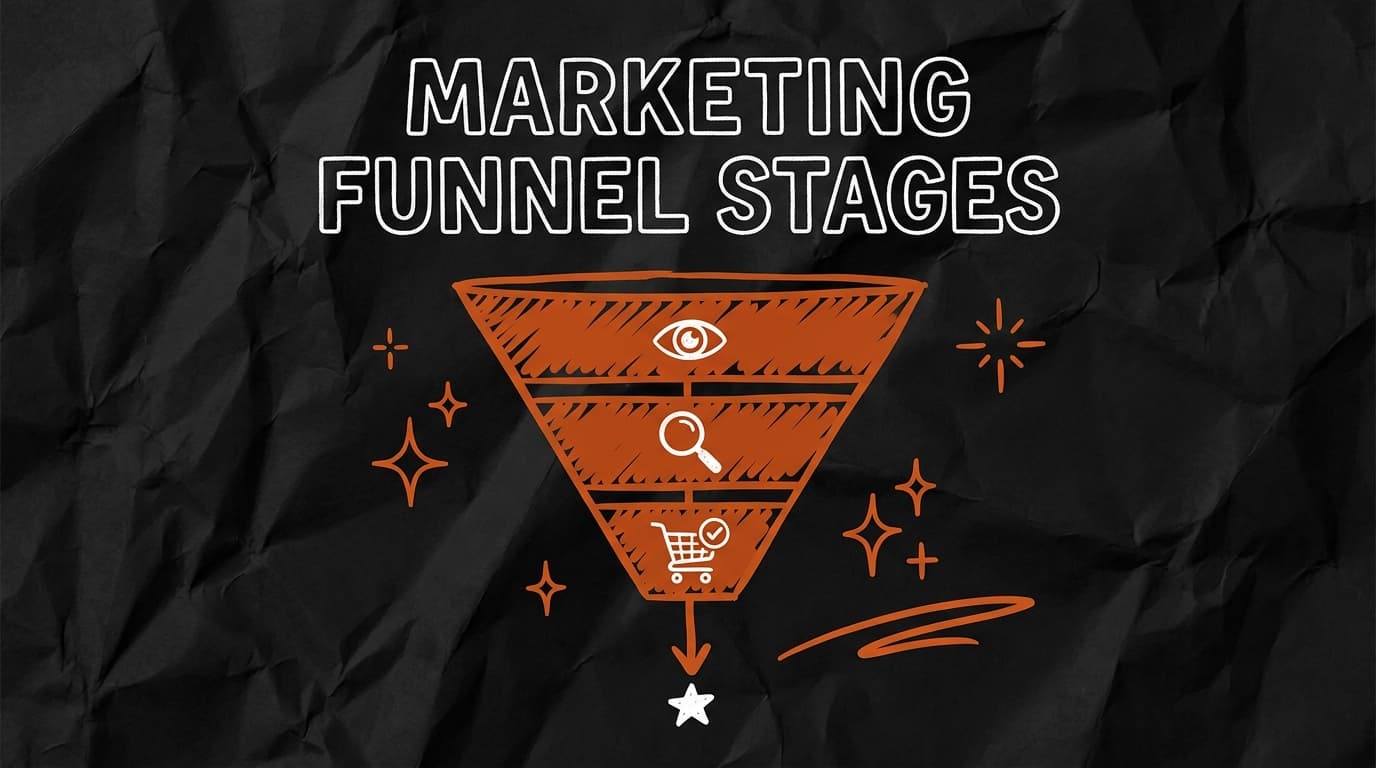
Here are the four stages, defined by what the buyer is actually thinking:
- Awareness (Top of Funnel / TOFU) — "I have a problem (or a curiosity). Help me understand it." They don't know your brand and aren't looking to buy. They're looking to learn.
- Consideration (Middle of Funnel / MOFU) — "I understand the problem. Now, what are my options?" They're aware solutions exist and are weighing approaches and providers.
- Decision (Bottom of Funnel / BOFU) — "I've shortlisted. Convince me you're the right choice." They have high intent and need proof, specifics, and a reason to act.
- Retention & Advocacy (Post-Purchase) — "I bought. Was this a good decision — and should I stay, expand, or recommend you?" The most profitable and most neglected stage.
That last stage earns its place on the math alone: a 5% lift in retention can increase profits by 25–95%, and a healthy business wants its customer lifetime value to outrun acquisition cost by at least a 3:1 ratio. Treating "closed-won" as the end of the content job leaves most of that value on the table.
Funnel ≠ rigid path
Real buyers don't march top-to-bottom in order. They loop back, skip steps, and binge three stages in an afternoon. The funnel isn't a description of how people behave — it's a tool for making sure you've created something useful for every mindset they might be in when they find you.
The Content Map: Stage by Stage
This is the table to bookmark. It maps each stage to the buyer's question, the content formats that fit, the primary metric, and the trap most teams fall into.
| Stage | Buyer is asking | Content that fits | Primary metric | Common trap |
|---|---|---|---|---|
| Awareness (TOFU) | "Help me understand my problem" | Blog posts, SEO guides, social, short video, free tools, infographics | Reach, engaged sessions, new visitors | Pitching too early |
| Consideration (MOFU) | "What are my options?" | Comparison guides, case studies, webinars, ebooks, email nurture | Lead quality, content downloads, email engagement | Generic "lead magnets" no one wants |
| Decision (BOFU) | "Why you, and why now?" | Demos, free trials, pricing pages, ROI calculators, consultations, testimonials | Conversion rate, CPA, ROAS | Not creating it at all |
| Retention & Advocacy | "Was this right? Should I stay/refer?" | Onboarding content, how-to docs, customer newsletters, loyalty offers, referral programs | Repeat rate, LTV, NPS, referrals | Going silent after the sale |
Notice the pattern: as buyers descend, the audience narrows but the intent — and the revenue per piece — climbs. A single great BOFU page can outearn fifty TOFU posts. Now let's go stage by stage.
Top of Funnel: Earn Attention
The mindset: curiosity, not commerce. The reader has a question or a pain and zero loyalty to you. Your only job is to be genuinely the most helpful answer they find — and to be memorable enough that they recognize your name later.
What works here: educational blog posts and SEO content targeting informational queries, short-form social video, infographics, podcasts, and free tools. The best TOFU asset is often a tool or a definitive guide that earns links and gets cited elsewhere.
The metric that matters: reach and engaged attention — new visitors, scroll depth, time on page, social shares. Do not judge TOFU content by conversions. Holding a "what is X" article to a demo-request target is how good awareness content gets killed before it's done its job.
The trap: selling too early. The fastest way to lose a TOFU reader is to interrupt their learning with a hard pitch. Capture intent gently — a relevant newsletter, a free tool, a "related guide" — and let the next stage do the converting. With 71% of consumers now expecting personalized experiences, the brands that win the top of the funnel are the ones that feel like a helpful expert, not a billboard.
Middle of Funnel: Earn Trust
The mindset: evaluation. They've accepted they have a problem worth solving and are now comparing approaches and providers — including yours against the status quo of doing nothing.
What works here: comparison guides, case studies, webinars, ebooks, and email nurture sequences. This is the stage where email earns its keep — roughly 72% of use cases report email as effective specifically for mid-funnel nurturing. Webinars and case studies do the heavy lifting because they combine education with proof.
The metric that matters: lead quality and engagement, not raw lead volume. Track content downloads, email click-through and reply rates, webinar attendance, and how many MOFU-engaged leads actually progress. A thousand ebook downloads that never advance is a vanity number; fifty webinar attendees who book calls is a pipeline.
The trap: the generic lead magnet. "Download our free guide" gated behind a form, offering nothing the reader couldn't get from a blog post, trains people to ignore you. MOFU content has to be worth an email address — specific, useful, and tied to a real decision the buyer is making.
Bottom of Funnel: Earn the Sale
This is where most of the money is — and, bizarrely, where most of the content isn't.
The mindset: high intent, final hesitation. They've shortlisted. They want to know why you specifically, what it costs, what could go wrong, and whether they can trust the outcome. They are looking for reasons to say yes and reasons to say no, and they will find both somewhere — make sure it's on your site, framed by you.
What works here: product demos, free trials, transparent pricing and landing pages, ROI calculators, detailed testimonials and case studies, comparison-vs-competitor pages, and "free strategy call" style consultations. Offers with a clear, low-friction next step convert best — for example, a free audit paired with a first-month incentive.
The metric that matters: the business ones — conversion rate, cost per acquisition (CPA), return on ad spend (ROAS), and sales-qualified-lead-to-close rate. This is the only stage where conversion is the right yardstick, and it's the stage that should map most directly to revenue. If you struggle here on paid channels specifically, our breakdown of why Meta Ads ROAS underperforms digs into the conversion side in depth.
The trap: simply not creating it. Remember the opening stat — ~14% of marketers make BOFU content versus ~50% making TOFU. That imbalance means most companies spend heavily to attract demand and then have nothing to capture it with. If your traffic is strong but deals stall, you almost certainly have a bottom-funnel content gap, and closing it is the highest-leverage move available to you. (This is also where dedicated lead generation and funnel building earn their return.)
After the Sale: Retention & Advocacy
The funnel doesn't end at "closed-won." For any business with renewals, repeat purchases, or referrals, that's where the most profitable work begins.
The mindset: validation and expansion. New customers want reassurance they chose well; established ones are deciding whether to stay, spend more, or recommend you.
What works here: onboarding sequences, how-to and knowledge-base content, customer-only newsletters, loyalty and upgrade offers, and referral programs that make sharing easy. Email and lifecycle marketing is the engine of this stage.
The metric that matters: repeat purchase / renewal rate, customer lifetime value, net promoter score, and referral volume. The economics are hard to argue with: a 5% retention improvement can lift profits 25–95%, and your CLV should comfortably clear a 3:1 ratio over acquisition cost. A happy customer who refers two others is the cheapest, highest-converting "top of funnel" you'll ever build — the funnel quietly loops back on itself.
The Content Mix (and the BOFU Trap)
So how much of each should you make? A reasonable starting allocation — well-supported for B2B and adaptable for most businesses — is:
- ~50% Awareness (TOFU) — fuel the top so there's always demand entering.
- ~30% Consideration (MOFU) — nurture and qualify so demand doesn't stall.
- ~20% Decision (BOFU) — capture and convert the demand you've earned.
But treat that as a starting point, not a law. The most common real-world failure is over-indexing on TOFU because blog posts are cheap and feel productive, while MOFU and BOFU starve. If your analytics show strong traffic but weak pipeline, shift budget down the funnel immediately — the marginal BOFU page is worth far more than the fiftieth TOFU post.
The fastest audit you'll run all quarter
Tag your last 30 pieces of content by stage. If more than ~60% is TOFU and you have fewer than a handful of true BOFU assets (pricing, comparisons, demos, proof), you've found your bottleneck — and your next quarter's content plan writes itself.
One more efficiency: content compounds across stages. A BOFU case study can be repackaged into a MOFU lead magnet; a TOFU blog post can expand into a MOFU ebook; a single webinar can be trimmed into a dozen TOFU social clips. You don't always need new content for a starved stage — sometimes you need to reframe what you already have.
How to Map Your Existing Content
You don't need a blank-page strategy. You need to see what you already have through a funnel lens. Three steps:
1. Audit and tag. List your existing content and tag each piece by stage. Be honest — a post titled "the ultimate guide to X" is almost always TOFU no matter how much you'd like it to convert.
2. Find the gap. Count by stage. Funnel-stage tagging makes imbalances obvious: a fat TOFU layer and a thin BOFU layer is the classic pattern, and it tells you exactly where pipeline is leaking. Strong sales-and-marketing alignment around these shared funnel metrics correlates with ~19% faster growth, so get both teams reading the same map.
3. Create and connect for each stage. Fill the gaps, then link the stages together so a reader can move down the funnel without hitting a dead end — a TOFU guide that points to a MOFU comparison that points to a BOFU demo. Tag everything with proper analytics and UTMs so you can answer "what's our MOFU-to-BOFU conversion rate?" with data instead of opinion.
The Funnel in the AI-Search Era
Here's what most funnel guides written before 2026 miss: AI assistants are compressing the funnel into a single conversation.
A buyer used to run separate searches across days — "what is X" (Awareness), then "best X tools" (Consideration), then "X vs Y pricing" (Decision). Now they can ask ChatGPT or Perplexity all three in one thread and get a synthesized answer with a shortlist of recommended brands. The stages still exist in the buyer's head; they just happen faster and increasingly off your website.
This makes mapped, bottom-funnel content more valuable, not less. The brands that get cited in AI answers for high-intent, comparison-and-decision queries are the ones that actually published clear, specific BOFU and MOFU content — comparisons, pricing logic, proof. Thin TOFU fluff doesn't get cited; decisive, specific content does. We cover the mechanics of earning those citations in our guides to answer engine optimization and building an AI SEO strategy.
The takeaway: keep mapping content to stages, but assume a buyer might hit any stage first, via an AI answer, with no prior awareness of you. That raises the bar for every piece to stand on its own — and rewards the teams who stopped neglecting the bottom of the funnel.
The Bottom Line
The marketing funnel isn't a dusty diagram. It's a practical filter for one question you should ask of every piece of content you make: which mindset is this for, and what's the one job it has to do?
Get that right and the symptoms of a broken funnel — high traffic, low pipeline, "bad leads" — start to resolve, because each piece is finally aimed at a real person at a real moment in their decision. Get the balance right too — especially by closing the bottom-funnel gap that most of your competitors are ignoring — and you stop paying to attract demand you have no way to capture.
Four stages. One metric each. A deliberate mix. And content that meets the buyer where they actually are, not where you wish they were.
Aurelius Media builds full-funnel content strategies and the growth systems that turn attention into revenue for Indian businesses and funded startups. If your traffic is strong but your pipeline isn't, book a strategy call and we'll find the gap.
Frequently Asked Questions
What are the stages of the marketing funnel?
The marketing funnel has four stages: Awareness (top of funnel / TOFU), where buyers are learning about a problem; Consideration (middle of funnel / MOFU), where they compare options; Decision (bottom of funnel / BOFU), where they choose a provider; and Retention & Advocacy (post-purchase), where they decide whether to stay, expand, and refer. The first three are often called TOFU, MOFU, and BOFU.
What is TOFU, MOFU, and BOFU content?
TOFU (top of funnel) content educates and attracts a broad audience — blog posts, guides, social video, free tools. MOFU (middle of funnel) content nurtures and builds trust — comparison guides, case studies, webinars, email sequences. BOFU (bottom of funnel) content converts high-intent buyers — demos, free trials, pricing pages, testimonials, and consultations. Each maps to a different buyer mindset.
How much content should I create for each funnel stage?
A reasonable starting mix is roughly 50% TOFU, 30% MOFU, and 20% BOFU, then adjust based on your data. Most teams over-invest in TOFU (it's cheap to produce) and under-invest in BOFU (only ~14% of marketers create it). If you have strong traffic but weak pipeline, shift effort toward the middle and bottom of the funnel immediately.
Which metrics matter at each funnel stage?
Use stage-specific metrics. TOFU: reach, new visitors, engaged sessions, shares. MOFU: lead quality, content downloads, email engagement, webinar attendance. BOFU: conversion rate, cost per acquisition (CPA), return on ad spend (ROAS), and lead-to-close rate. Retention: repeat/renewal rate, customer lifetime value (LTV), NPS, and referrals. Judging TOFU content by conversions is a common mistake.
How do I map my existing content to the funnel?
Audit your content and tag each piece by stage, count the pieces per stage to expose gaps (usually a fat TOFU layer and thin BOFU layer), then create or repurpose content to fill the gaps and link the stages together so readers can progress. Tag everything with UTMs and analytics so you can measure conversion rates between stages.
Does the marketing funnel still matter with AI search?
Yes — arguably more. AI assistants like ChatGPT and Perplexity compress the funnel into a single conversation, so buyers may reach any stage first via an AI answer. The brands cited in those answers tend to be the ones with clear, specific consideration and decision-stage content. Mapping content to stages — and finally investing in the bottom of the funnel — is how you earn those citations and the high-intent traffic they drive.