
Let's skip the pleasantries.
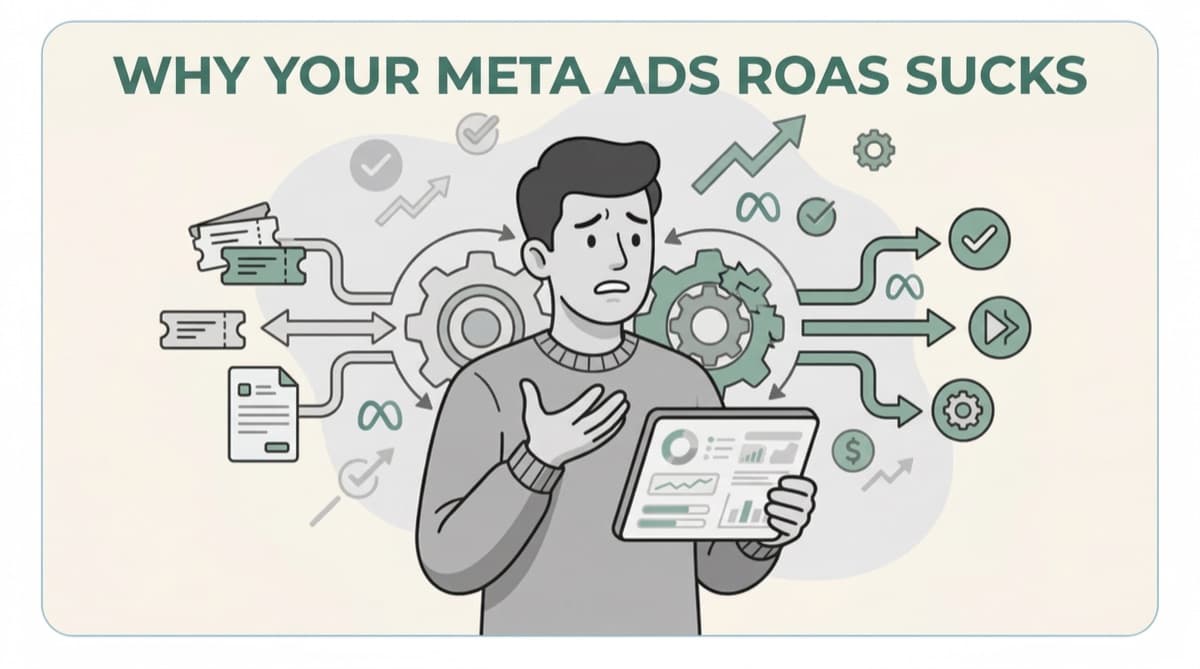
If your Meta Ads ROAS is sitting below 2x and you're wondering what's wrong — it's probably not the algorithm. It's not "the market." It's not even your product.
It's your setup.
The median Meta Ads ROAS across all industries in 2025 was 1.86x — according to Triple Whale's analysis of 35,000+ brands. CPMs rose 20% year-over-year to $14.19. The platform is getting more expensive while most brands are making the same fixable mistakes.
We've audited over 80 Meta Ads accounts in the last 18 months. The average account we inherit is wasting 30–40% of its monthly budget on structural problems that compound month over month until someone finally asks: why isn't this working?
Here are the 7 most common reasons your ROAS is underperforming — and exactly what to do about each one.
In a Nutshell
- Creative fatigue is the #1 ROAS killer in 2026. Meta's Andromeda algorithm — globally rolled out by October 2025 — uses your creative as the primary targeting signal. If you're running the same 3–5 ads for weeks, the algorithm has nothing to work with. Creative diversity isn't optional anymore — it's your targeting strategy.
- Most accounts have broken or incomplete conversion tracking. 76% of Meta ad accounts we audit have at least one critical tracking gap — missing Conversions API, incorrect event configurations, or attribution windows that don't match the buying cycle. CAPI alone recovers 20–30% of lost conversion data that browser-based pixels miss entirely.
- Broad targeting beats interest-based targeting in Andromeda — but only if your creative is strong enough. Advantage+ Shopping campaigns deliver 15–30% lower CPA compared to manual campaigns. But go broad with weak creative, and performance collapses.
- Campaign objective matters more than you think. Sales-optimized campaigns on Meta generate a median 4.87x ROAS versus 0.52x for traffic campaigns — an 835% difference. If you're running the wrong objective, nothing else you optimise will matter.
- Your landing page is a conversion leak. A 1-second delay in page load costs 7% of conversions. Most Meta ad clicks land on pages that load in 4–6 seconds on mobile. Do the math.
- Retargeting is either neglected or over-indexed. Retargeting campaigns deliver a median 3.61x ROAS vs 2.11x for prospecting — 71% higher returns. The sweet spot for allocation is 15–25% of total Meta budget. We regularly see accounts spending 50%+ on retargeting (diminishing returns) or 0% (leaving the cheapest conversions on the table).
- Attribution confusion causes bad decisions. Triple Whale brands invested 68% of their total ad budget on Meta in 2025 — but if you're judging Meta on last-click attribution in GA4, you're systematically undervaluing it and probably cutting the one channel filling your top of funnel.
Table of Contents
- Mistake #1: Creative Fatigue Is Killing Your Algorithm
- Mistake #2: Your Conversion Tracking Is Broken
- Mistake #3: You're Fighting the Andromeda Algorithm
- Mistake #4: Your Campaign Structure Is a Mess
- Mistake #5: Your Landing Page Is a Conversion Leak
- Mistake #6: Your Retargeting Is All Wrong
- Mistake #7: You're Reading the Wrong Numbers
- The ROAS Recovery Playbook: Where to Start
- The Bottom Line
- Frequently Asked Questions
Mistake #1: Creative Fatigue Is Killing Your Algorithm
This is the single biggest reason Meta Ads ROAS drops — and it's the one most brands misdiagnose.
Meta's Andromeda algorithm — which completed its global rollout around October 2025 — uses your ad creative as the primary targeting signal. Not your audience selections. Not your interest targeting. Your creative.
This wasn't a toggle that got switched on. Meta phased Andromeda in gradually: limited testing in 2024, incremental algorithmic adjustments through 2025, and by 2026 it became the primary engine shaping ad eligibility and delivery. As upROAS explains: "Meta is no longer optimizing ads primarily around who advertisers think their audience is. It is optimizing around what the system can predict people will do."
When Andromeda sees a video of a woman unboxing a skincare product, it doesn't just show it to people who "like skincare." It analyzes the visual content, the narrative, the emotion, and finds users who are most likely to respond to that specific creative based on behavioral patterns.
This means creative fatigue doesn't just mean "people have seen your ad too many times." It means the algorithm runs out of new audiences to match your stale creative against. Your CPMs climb, your CTR drops, and your ROAS craters — not because Meta is broken, but because you gave the algorithm nothing new to work with.
The Numbers
Triple Whale's 2025 benchmark data across 35,000+ brands shows the stakes clearly:
- Platform-wide CPMs rose 20% year-over-year to $14.19 — every single industry saw CPM increases
- Health & Wellness CPM spiked +38% to $20.70, the highest of any vertical
- Yet CTR improved to 2.19% (up 13.5% YoY) — proof that better creative is cutting through despite higher costs
- Creative quality drives 50–70% of ad performance in the Andromeda era — up from ~30% pre-2024
- Creative fatigue sets in within 7–14 days on most accounts
- Brands running 15+ active creative variations see 2–3x the ROAS of brands running fewer than 5
- 67% of companies have shifted their primary budgets toward AI-first campaign tools that are entirely creative-dependent
The Fix
Diversify format, not just visuals. You need variety across these dimensions:
| Dimension | What to Vary | Example |
|---|---|---|
| Format | Static, video, carousel, UGC, motion graphic | Don't run 5 static images — run 2 statics + 1 UGC video + 1 carousel + 1 motion graphic |
| Hook | First 3 seconds of video, headline approach | "Stop doing X" vs "The secret to X" vs customer testimonial opener |
| Angle | Problem-aware, solution-aware, product-focused | Pain point ad vs aspirational lifestyle ad vs feature comparison ad |
| Social proof | Reviews, UGC, before/after, data points | Customer quote vs star rating vs "10,000+ sold" |
The refresh cadence:
- Spending under $5K/month: Refresh creative every 2–3 weeks
- Spending $5K–$20K/month: Refresh weekly, introduce 3–5 new variations per week
- Spending $20K+/month: Continuous creative pipeline — new concepts every 3–5 days
If you don't have the capacity for this, that's not a creative problem — it's a strategic problem. AI-powered creative production has collapsed the cost of generating diverse ad creative by 80%+ since 2024. There's no excuse for running stale ads anymore.
Mistake #2: Your Conversion Tracking Is Broken
This is the most expensive mistake on the list because it corrupts everything downstream.
If your conversion tracking is wrong, Meta's algorithm optimises toward the wrong actions. Your reported ROAS is fiction. Your budget allocation decisions are based on made-up numbers. And you have no idea what's actually working.
How Common Is This?
In our audits, 76% of accounts have at least one critical tracking issue. The most frequent:
| Tracking Problem | How Often We See It | Impact |
|---|---|---|
| No Conversions API (CAPI) | 60% of accounts | 20–40% of conversions invisible to Meta |
| Duplicate events firing | 35% of accounts | Inflated ROAS by 15–50% |
| Wrong attribution window | 40% of accounts | Optimising toward misattributed conversions |
| Missing micro-conversions | 55% of accounts | Algorithm can't optimise mid-funnel |
| No event deduplication | 30% of accounts | Browser pixel + CAPI both fire = double counting |
The Fix
Step 1: Implement the Conversions API.
If you're relying solely on the Meta Pixel (browser-side tracking), you're losing 20–40% of your conversion data due to iOS App Tracking Transparency, ad blockers, and browser privacy restrictions. As AdsUploader's comprehensive CAPI guide puts it: "The Pixel is your eyes on the ground, watching what happens in the browser. CAPI is your secure backend channel, reporting what happened on your server. When you use both together, Meta gets the complete picture."
CAPI recovers 20–30% of lost conversion data and provides redundancy — if the Pixel fires but CAPI doesn't, Meta still gets the conversion, and vice versa. This isn't optional in 2026. Brands with CAPI implemented see an average 13% improvement in CPA simply from better data feeding the algorithm.
Step 2: Audit your event configuration.
Open Events Manager. Check every custom conversion and standard event. Ask:
- Is the event firing on the correct page? (Test with the Meta Pixel Helper extension)
- Is the event deduplication ID set correctly between Pixel and CAPI?
- Are event parameters (value, currency, content IDs) populated correctly?
- Is the attribution window aligned with your actual buying cycle?
Step 3: Set the right attribution window.
| Business Type | Recommended Attribution Window | Why |
|---|---|---|
| Impulse e-commerce (under $50 AOV) | 7-day click, 1-day view | Short decision cycle |
| Considered purchase ($50–$500) | 7-day click, 1-day view | Standard for most e-commerce |
| High-ticket ($500+) | 28-day click, 1-day view | Longer decision cycle needs wider window |
| B2B / Lead gen | 28-day click, 7-day view | Long sales cycles, multiple touchpoints |
If you're running a high-ticket product on a 1-day click window, you're telling Meta that conversions after 24 hours don't count — which means the algorithm can't learn from your highest-value customers.
Step 4: Configure micro-conversions.
Don't just track purchases or leads. Feed Meta signals along the journey — Add to Cart, Initiate Checkout, View Content with time-on-page thresholds. This gives the algorithm 10–50x more data points to learn from, which is critical if you're spending under $10K/month and don't generate enough purchases for the algorithm to optimise against.
Mistake #3: You're Fighting the Andromeda Algorithm
If you're still manually selecting interest-based audiences, layering demographic restrictions, and running separate retargeting campaigns with custom audiences — you're running a 2023 playbook on a 2026 platform.
Andromeda operates at the retrieval stage of ad delivery — it determines which ads even get a chance to compete before bidding and ranking begin. As Meta's engineering team explained, the system prioritizes creative performance data and real behavioral patterns over advertiser-defined audience inputs. If an ad is never retrieved, your bid size and budget become irrelevant.
Why Broad Targeting Wins Now
Focus Digital's 2025 data on targeting strategy performance tells a clear story:
| Targeting Approach | Median ROAS | ROAS Range | Notes |
|---|---|---|---|
| Retargeting | 3.61x | 1.73–7.52x | Warm audiences, highest returns |
| Broad / Prospecting | 2.11x | 1.14–4.07x | Best with 10+ creative variations |
| Lookalike audiences | 1.80x | 0.78–4.74x | Wide variance — useful as suggestions, not restrictions |
Meanwhile, Advantage+ Shopping campaigns — which use fully automated broad targeting — deliver 15–30% lower CPA than manual campaigns and a conversion rate of 9.0%+ versus 8.2% for manual setups. They can test up to 150 creative combinations automatically, finding pockets of high-intent users you'd never target manually.
The key insight from practitioners: "Creative is the new targeting." As one advertiser on Medium noted: "When Meta takes more control inside the platform, your advantage comes from what you build outside it. Better offer beats better targeting. Better creative beats more budget."
The Fix
Transition gradually. Don't kill your performing interest-based campaigns overnight. Instead:
- Launch one Advantage+ Shopping campaign (for e-commerce) or one broad-targeted campaign alongside your existing structure
- Feed it your best 10–15 creatives across multiple formats
- Give it $50–$100/day minimum and 7 days to exit the learning phase
- Compare performance against your manual campaigns over 2–3 weeks
- Scale the winner, reduce the loser
Most brands we work with end up running 60–80% of their budget through broad/Advantage+ campaigns within 8 weeks of testing.
The exception: If you're selling a niche B2B product with a tiny addressable market, some audience constraints still make sense. But even then, use them as "suggestions" (Advantage+ audience with suggestions) rather than hard restrictions.
For a deeper understanding of how Andromeda works and when to use broad vs targeted approaches, our Meta Ads service page covers the current best practices.
Mistake #4: Your Campaign Structure Is a Mess
Here's what a typical underperforming account looks like:
- 12–20 active campaigns
- Multiple campaigns targeting the same audiences
- Separate prospecting and retargeting campaigns (with audience overlap)
- Ad sets with $10–$15/day budgets that never exit the learning phase
- Traffic or engagement objectives instead of sales objectives
- A graveyard of paused campaigns nobody cleaned up
That last point about objectives is devastating. Focus Digital's data shows sales-optimized campaigns on Meta generate a median 4.87x ROAS versus 0.70x for engagement and 0.52x for traffic campaigns. That's an 835% difference. If you're running traffic campaigns and wondering why your ROAS is low, this is your answer — the algorithm finds people who click, not people who buy.
Beyond objectives, campaign structure actively hurts performance because Meta's campaigns compete against each other in the same auction. When two of your campaigns target overlapping audiences, you're bidding against yourself — driving up your own CPMs.
Advantage+ Shopping campaigns solve this by consolidating everything into a single AI-optimized structure. As Alex Neiman explains: "The biggest mistake I see advertisers make is over-engineering their ad accounts. When you fragment your budget across too many ad sets, none of them get enough conversions to exit the learning phase." ASC needs roughly 50 conversions per week to fully exit the learning phase — fragment your budget, and you'll never get there.
The Fix: The Simplified Structure
The highest-performing account structures we manage in 2026 follow a simple pattern:
For e-commerce:
| Campaign | Type | Budget Share | Purpose |
|---|---|---|---|
| Advantage+ Shopping | ASC | 50–60% | Primary revenue driver, broad targeting |
| Testing | Manual, broad | 15–20% | New creative testing, 3–5 ad sets |
| Retargeting | Manual, custom audiences | 15–20% | Website visitors, cart abandoners, engaged users |
| Retention | Manual, customer list | 5–10% | Existing customers, upsell/cross-sell |
For lead generation:
| Campaign | Type | Budget Share | Purpose |
|---|---|---|---|
| Broad Prospecting | Advantage+ or CBO broad | 50–60% | Primary lead driver |
| Testing | Manual, broad | 15–20% | New creative and offer testing |
| Retargeting | Manual, custom audiences | 20–25% | Engaged users, page visitors |
| Lookalike Expansion | CBO, lookalike suggestions | 10–15% | Scale beyond core audience |
The golden rules:
- No ad set should spend less than $20–$30/day. Below this threshold, you'll never exit the learning phase and Meta can't optimise.
- Consolidate overlapping audiences. If two campaigns target the same people, merge them.
- Use Campaign Budget Optimisation (CBO) instead of ad set budgets — let Meta distribute spend to the best-performing ad sets automatically.
- Limit active ad sets to 3–5 per campaign. More than that fragments your data.
Spotted more than two of these in your account?
We've audited 80+ Meta Ads accounts. Book a free 15-minute ROAS audit and we'll pinpoint exactly what's leaking your ad spend.
Book a Free ROAS Audit →Mistake #5: Your Landing Page Is a Conversion Leak
You can have the best Meta Ads strategy in the world and still get terrible ROAS if your landing page doesn't convert.
This is where we see the most denial. Brands invest $10K–$50K/month in media, then send all that traffic to a homepage, a product page that loads in 5 seconds, or a landing page built 2 years ago that hasn't been tested since.
The Numbers That Should Scare You
| Landing Page Issue | Conversion Impact | How Often We See It |
|---|---|---|
| Page load >3 seconds on mobile | -53% of visitors bounce | 65% of accounts |
| No message match with ad | -30–40% conversion rate | 50% of accounts |
| Generic homepage as landing page | -60% vs dedicated landing page | 40% of accounts |
| Form with 5+ fields | -20% per additional field | 35% of accounts |
| No social proof above the fold | -15–25% conversion rate | 55% of accounts |
The Fix
1. Dedicated landing pages for every major campaign.
Your Meta ad made a specific promise. Your landing page must deliver on that exact promise in the first 3 seconds. If your ad says "Get 50% off yoga pants," the landing page headline should reference the 50% off offer — not your brand story.
2. Mobile-first, always.
85%+ of Meta ad clicks happen on mobile. Test your landing page on a phone. Time the load. Fill out the form with your thumb. If anything is frustrating, fix it before spending another dollar on ads.
3. The 3-second test.
Show your landing page to someone for 3 seconds. Then take it away. Can they tell you:
- What you're offering?
- Why it matters to them?
- What they should do next?
If the answer to any of these is no, your page needs work. We cover landing page optimisation and CRO in detail as part of our full-funnel approach.
4. Speed optimization checklist:
- Compress images to WebP format
- Lazy load anything below the fold
- Remove unnecessary scripts and tracking pixels
- Use a CDN
- Target: under 2.5 seconds on mobile 4G
Mistake #6: Your Retargeting Is All Wrong
Retargeting is the highest-ROAS activity on Meta — when done right. Focus Digital's 2025 data shows retargeting campaigns deliver a median 3.61x ROAS (range: 1.73–7.52x) versus 2.11x for prospecting — 71% higher returns. Retargeting campaigns at the top end hit 15x+. But most brands either ignore it or over-invest in it.
The Two Extremes
The "no retargeting" mistake: You're spending thousands driving cold traffic to your site, and then doing nothing with the 97% who don't convert on the first visit. These people already know your brand. Reaching them again costs a fraction of prospecting. Ignoring them is leaving your cheapest conversions on the table.
The "all retargeting" mistake: You're spending 40–60% of your budget showing ads to the same small pool of website visitors and engaged users. Returns diminish fast. After 7–10 impressions, you're annoying people, not persuading them. And you're starving your prospecting campaigns — which means the retargeting pool shrinks over time.
The Fix
The 15–25% rule: Allocate 15–25% of your total Meta budget to retargeting. This is enough to reach warm audiences with high frequency without cannibalizing prospecting.
Tiered retargeting windows:
| Audience | Window | Creative | Typical ROAS |
|---|---|---|---|
| Cart abandoners (0–3 days) | Highest priority | Urgency + incentive (free shipping, discount) | 6–15x |
| Product viewers (0–7 days) | High priority | Social proof + product benefits | 3–6x |
| Website visitors (7–30 days) | Medium priority | Brand story + offer | 2–4x |
| Engaged users (30–60 days) | Lower priority | New creative concepts, content | 1.5–3x |
Frequency caps matter. Set frequency caps of 3–5 impressions per week per person. Beyond that, you're burning money and brand goodwill.
Exclude converters. This sounds obvious but 40% of accounts we audit are retargeting people who already bought. Unless you have a deliberate upsell or cross-sell strategy, exclude purchasers from your retargeting audiences for at least 7–14 days after conversion.
Mistake #7: You're Reading the Wrong Numbers
This is the mistake that causes every other mistake.
If you're judging Meta Ads on last-click attribution in Google Analytics, you're systematically undervaluing Meta's contribution. Here's why: Meta's primary job in most marketing stacks is demand creation — showing your product to people who weren't looking for it. Those people don't buy immediately. They see your ad, visit your site, leave, Google your brand name 3 days later, and buy. Google Search gets the last-click credit. Meta gets nothing.
Then someone on your team says "Google converts better than Meta, let's shift budget." You cut Meta spend. Two weeks later, Google's branded search volume drops because nobody's discovering your brand anymore. ROAS collapses across both channels.
We've seen this pattern destroy marketing performance at least a dozen times.
The Fix
1. Track blended MER (Marketing Efficiency Ratio).
Total revenue ÷ total ad spend across all channels. This is your single most important metric. If blended MER is healthy, your marketing is working — even if individual channel attribution is messy.
2. Use Meta's own attribution as a directional signal.
Meta Ads Manager reports on a 7-day click / 1-day view window by default. These numbers include Meta-attributed conversions that Google Analytics won't show you. Neither platform's numbers are "right" — use them together as upper and lower bounds.
3. Run holdout tests. (See Performance Max 2026 for how Google approaches the same incrementality question on the search side.)
The gold standard: pause Meta Ads in one geo or for one audience segment for 2–4 weeks. Measure the impact on overall revenue, including channels that aren't Meta. This gives you the true incremental value of your Meta spend.
4. Build a proper analytics and reporting stack.
At minimum:
- Meta Ads Manager for platform-level reporting
- GA4 with UTM parameters for cross-channel view
- A blended dashboard (Looker Studio, Supermetrics, or custom) showing MER, blended CPA, and channel contribution
- Monthly incrementality checks comparing periods with different spend levels
If you're spending $10K+/month on Meta and don't have this measurement stack, you're flying blind. Every budget decision is a guess.
The ROAS Recovery Playbook: Where to Start
If you've recognised your account in multiple sections above, don't try to fix everything at once.
First, know where you stand. Here are the 2025 Meta Ads ROAS benchmarks by industry from Triple Whale's 35,000-brand dataset:
| Industry | 2025 Meta ROAS | YoY Change | CPA |
|---|---|---|---|
| Automotive | 2.54x | +1.66% | $34.15 |
| Sports & Outdoors | 2.28x | +3.77% | $43.89 |
| Apparel & Accessories | 2.18x | +3.90% | $36.76 |
| Home & Garden | 2.18x | +7.04% | $46.46 |
| Baby | 2.17x | +1.63% | $30.04 |
| Lifestyle & Boutique | 1.93x | +2.70% | $29.99 |
| Electronics | 1.92x | +1.46% | $49.48 |
| Pets & Animals | 1.58x | +7.07% | $38.18 |
| Beauty | 1.57x | -1.07% | $37.92 |
| Food & Beverage | 1.56x | +7.17% | $38.15 |
| Health & Wellness | 1.50x | -2.78% | $38.55 |
| Media & Publishing | 1.17x | -2.22% | $33.78 |
If you're significantly below your industry median, the fixes below should have outsized impact. Here's the priority order — fix each one before moving to the next:
Week 1–2: Fix Tracking
Nothing else matters if your data is wrong. Implement CAPI, audit events, fix attribution windows. This alone often reveals that your ROAS is better than you thought — or exposes that it's worse than reported.
Week 2–3: Simplify Campaign Structure
Consolidate overlapping campaigns. Kill anything spending less than $20/day per ad set. Move to CBO. Reduce the number of active campaigns to 3–5.
Week 3–4: Launch a Creative Sprint
Produce 10–15 new creative variations across multiple formats. Launch a broad-targeted or Advantage+ campaign alongside your existing structure. Give it real budget and 7 days.
Week 4–6: Fix the Landing Page
Run a page speed audit. Create dedicated landing pages for your top campaigns. Implement the 3-second test. Add social proof above the fold.
Week 6–8: Optimise Retargeting
Set up tiered retargeting windows. Cap frequency. Exclude converters. Allocate 15–25% of budget.
Week 8+: Build the Measurement Stack
Implement blended MER tracking. Run your first holdout test. Build a dashboard that shows the real picture.
Expected results: Brands that complete this full playbook typically see ROAS improvements of 40–120% over 60–90 days. The biggest gains usually come from fixing tracking (you see what was always there) and creative diversification (the algorithm finally has room to work).
The Bottom Line
Your Meta Ads ROAS probably doesn't suck because Meta is broken or because paid social is dying. It sucks because of fixable structural issues that compound over time.
The platform has changed dramatically since Andromeda's global rollout. The old rules — granular interest targeting, manual bid management, pixel-only tracking — are actively counterproductive in 2026. The brands seeing ROAS improve year-over-year (Food & Beverage +7.17%, Pets +7.07%, Home & Garden +7.04% per Triple Whale) are the ones that adapted to the new reality: creative diversity as the primary targeting lever, server-side tracking as the data backbone, and simplified campaign structures that let Meta's AI do what it does best.
The good news: every single issue on this list is fixable. Most can be addressed within 60 days. And the ROAS upside from fixing them is substantial.
The brands winning on Meta in 2026 aren't doing anything magical. They're doing the basics right — and doing them consistently.
For a broader view of how Meta fits into your overall paid media strategy, see our Meta Ads vs Google Ads comparison — including budget allocation frameworks by business type.
If you're spending $5K+ per month on Meta Ads and your ROAS isn't where it should be, we can diagnose the specific issues in your account. Aurelius Media is a specialist Meta Ads agency in India running full-funnel performance marketing for funded startups and established brands. Book a free audit call — we'll tell you exactly what's broken and what to fix first.
Frequently Asked Questions
What is a good ROAS for Meta Ads in 2026?
It depends heavily on your industry. According to Triple Whale's 2025 analysis of 35,000+ brands, the overall Meta Ads median ROAS is 1.86x. By industry: Automotive leads at 2.54x, Sports & Outdoors 2.28x, Apparel 2.18x, Home & Garden 2.18x, and Baby 2.17x. On the lower end: Health & Wellness 1.50x, Food & Beverage 1.56x, and Media & Publishing 1.17x. But campaign objective matters enormously — sales-optimized campaigns deliver a median 4.87x ROAS versus 0.52x for traffic campaigns. If you're below your industry median, there's room to improve.
How do I know if my Meta Ads conversion tracking is broken?
Three quick checks: (1) Compare conversions reported in Meta Ads Manager vs GA4 — a 20–40% variance is normal, anything beyond that signals a tracking issue. (2) Open Events Manager and check for duplicate events or events with missing parameters. (3) Test with the Meta Pixel Helper Chrome extension on your key conversion pages. If you're not running the Conversions API (CAPI) alongside the Pixel, you're almost certainly missing 20–40% of your conversions due to iOS privacy restrictions and ad blockers.
Should I use broad targeting or interest-based targeting on Meta?
In 2026, broad targeting outperforms interest-based targeting for most advertisers — but only when paired with strong creative diversity (10+ variations across multiple formats). Meta's Andromeda algorithm uses your creative as the primary targeting signal, so broad targeting gives the AI maximum room to find your best customers. The exception is very niche B2B products with small addressable markets, where some audience constraints still help. Start by testing a broad campaign alongside your existing interest-based campaigns and compare over 2–3 weeks.
How often should I refresh my Meta Ad creatives?
Creative fatigue sets in within 7–14 days on most accounts. If you're spending under $5K/month, refresh every 2–3 weeks with 3–5 new variations. At $5K–$20K/month, introduce new creative weekly. Above $20K/month, you need a continuous creative pipeline with new concepts every 3–5 days. The key is diversifying across format (static, video, carousel, UGC), hook (first 3 seconds), angle (problem vs solution vs social proof), and social proof type. Don't just swap colors — change the concept.
Why did my ROAS drop when I switched to broad targeting?
This almost always means your creative isn't diverse enough. Broad targeting removes the audience constraints that were previously compensating for limited creative variety. With interest-based targeting, you could get away with 3–5 similar ads because you were manually narrowing the audience. With broad targeting, the algorithm needs creative diversity to differentiate audience segments. The fix: launch 10–15 creatives across multiple formats before going broad. If you went broad with fewer than 10 variations, add more creative before judging the targeting change.
How much of my Meta budget should go to retargeting?
15–25% is the sweet spot for most accounts. Below 15%, you're leaving cheap conversions on the table — retargeting audiences already know your brand and convert at significantly higher rates. Above 25%, you hit diminishing returns and starve your prospecting campaigns, which shrinks the retargeting pool over time. Prioritise cart abandoners (0–3 days) and recent product viewers (0–7 days) first, then expand to broader website visitors. Always set frequency caps of 3–5 impressions per week and exclude recent converters.
Is last-click attribution killing my Meta Ads performance?
Probably. Last-click attribution systematically undervalues Meta's contribution because Meta's primary role is demand creation — showing your product to people who weren't looking for it. Those people often convert later via Google Search, direct visit, or email, giving the last-click credit to another channel. If you cut Meta budget based on last-click data, expect Google branded search volume to drop 2–4 weeks later. Instead of last-click, track blended MER (total revenue ÷ total ad spend across all channels) and run periodic holdout tests to measure Meta's true incremental value.