
Most advertisers never saw it coming.
Between late 2024 and January 2026, Meta quietly rebuilt the core intelligence layer that decides which ads get shown to which users. They named it Andromeda. There was no fanfare, no pop-up in Ads Manager, no email from your account rep.
Most advertisers only felt the symptoms: unstable ROAS, weaker targeting levers, creative that stopped working after a week, and a general sense that the old playbook no longer applied. If that sounds familiar, it's not bad luck. It's Andromeda.
A study by Confect — covering 3,014 eCommerce advertisers, $834 million in ad spend, 1 million ads, and 115.7 billion impressions — found that ROAS declined 7% and conversion rates dropped 17% during the Andromeda rollout period. The damage was permanent. The data showed no recovery signal at any point.
This article is a complete, data-backed breakdown of what Andromeda actually changed, what the impact looks like in real accounts, and exactly what to do differently in 2026.
In a Nutshell
- Andromeda replaced Meta's entire ad retrieval engine — the gatekeeper stage that decides which ads even get a chance to compete in the auction. Announced December 2, 2024 on the Meta Engineering Blog, it represents a 10,000x increase in model complexity and reached full global deployment by October 2025 / January 2026.
- Your creative is now your targeting. Under the old system, audience definitions filtered who saw your ads. Under Andromeda, the algorithm reads your creative content — visual elements, copy, narrative, format — and uses those signals to find users most likely to respond. Interest targeting still exists, but it's now a soft suggestion, not a hard filter.
- The real-world impact is substantial. Confect's 2025 study across 3,014 eCommerce advertisers found: ROAS declined 7%, conversion rates fell 17%, prospecting performance dropped 13%, and the previously best-performing accounts lost 31% of their results. There is no recovery signal — these are permanent new baselines.
- Creative fatigue has accelerated dramatically. Effective ad lifespan compressed from 6–8 weeks pre-Andromeda down to just 2–4 weeks in 2026. Andromeda finds and exhausts the optimal audience for your creative faster. Running the same 3–5 ads month after month is now actively counterproductive.
- Broad targeting outperforms interest targeting by 49%. Data from Lebesgue shows broad audiences deliver 49% higher ROAS compared to lookalike targeting under Andromeda. Advantage+ Shopping campaigns deliver 22% ROAS increases compared to manual campaigns (Meta's own data).
- Small variations are treated as one ad. If you run 20 versions of the same product shot with minor tweaks, Andromeda clusters them into a single creative entity — one auction ticket. The old playbook of "test 50 variations of your winner" now actively works against you.
- Andromeda is one part of a three-system AI stack. It handles retrieval (the gatekeeper). Meta Lattice handles the auction ranking. GEM (Generative Engagement Model) powers AI creative tools. All three were deployed simultaneously and fundamentally changed how the ad system operates.
Table of Contents
- What Is Meta Andromeda?
- The Rollout Timeline: When It Actually Happened
- The Three-System AI Stack
- The Real Impact: What the Data Shows
- Creative Is the New Targeting
- Campaign Structure in the Andromeda Era
- Tracking and Signal Quality Under Andromeda
- What Top Performers Are Doing Differently
- What's Next: GEM and the Future of Meta Ads
- The 2026 Andromeda Action Plan
- The Bottom Line
- Frequently Asked Questions
What Is Meta Andromeda?
Andromeda is Meta's new personalized ads retrieval engine. It sits at the very first stage of ad delivery — before bidding, before ranking, before optimization — and decides which ads even get a chance to compete.
Here's how ad delivery actually works. Every time a user opens Facebook or Instagram, Meta's system evaluates tens of millions of active ads and narrows them down to roughly 1,000 candidates that enter the auction. That narrowing process — called retrieval — is what Andromeda controls.
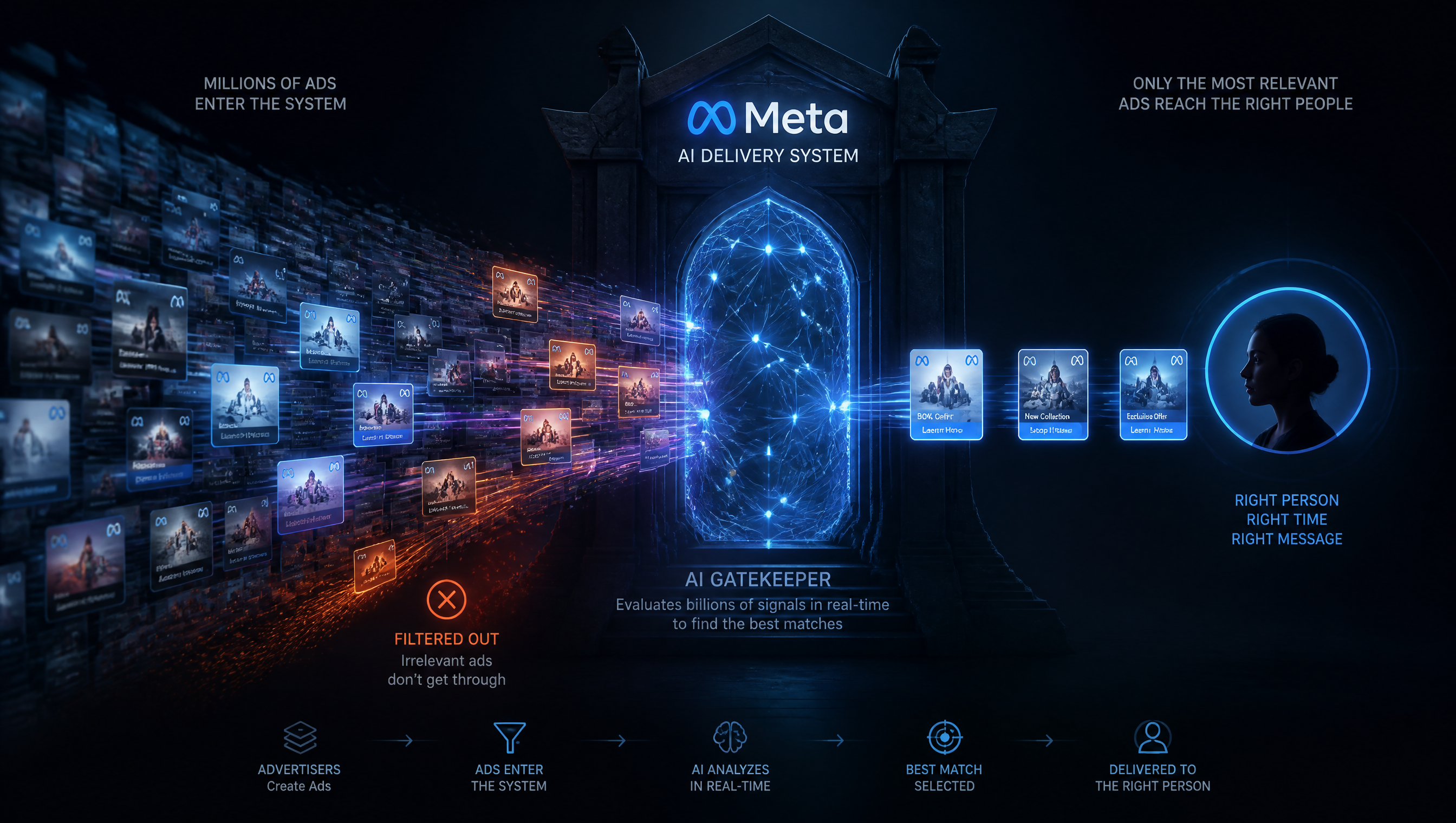
If your ad doesn't make it through retrieval, nothing else matters. Your targeting, your bid, your budget — all irrelevant. The ad never gets a shot.
Under the old system (2014–2024), retrieval leaned heavily on advertiser-defined audience inputs: interests, demographics, lookalikes, exclusions. These acted as hard gates determining which ads entered the auction. Andromeda fundamentally changes those gates.
Instead of treating audience definitions as the primary signal, Andromeda uses deep neural networks to read the actual content of your creatives — visual elements, copy themes, messaging angles, format, pacing — and matches them to individual users based on behavioral prediction and real engagement patterns.
As Meta's engineering team described, the system represents a 10,000x increase in model complexity at the retrieval stage. It runs on NVIDIA's Grace Hopper Superchip (GH200) and uses sublinear inference cost — meaning it can process exponentially more creative variations without proportional increases in computing cost. This is what enables Meta to handle 15 million+ AI-generated ads per month from 1 million+ advertisers without the system collapsing.
The philosophical shift is stark:
| The Old System | Andromeda |
|---|---|
| Advertisers define the audience; creative competes within those bounds | Creative defines the audience; Andromeda finds the right users |
| Interest and demographic signals are primary targeting levers | Creative content signals are the primary targeting lever |
| Narrow interest targeting adds precision | Narrow targeting limits the algorithm's ability to learn |
| Find one winning ad and scale it | Build a diverse creative ecosystem; no single winner |
| Audience first, then creative | Creative first, audience follows |
The Rollout Timeline: When It Actually Happened
Andromeda didn't arrive with a press release in Ads Manager. Most advertisers never saw it roll out — they only felt the instability it caused.
The phased rollout:
| Period | Andromeda Coverage | What Advertisers Noticed |
|---|---|---|
| Dec 2024 | Announced; limited partner testing | Early adopters started testing broad targeting |
| Jan–Mar 2025 | 18–42% of ad accounts | Volatile performance; broad targeting beating interest stacks |
| Apr–Sep 2025 | 58–82% of accounts | "Something feels different" — creative fatigue accelerated, simplified structures winning |
| October 2025 | 100% — full global deployment | Universal implementation confirmed |
| January 2026 | Full operational baseline | Legacy interest targeting methods effectively deprecated |
Search interest tells the story clearly: "Meta Andromeda" got essentially zero searches in early 2024. By October 2025, it peaked at 2,400 monthly searches — a direct signal that advertisers had finally realized something fundamental had changed, even if they couldn't name it until they searched for it.
During the beta phase, Meta's own data showed Andromeda delivered a 5% increase in ad conversions on Instagram in Q2 2025, which doubled to 10% by Q3 — proof the system improved rapidly through the rollout period. According to Social Media Examiner's analysis, this rapid evolution means advertiser performance diverged sharply between those who adapted and those who didn't.
Confect's massive dataset showed ROAS declining 7% across the rollout with no recovery signal. But those are averages. The spread is enormous — some advertisers are outperforming their pre-Andromeda benchmarks. The differentiator is adaptation speed. The system didn't break advertising; it rewarded a different set of behaviors.
The Three-System AI Stack
Andromeda doesn't work alone. Meta deployed three interconnected AI systems throughout 2024–2025 that collectively rebuilt the entire ad delivery pipeline — retrieval, ranking, and creative generation — simultaneously.
System 1: Andromeda (The Gatekeeper)
Handles ad retrieval. Scans millions of active ads, reads creative content using computer vision and semantic analysis, and narrows the field to ~1,000 candidates per auction. Creative performance signals, behavioral patterns, and user intent embeddings determine which ads get a ticket.
Critical detail: Andromeda uses hierarchical indexing — it groups ads by semantic similarity and evaluates clusters, not individual ads. This is why 20 minor variations of the same product shot count as one entity, not 20 distinct bets.
System 2: Meta Lattice (The Ranker)
Once Andromeda passes ~1,000 candidates to the auction, Meta Lattice handles the ranking and bidding stage. According to Meta's engineering team, Lattice delivered 10% metric gains and 6% conversion improvements compared to the previous ranking system. Where Andromeda decides who gets a chance, Lattice decides who wins.
System 3: GEM — Generative Engagement Model (The Creator)
The AI behind Meta's creative generation tools: background generation, text variations, image expansion, ad animation. GEM is described as 4x more efficient at driving performance than previous generation tools. It's currently used by 1 million+ advertisers to generate 15 million+ ads per month — and is the foundation for what Meta is building toward with fully automated campaign generation (more on that in What's Next).
Together, these three systems represent a complete overhaul. The retrieval is new. The ranking is new. The creative tools are new. Every stage of the pipeline from "which ads exist" to "which ad wins the impression" has been rebuilt.
The Real Impact: What the Data Shows
Here is the most comprehensive dataset on Andromeda's real-world impact: Confect's 2025 study covering 3,014 eCommerce advertisers in 73 countries, $834 million in ad spend, 1 million individual ads, and 115.7 billion impressions across the full Andromeda rollout period.
The Headline Numbers
What makes these numbers significant is that Confect qualified their data strictly — excluding anomalous accounts, requiring 5,000+ impressions per ad, and filtering extreme outliers. These aren't cherry-picked results. Every chart is based on 44.3 million actual purchases across real eCommerce businesses.
What the Data Shows in Detail
Prospecting took the hardest hit (−13%). The Andromeda-driven shift from interest-based to creative-based retrieval disrupted prospecting more than retargeting. Cold audiences that were previously "found" via interest targeting now need to be found via creative resonance — which requires a fundamentally different creative strategy.
Top performers were hit hardest. The accounts that were most finely tuned to the old system — with optimized interest stacks, scalable winning creatives, and established audience segmentation — had the most to unlearn. The -31% loss for top performers is the Andromeda "great equalizer": it made the old advantages irrelevant.
Creative lifespan compressed sharply. Pre-Andromeda, effective ads could run for 6–8 weeks. Under Andromeda: 2–4 weeks. The reason is counterintuitive — Andromeda is more efficient at matching creatives to optimal audiences, which means it burns through those audiences faster. Better targeting → faster fatigue.
Category pages (landing pages) collapsed 24%. Traffic quality changed under Andromeda. The old system delivered audiences with established interest signals. Andromeda's behavioral matching brings different user intents. Advertisers who sent all traffic to generic category or collection pages saw a 24% conversion rate drop post-click. Specific product pages and dedicated landing pages held up.
The ad lifecycle changed. Under the old system, an ad would ramp up over 1–2 weeks, peak, then gradually decline. Under Andromeda: performance peaks in week 1, then plateaus or declines steadily. This is why extending winning ads past their natural lifecycle is especially damaging in 2026.
Creative Is the New Targeting
This is the single most important thing to understand about Andromeda — and the most improperly understood.
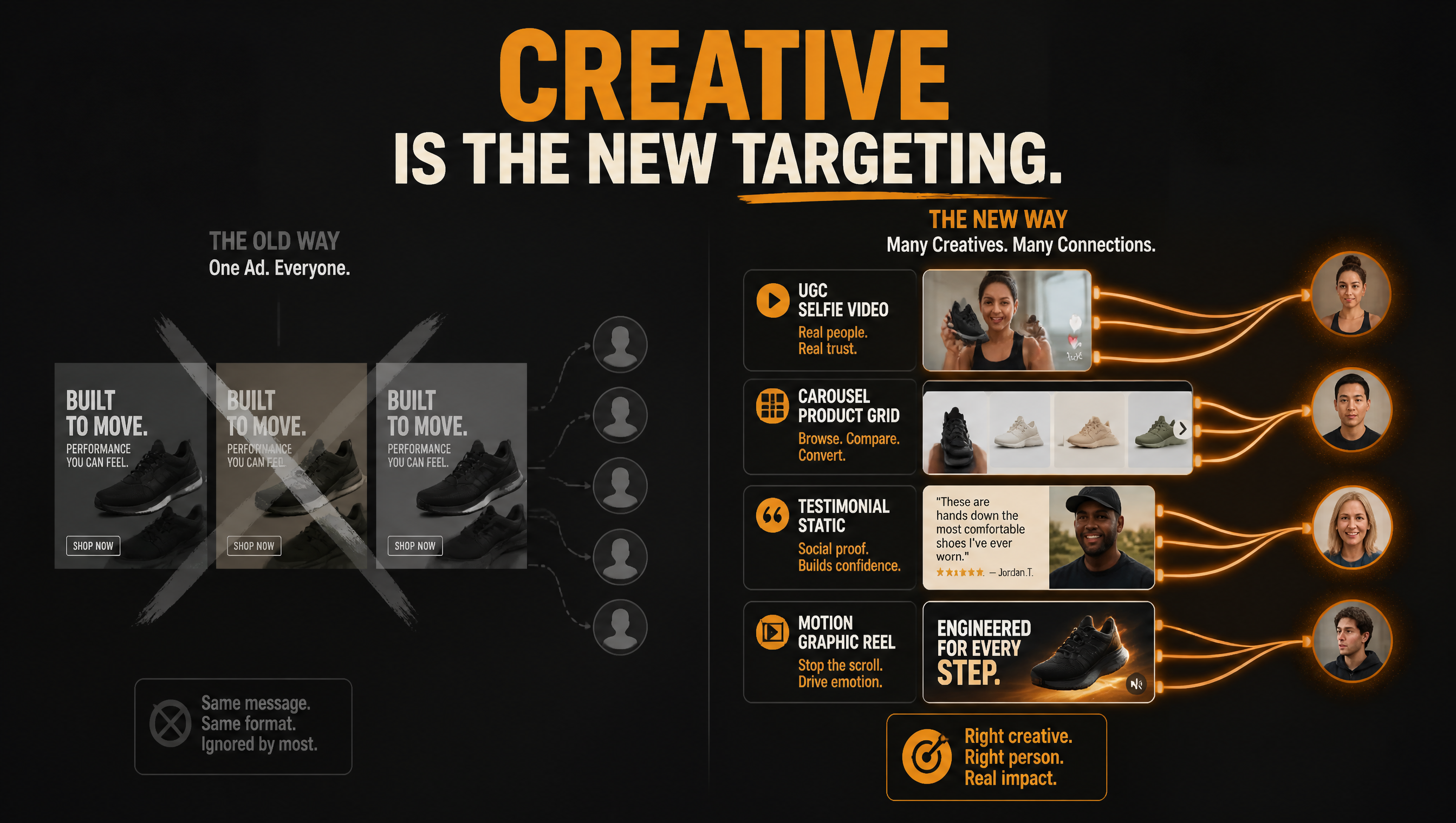
"Creative is the new targeting" isn't a metaphor. It's a description of a literal technical change. Your creative content is what Andromeda reads to determine who sees your ad. Your ad's visual style, narrative angle, emotional register, and format are the signals the algorithm uses to match it against user behavior patterns.
This has several implications that run directly counter to the old playbook:
The Entity Clustering Problem
If you create 20 variations of the same product shot — different headline colors, slightly cropped images, minor text changes — Andromeda treats them as one creative entity. One set of 20 ads gets one auction ticket. The old strategy of "find a winner, test 50 variations of it" is now actively working against you. You're not generating 50 shots at different audiences. You're generating 1 shot, 50 times.
Genuinely different creatives — different format, different hook, different narrative angle, different emotional register — each get their own entity ID and their own auction ticket.
The Format Reality
Despite assumptions that video has taken over, static images still drive 60–70% of conversions on Meta (Social Media Examiner, 2025). What has changed is which static formats perform best:
| Format | Andromeda Performance | Notes |
|---|---|---|
| Static image | Strong — 60–70% of conversions | Still the backbone |
| Carousel | Trending up — strong performance | Multiple products, multiple angles = more entity signals |
| UGC selfie video | High for cold audiences | Authentic, behavioral signal-rich |
| Text-only static | Trending in 2026 | Counterintuitive but algorithmic signal diversity helps |
| Motion graphic | Mid-funnel strong | Attention capture on scroll |
| Polished brand video | Awareness stage | High CPM, longer consideration cycle |
The right answer is format diversity across your creative library — not picking one winning format and flooding it with variations.
The Creative Ecology Framework
Under Andromeda, think about your creative library as an ecology, not a competition. Each meaningfully distinct creative gives the algorithm another lens through which to interpret user intent.
A healthy creative library varies across four dimensions:
| Dimension | What Diversity Means | Example |
|---|---|---|
| Format | Static, video, carousel, UGC, motion graphic | Not 5 statics — 2 statics + 1 UGC + 1 carousel + 1 text-only |
| Angle | Problem-aware, solution-aware, desire-driven, identity | "Tired of X?" vs "Imagine Y" vs "10,000 people switched to Z" |
| Hook | Direct question, stat, story, testimonial, bold claim | First 3 seconds of video, first line of copy, headline |
| Social proof | Reviews, star ratings, UGC, before/after, case study data | Each type attracts different behavioral patterns |
A controlled test by Five Nine Strategy showed that a single ad set with 25 diverse creatives produced 17% more conversions at 16% lower cost versus a traditional 5-ad-set structure with fewer creative variations. The diversity gave Andromeda more signals; the consolidation gave it more budget to learn with.
Creative Refresh Cadence
Andromeda's efficiency means creative burnout happens faster. The new recommended refresh cycles:
| Monthly Spend | Refresh Frequency | Volume |
|---|---|---|
| Under $5K/month | Every 2–3 weeks | 3–5 new variations |
| $5K–$20K/month | Weekly | 5–10 new variations |
| $20K–$100K/month | Every 3–5 days | 10–15 new concepts |
| $100K+/month | Continuous pipeline | New concepts entering weekly |
The key metric to watch: Creative Similarity score in Ads Manager. If it's high (meaning your library lacks diversity), Andromeda will penalize your account by raising CPMs. Rising CPMs with flat or declining CTR is the primary real-world signal of creative fatigue under Andromeda.
If your team doesn't have the capacity for this creative volume, that's a strategic problem, not just a creative problem. AI-powered creative production has collapsed the cost of generating diverse ad creative by 80%+ since 2024 — the tools are there.
Campaign Structure in the Andromeda Era
Andromeda doesn't just change how you think about creative — it changes the structural logic of your ad account.
The old best practice was segmentation: separate campaigns for cold and warm audiences, multiple ad sets by interest cluster, geographic splits, demographic partitions. This gave advertisers perceived control. Under Andromeda, it starves the algorithm.
When you fragment your budget across many narrowly defined ad sets, none of them generate enough conversion data to exit the learning phase. Andromeda needs behavioral signal density to optimize. Fragmentation dilutes that signal. Fewer, broader ad sets concentrated with budget outperform.
The Simplified Structure That Works in 2026
For eCommerce:
| Campaign | Type | Budget Share | Purpose |
|---|---|---|---|
| Advantage+ Shopping (ASC) | AI-automated | 50–60% | Primary revenue driver; 22% ROAS lift vs. manual (Meta data) |
| Testing | Manual, broad | 15–20% | New creative concepts, 3–5 ad sets maximum |
| Retargeting | Manual, custom audiences | 15–20% | Cart abandoners, page visitors, engaged users |
| Retention | Manual, customer list | 5–10% | Existing customers, upsell / cross-sell |
For lead generation:
| Campaign | Type | Budget Share | Purpose |
|---|---|---|---|
| Broad Prospecting | Advantage+ or CBO broad | 50–60% | Primary lead driver |
| Testing | Manual, broad | 15–20% | New creative and offer tests |
| Retargeting | Manual, custom audiences | 20–25% | Engaged users, page visitors |
| Lookalike Expansion | CBO with suggestions | 10–15% | Extend beyond core warm audience |
The Retargeting Consolidation
One of the more counterintuitive Andromeda changes: many advertisers have stopped running separate retargeting campaigns entirely. Andromeda is smart enough to identify warm audiences and serve them appropriate ads within a broad prospecting campaign. The algorithm knows which users have already seen your brand and adjusts creative delivery accordingly.
This doesn't mean retargeting is dead. It means the case for separate retargeting campaigns is weaker than it used to be — and the decision should be based on volume, not habit. If your retargeting audience is smaller than 10,000 users and your retargeting budget is under $30/day, you may be better off consolidating into your main broad campaign and letting Andromeda handle the sequencing.
Broad Targeting: The Numbers
Lebesgue's data on targeting approach under Andromeda:
| Approach | ROAS vs. Lookalike | Context |
|---|---|---|
| Broad targeting | +49% ROAS | Country-wide, no age/interest restrictions |
| Advantage+ Audience | +22–30% ROAS | Meta's automated audience with optional suggestions |
| Lookalike targeting | Baseline | Wide variance — useful as suggestions, not hard filters |
| Narrow interest stacks | Underperforms | Legacy approach; no longer recommended as primary strategy |
The exception: Very niche B2B products with small addressable markets may still benefit from geographic or demographic constraints. But even then, use them as "suggestions" (Advantage+ audience with suggestions) rather than hard restrictions that limit algorithmic learning.
Tracking and Signal Quality Under Andromeda
This is a point most Andromeda coverage misses: signal quality is now a retrieval factor, not just a measurement factor.
Under the old system, your conversion tracking influenced how Meta optimized your campaign after the auction — which ads it showed more of, to whom. Under Andromeda, signal quality influences whether your ads make it through retrieval in the first place.
Andromeda uses conversion signal quality as a factor in determining how often your ads are retrieved. Poor signal quality — pixel-only tracking with no Conversions API, duplicate events, incorrect attribution windows — directly lowers your effective retrieval rate. As Confect's study notes: "Pixel-only tracking now penalizes your ad quality score. Implementing the Conversions API with proper deduplication directly improves how often your ads make it through the retrieval gate."
The Tracking Stack for Andromeda
| Layer | What It Does | 2026 Status |
|---|---|---|
| Meta Pixel | Browser-side event tracking | Necessary but insufficient |
| Conversions API (CAPI) | Server-side redundancy; recovers 20–40% of signal iOS ATT blocks | Non-negotiable |
| Event deduplication | Prevents Pixel + CAPI from double-counting the same event | Required if running both |
| Micro-conversions | View Content, Add to Cart, Initiate Checkout feed Andromeda mid-funnel signals | High value, especially for lower-spend accounts |
| Attribution window matching | Window should reflect actual buying cycle, not platform default | Must be configured per business type |
Brands with full CAPI implementation see an average 13% improvement in CPA simply from better signal quality feeding Andromeda's retrieval decisions — before any creative or campaign changes. Fixing tracking is often the fastest ROAS lever because the improvement compounds: better signal → better retrieval → better optimization → lower CPA.
What Top Performers Are Doing Differently
The Confect study's most valuable section isn't the damage report — it's the breakdown of what separates the advertisers winning under Andromeda from those losing ground.
The patterns are consistent across all 3,014 advertisers in the dataset, regardless of size, industry, or geography:
They're running 33% more ads. Not 20 variations of the same concept — 33% more genuinely distinct creative entities. Each entity gives Andromeda another retrieval ticket.
They're running 72% more Catalog Ads and spending 117% more on them. Catalog Ads have a structural advantage under Andromeda: each product in a large catalog creates a unique creative entity with its own retrieval signal. Top performers in the Confect study get 60% of their total revenue from Catalog Ads.
They're achieving 20–30% higher ROAS from Catalog Ads over the entire ad lifecycle — from week zero through week six — compared to standard static ads. The lifecycle advantage compounds.
They're using 5+ creative variants per concept (+38% adoption gap vs. average). Not identical variations — genuinely different executions of the same concept. Each covers a different emotional angle or audience awareness stage.
They're using video Catalog Ads (+62% adoption gap). Video format Catalog Ads unlock a distinct retrieval pathway. Most advertisers haven't implemented them, creating a meaningful competitive gap.
In the Confect data, the performance gap between top performers and everyone else wasn't additive — it was multiplicative. More creative diversity × better catalog structure × proper CAPI implementation × consolidated campaign structure each amplified the others. The gap is widening, not narrowing, as Andromeda matures.
For brands not running Catalog Ads: this is the clearest gap in the market right now. The adoption barrier is surprisingly low — a product feed connected to Meta Business Suite plus a Catalog campaign is the minimum viable entry point. The ROAS differential is large enough that this should be evaluated before any other structural change.
For a deeper dive into how Meta Ads management works in the Andromeda era, including full account structures and creative strategies, that's a significant part of what we implement for clients.
What's Next: GEM and the Future of Meta Ads
Andromeda is the current state. GEM (Generative Engagement Model) is the near future — and understanding where Meta is heading changes how you invest in your creative capabilities today.
GEM is currently the engine behind Meta's AI creative tools: background generation, image expansion, text variations, ad animation. Meta describes it as 4x more efficient at driving performance than previous generation tools. Right now, it's a tool that assists advertisers. Meta's trajectory suggests it's moving toward something more autonomous.
As Social Media Examiner's analysis of Tara Zirker's research describes: Meta is evolving GEM toward a future where advertisers can "simply provide a product URL, budget, and basic prompt, and the AI will generate the entire ad campaign from scratch — images, copy, headlines, and animations."
When that capability arrives — and the technical foundations are already in place — the marketer's competitive advantage shifts entirely. The optimization lever won't be "who has the best Ads Manager settings or targeting strategy." It'll be:
- The offer itself — GEM can generate ads, but it can't create a genuinely compelling value proposition for you
- The post-click experience — Your landing page, checkout flow, and customer journey become the primary conversion driver
- The creative brief quality — Prompting a generative system well is a distinct skill from building creative manually
- First-party data depth — The more behavioral signal you've accumulated (via CAPI, strong pixel history, customer lists), the better GEM-powered campaigns will perform
This is the medium-term implication of where Meta Ads is heading: the platform will handle more of the creative execution, and the strategic advantage shifts entirely to brand fundamentals. Offer quality, post-click conversion, and data richness.
The 2026 Andromeda Action Plan
Based on the research above and what we're seeing across client accounts, here's the priority-ordered list of what to do now:
Priority 1: This Week — Fix Tracking and Signal Quality
Nothing else works correctly if your signal is broken. Andromeda uses signal quality as a retrieval factor.
- Implement CAPI if not already running (Shopify, WooCommerce, and most major platforms have native CAPI integration)
- Set up event deduplication between Pixel and CAPI
- Audit Events Manager for duplicate or misfiring events
- Set attribution windows that match your actual buying cycle (see table in the full Meta Ads ROAS guide)
- Add micro-conversions (View Content, Add to Cart, Initiate Checkout) if tracking only final purchases
Priority 2: This Week — Simplify Campaign Structure
- Consolidate overlapping campaigns that target similar audiences
- Eliminate ad sets spending less than $20–30/day (they'll never exit learning phase)
- Move to Campaign Budget Optimisation (CBO) instead of ad set-level budgets
- Launch one Advantage+ Shopping campaign (or broad-targeted campaign for lead gen) if not already running
- Give it your best 10–15 creatives and real budget for at least 7 days
Priority 3: This Month — Creative Ecosystem Rebuild
- Audit your creative library: how many genuinely distinct entities are running?
- Identify format gaps — are you missing UGC, carousel, text-only, or motion graphic formats?
- Build one new creative per format type that addresses a different buyer angle (problem-aware vs. desire-based vs. identity)
- Set up a refresh cadence matching your budget tier (see table in Creative Is the New Targeting)
- Watch Creative Similarity and Creative Fatigue scores in Ads Manager weekly
Priority 4: This Quarter — Catalog Ads and Landing Pages
- If running eCommerce: Set up or optimize your Meta Catalog with complete product data
- Launch a Catalog Ads campaign alongside your standard creative campaigns
- Evaluate landing page performance post-Andromeda — if CTR is healthy but post-click conversion dropped, the traffic quality change is hitting your landing page
- Create dedicated landing pages for top campaigns that match the exact creative message (not a generic collection page)
Priority 5: Ongoing — Measurement and Learning
- Track blended MER (Marketing Efficiency Ratio: total revenue ÷ total ad spend) as your primary health metric
- Run monthly creative performance reviews using Top Creative Themes in Ads Manager
- Plan quarterly holdout tests to measure Meta's true incremental contribution
- Build the habit of treating creative strategy as a core marketing investment, not a production cost
The Bottom Line
Andromeda isn't a temporary disruption or a bug to wait out. The Confect study's clearest finding is that there is no recovery signal — the performance changes are the new baseline, and the divergence between adapters and non-adapters is widening.
The good news: the adaptation path is clear. It's not a mystery or proprietary knowledge. Creative diversity, signal quality, consolidated structure, and broader targeting consistently separate winning accounts from losing ones in every dataset we've seen. For a full comparison of how Meta and Google are both evolving their AI systems in parallel, see our Meta Ads vs Google Ads 2026 analysis.
What changed under Andromeda is which skills matter. Audience research, interest stack optimization, and campaign micromanagement were the winning competencies before 2025. Creative strategy, behavioral signal quality, and a willingness to let the algorithm learn are the winning competencies now.
The brands seeing meaningful ROAS improvement in 2026 — not just surviving Andromeda but outperforming their pre-Andromeda benchmarks — are the ones that adapted their creative model, fixed their data infrastructure, and stopped fighting the algorithm for control they no longer have.
The question is whether you adapt before or after the gap gets wider.
Running Meta Ads in 2026 without a clear Andromeda adaptation strategy is the single fastest way to see budget efficiency erode. At Aurelius Media, our Meta Ads management service — part of our broader performance marketing practice — includes a full Andromeda audit: creative diversity analysis, signal quality review, and campaign structure assessment, as part of every engagement. Book a free audit call and we'll tell you exactly where your account stands.
Frequently Asked Questions
What is Meta Andromeda and when did it launch?
Meta Andromeda is Meta's new AI-powered ad retrieval engine — the system that decides which ads even get a chance to compete in the auction before bidding begins. It was officially announced on December 2, 2024, via the Meta Engineering Blog. Meta rolled it out in phases throughout 2025, reaching full global deployment in October 2025. It represents a 10,000x increase in model complexity compared to the previous retrieval system and runs on NVIDIA's Grace Hopper Superchip. By January 2026, it was the universal foundation for all Meta ad delivery.
Did Andromeda hurt Meta Ads performance?
On average, yes — though the impact varies significantly by advertiser. Confect's study across 3,014 eCommerce advertisers found ROAS declined 7%, conversion rates dropped 17%, and prospecting performance fell 13%. The previously best-performing accounts lost 31%. The study found no recovery signal — the performance changes represent permanent new baselines, not temporary disruption. However, the same dataset shows that advertisers who adapted to Andromeda — through creative diversity, catalog ads, and consolidated structures — are outperforming their pre-Andromeda benchmarks. The average decline masks a wide divergence between adapters and non-adapters.
How does Andromeda change Meta ad targeting?
Fundamentally. Under the old system (2014–2024), you defined the audience (interests, demographics, lookalikes) and Meta's system found ads to show them. Under Andromeda, your creative content defines who sees the ads. The algorithm reads your ad's visual elements, copy, narrative angle, and format, then matches it to users whose behavioral patterns suggest they'd respond. Interest targeting still exists but is now treated as a soft suggestion rather than a hard filter. Broad targeting consistently outperforms interest stacking because it gives Andromeda more room to find behavioral matches — Lebesgue data shows broad targeting delivers 49% higher ROAS vs. lookalike targeting under Andromeda.
Why do I need more creatives now than before?
Two reasons. First, Andromeda clusters similar creatives into a single "entity" — so 20 minor variations of the same product shot count as one ad in the retrieval system, not 20. You get one auction ticket instead of twenty. Second, Andromeda is more efficient at matching your creative to optimal users, which means it burns through those users faster. Effective ad lifespan compressed from 6–8 weeks pre-Andromeda to 2–4 weeks in 2026. You need more genuinely distinct creatives (different format, angle, hook) entering the system more frequently to maintain performance.
Should I still use retargeting campaigns?
It depends on scale, but the answer is more nuanced than before. Andromeda is sophisticated enough to identify warm audiences and serve them appropriate creative within a broad prospecting campaign — which is why some advertisers have consolidated retargeting into their main campaigns entirely. The case for separate retargeting campaigns remains strong if: your retargeting audience is large (50,000+ users), you have meaningful budget to dedicate ($50+/day), and your retargeting creative is genuinely different from your prospecting creative. If retargeting audiences are small and budgets are low, consolidation is likely more effective. The 15–25% budget allocation rule still applies as a reasonable ceiling to prevent over-indexing on warm audiences at the expense of prospecting.
What is Meta GEM and how does it relate to Andromeda?
GEM (Generative Engagement Model) is the third component of Meta's 2024–2025 AI overhaul, alongside Andromeda (retrieval) and Meta Lattice (ranking). GEM is the engine behind Meta's AI creative tools — background generation, text variations, image expansion, ad animation. Meta describes it as 4x more efficient at driving performance than previous generative tools. In the near term, it helps advertisers generate creative variants faster. In the longer term, Meta is evolving GEM toward full campaign generation from a URL and a brief. When that arrives, the advertiser's competitive advantage shifts entirely to the quality of the offer and the post-click experience — not the sophistication of their Ads Manager configuration.
How do I know if my Meta account is adapted to Andromeda?
Check these signals in Ads Manager: (1) Creative Similarity score — if it's high, your library lacks diversity and Andromeda is penalizing you with higher CPMs. (2) CPM trend — rising CPMs with flat or declining CTR is the primary real-world signal of creative fatigue under Andromeda. (3) Conversion rate post-click — if CTR is healthy but post-click conversion is lower than pre-Andromeda, your landing page needs to match the new traffic quality. (4) Ad age — if your top ads are older than 4 weeks and still running, they're likely past their effective lifespan. (5) Campaign count — if you're running more than 5–6 active campaigns with overlapping audiences, the structure is hurting signal density.