
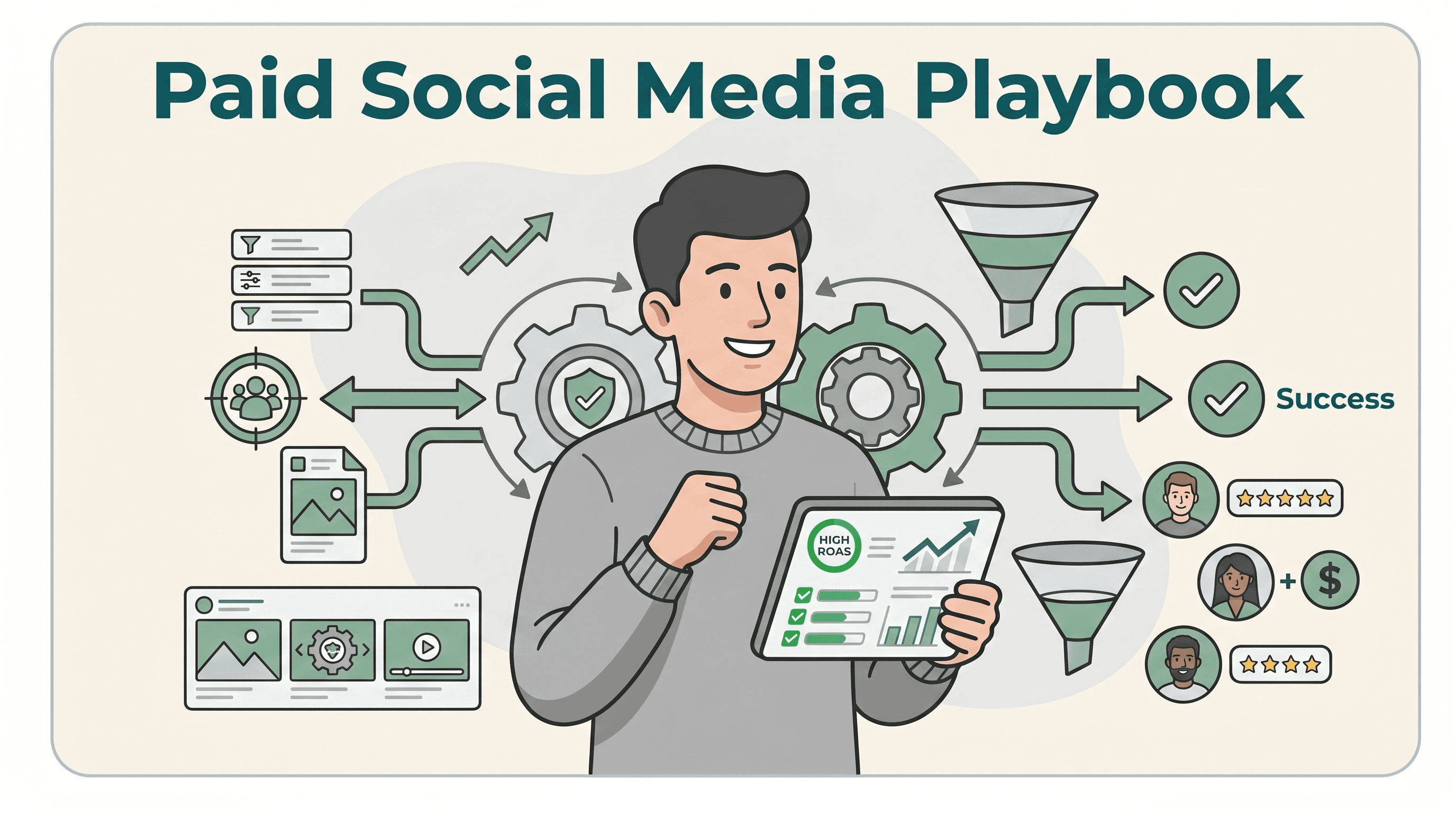
Most brands treat paid social like a coin slot — insert budget, expect customers.
It doesn't work that way. It never did. But in 2026, the gap between brands running paid social correctly and brands running it carelessly has grown into a canyon.
Meta's Andromeda algorithm now uses your creative as the primary targeting signal. TikTok rewards native, rapid-iteration UGC, not polished brand films. CPMs are rising across every major platform. And yet, the brands that have cracked the creative engine are compounding results quarter over quarter while everyone else scratches their head at a 1.2x ROAS.
We've managed ₹100Cr+ in ad spend across 25+ countries and 150+ clients. This is the system we use — from pre-launch readiness to creative production to scaling without killing performance. It's not a growth hack. It's an operating system.
In a Nutshell
- Paid social only amplifies what's working. Before spending, you need a clear offer, a functional landing page, and conversion tracking that isn't broken. These are table stakes.
- Campaign structure in 2026 is three buckets: test, scale, retarget. ABO for testing new creative hypotheses, CBO for scaling proven winners, and a small retargeting pool for warm audiences. Anything more complex is noise.
- Creative is now your targeting strategy. Since Meta's Andromeda rollout in late 2025, your ad creative directly signals the algorithm who to find. Brands running 15+ active creative variations see 2–3x the ROAS of brands running fewer than 5.
- You need 50 conversions per ad set per week to exit Learning Phase. Below that, the algorithm is flying blind and every optimization decision you make is based on noise.
- TikTok requires 5–10 fresh native videos per week — not one polished monthly asset. Platform-native UGC, hooks in the first two seconds, and Spark Ads to borrow influencer credibility.
- Media Efficiency Ratio (MER) is the only metric that tells the whole truth. Total revenue divided by total ad spend. Track it weekly. If budgets go up and MER stays flat, the incremental spend isn't working.
- Creative fatigue sets in within 7–14 days. If you haven't built a refresh cadence, you don't have a paid social strategy — you have a slow burn.
Table of Contents
- Why Paid Social Still Fails Most Brands
- Step 1: The Pre-Spend Readiness Check
- Step 2: Set One North Star Metric
- Step 3: Pick Your Channel and Commit
- Step 4: The Campaign Architecture That Works in 2026
- Step 5: Creative Is Your Only Moat
- Step 6: The Weekly Creative Production Loop
- Step 7: Measurement Frameworks That Actually Work
- Step 8: Scaling Without Destroying What's Working
- Five Mistakes That Kill Paid Social
- The Bottom Line
- Frequently Asked Questions
Why Paid Social Still Fails Most Brands
The problem isn't the platform. The problem isn't CPMs. The problem is that most brands run paid social as an experiment they want to pass, not as a system they want to build.
The tell-tale signs: five ads running simultaneously with no clear hypothesis, targeting stacked with interest layers that the algorithm ignores anyway, a creative refresh cycle of "when we feel like it," and performance judged by in-platform ROAS that nobody cross-checks with actual revenue.
According to Triple Whale's analysis of 35,000+ brands, platform-wide CPMs on Meta rose 20% year-over-year in 2025, reaching $14.19. Yet CTR improved to 2.19%, up 13.5%. That gap — higher costs, higher CTR — is the market separating brands with strong creative from brands without it. The platforms are getting more expensive. The creative quality floor is rising. Brands that haven't built a creative engine are subsidizing the ones that have.
The fix isn't a new bidding strategy or a new audience. It's a system.
Step 1: The Pre-Spend Readiness Check
Before you touch Ads Manager, run through this checklist. Skipping it is how you burn $10,000 proving what you could have figured out for free.
| Readiness Criteria | What to Check | If You Can't Check This |
|---|---|---|
| Budget | Do you have enough for ~50 conversions/week at your target CPA? | Wait. You'll waste the budget. |
| Creative capacity | Can you produce 3–5 new ad variations per week? | Build the pipeline first. |
| Offer clarity | Is the value proposition obvious in under 5 seconds? | Sharpen the offer before spending. |
| Landing page | Does it load under 3 seconds on mobile? Does it match the ad promise? | Fix the page first. |
| Conversion tracking | Are purchase events firing correctly in both pixel and CAPI? | Fix tracking first. Everything else is fiction. |
| CAC/LTV baseline | Do you know what a customer is worth? | You have no idea when to stop or scale. |
On tracking: This is the most expensive mistake we see. In our account audits, 76% of accounts have at least one critical tracking issue — no Conversions API, duplicate events, or the wrong attribution window. Meta's Conversions API alone recovers 20–30% of lost conversion data that browser-based pixels miss. If your tracking is broken, your reported ROAS is fiction, and the algorithm is optimizing toward phantom signals.
If you're missing any of the above, paid social will accelerate your problems, not solve them.
Step 2: Set One North Star Metric
Every campaign, every creative decision, every budget change should trace back to one number.
For most D2C brands: Cost Per Acquisition (CPA) vs. LTV ratio. For apps: Cost Per Install or Cost Per First Transaction. For lead-gen: Cost Per Qualified Lead. The metric itself matters less than the fact that everyone agrees on it before the first dollar is spent.
What not to optimize for: CTR, impressions, video views, follower growth. These are directional signals at best, vanity metrics at worst. Sales-optimized campaigns on Meta deliver a median 4.87x ROAS versus 0.52x for traffic campaigns — an 835% difference. The campaign objective you choose is one of the highest-leverage decisions you'll make.
The only exception is top-of-funnel awareness if you have a separate budget for it and a clear reason to run it. Most brands don't, and most agencies sell it anyway.
Step 3: Pick Your Channel and Commit
At early stage, the worst strategy is being mediocre on three platforms. Win on one first.
Meta is the default starting point for most verticals. It has the broadest reach, the most mature optimization algorithm, and the rare ability to create demand (not just capture it). If you're not sure where to start, start here.
TikTok outperforms Meta in specific conditions: beauty, food, low-ticket impulse products, and anything that benefits from entertainment-first content. The catch: TikTok only works if you can produce 5–10 native-looking videos per week. A polished brand film that costs $5,000 to produce will get crushed by a founder talking to the camera for 60 seconds. If you can't staff that content pipeline, TikTok is not the right first channel.
Second-wave channels — YouTube, Pinterest, LinkedIn, Reddit — come after you've established CAC/LTV on a primary channel and have the budget to test properly. Spreading spend across all of them at launch is how you prove nothing.
| Channel | Best For | Creative Requirement | Budget to Justify Testing |
|---|---|---|---|
| Meta (Facebook/Instagram) | Most verticals, demand creation | 5+ varied static/video formats | $3K–$5K/month minimum |
| TikTok | Impulse categories, Gen Z audiences | 5–10 native UGC videos/week | $3K+/month + creator pipeline |
| YouTube | High-consideration purchases, B2B | 1–2 high-quality video scripts/month | $5K+/month |
| B2B lead generation, SaaS | Thought leadership + direct response copy | $5K+/month (high CPCs) | |
| Home, fashion, lifestyle, food | High-quality static images | $2K+/month |
Step 4: The Campaign Architecture That Works in 2026
Good campaign structure does one thing well: it isolates variables so you know what's driving results. Everything else is complexity for complexity's sake.
The Three-Bucket System (Meta)
Testing Campaign — ABO — 70% of budget
- Objective: Conversions (Purchase / Lead / App Install)
- One ad set per creative hypothesis
- Broad targeting: location + age range only. No interest stacking — Andromeda handles this better than you can
- Budget: $20–$100/day per ad set. Let it spend 1–1.5× your target CPA before judging
- Every ad set tests one new concept. Multiple executions of the same concept are allowed within an ad set
Scaling Campaign — CBO — 20% of budget
- Move only proven winners from the testing campaign (3–5 creative variations per ad set)
- 1–2 broad ad sets under a single campaign budget
- Daily budget should be 3–5× your CPA goal per ad set
- Increase budgets by no more than 20% per day. Larger jumps reset Learning Phase
Retargeting Campaign — CBO — 10% of budget
- One consolidated ad set: site visitors (180 days), add-to-cart abandoners, email list, video viewers, page engagers
- Keep budgets small. The retargeting pool is finite — overspend and you'll hammer the same 500 people
- Creative doesn't need to match your prospecting creative — use testimonials, urgency, and direct offers
Pro-Tip: The Learning Phase requires ~50 conversions per ad set per week to stabilize. Below that threshold, every metric you see is statistically unreliable. If your CPA target is $50 and you're spending $500/week per ad set, you'll never exit Learning. Either increase spend, raise your CPA target, or optimize for a higher-volume micro-conversion (Add to Cart, Initiate Checkout) until you have the data to switch back.
Targeting in 2026
Stop building interest-stacked audience segments. Andromeda — Meta's AI-driven ad delivery system that completed global rollout by late 2025 — uses your creative to find its own audience. Your interest layers are, at best, redundant. At worst, they constrain the algorithm's reach and raise your CPMs.
Default to broad (18–65+, all genders). The creative does the targeting now.
Placements
Turn on Advantage+ Placements. Exclude Audience Network only if you see garbage conversion quality from mobile apps. Otherwise, let Meta's delivery system find efficiency across surfaces.
TikTok: Same Skeleton, Different DNA
TikTok campaign structure mirrors Meta's three-bucket approach — ABO for testing, CBO for scaling, broad targeting, 50 conversions/week to exit Learning. The difference is in how you feed it:
- 5–10 fresh native videos per week. Not one polished asset. TikTok rewards velocity.
- Hook in the first 2 seconds. The algorithm measures what percentage of users watch past that threshold. Fail there and nothing else matters.
- Spark Ads. Boost organic influencer content instead of running dark ads. You borrow the post's engagement signals, which increases credibility and lowers CPA.
- Captions on. 83% of TikTok users watch with sound off at least sometimes. Text captions are not optional.
Step 5: Creative Is Your Only Moat
Every other lever in paid social — bidding strategy, audience targeting, campaign structure — is commoditized. Andromeda sees the same input from your competitor's account that it sees from yours. The creative is the only variable that's genuinely yours.
Brands running 15+ active creative variations see 2–3x the ROAS of brands running fewer than 5. Creative quality now drives 50–70% of ad performance in the Andromeda era, up from ~30% pre-2024. This isn't a platform quirk — it's the new structural reality of paid social.
Building the Creative Stack
Start with audience obsession. Before writing a single script, spend two hours doing this:
- Read 1-star and 5-star reviews of your product (and your competitors')
- Scroll relevant subreddits and Facebook groups
- Watch the top 20 TikToks in your category
- Talk to three customers about what almost made them not buy
From this, extract four creative pillars: Pain, Transformation, Identity, and Proof. Every ad you make should address at least one of these.
Match creative to mindset, not funnel stage. The funnel framework breaks down when the same person sees your ad multiple times in one session. Think about mindset instead:
| Audience Mindset | What They Need | Best Creative Format |
|---|---|---|
| Unaware — hasn't heard of your problem | Interrupt + entertain | Meme, pattern-interrupt, founder story |
| Problem-aware — knows the problem, not your solution | Empathize + hint | UGC review, explainer, relatable scenario |
| Solution-aware — evaluating options | Differentiate + prove | Comparison, before/after, social proof |
| Most aware — ready to buy, hasn't pulled the trigger | Nudge | Scarcity, influencer discount code, guarantee |
Use 4–5 proven formats. Don't try to reinvent the wheel every week:
- Founder Story — direct-to-camera, authentic, works at every stage
- UGC Review — customer talking about the product in their own voice
- Problem-Solution — dramatize the pain, then reveal the product as the fix
- Static Proof — a clean image with a data point, review, or bold claim
- Mash-Up / Remix — grab existing content (influencer clips, reviews, brand footage), cut them together with strong captions
Hooks are everything. A great hook with a mediocre body outperforms a mediocre hook with a great body. Every time. Write 10 hooks per concept, test 3, and scale the one that wins. Hook types that work:
- Negative — "Stop making this mistake with your skincare routine"
- POV — "POV: You finally found something that actually works"
- Data/Claim — "We spent $2M testing this. Here's what we found."
- Story — "Two years ago, I was ready to give up on this business"
- Pattern Interrupt — something visually or contextually jarring in the first frame
Pro-Tip: AI-powered creative production has collapsed the cost of generating diverse ad creative by 80%+ since 2024. A brand that 18 months ago needed a $30K/month production budget to maintain 15+ variations can now do it for a fraction of that. If creative volume is your constraint, it's a solvable problem.
Step 6: The Weekly Creative Production Loop
Creative is not a launch. It's a production rhythm. Without a weekly loop, you'll have a great first month, decent second month, and collapsed performance by month three.
Run this every week, without exception:
Monday — Review and Diagnose
- Pull last week's per-creative metrics: Thumb-Stop Rate, CTR, CVR, CPA
- Categorize each creative as Winner (scaling), Fatiguing (declining metrics over 2+ weeks), or Dead (consistently below threshold)
- Identify the common patterns in winners — is it the hook style? The format? The angle?
Tuesday — Brief and Plan
- Select 2–3 new concepts to test based on Monday's findings
- Write tight briefs: hook, problem, proof, CTA. One page per concept maximum
- Assign to creator, editor, or AI production pipeline
Wednesday–Thursday — Produce
- Film or edit new assets. UGC briefs go to creators. Statics and motion graphics to design team or AI tools
- Write ad copy variations (3 per asset minimum — headline, primary text, CTA)
Friday — Launch and Refresh
- Upload new creative to testing campaigns at small daily budgets ($20–$50/ad set)
- Swap weakest performers out of scaling campaigns
- Document everything in a shared creative log (format, hook type, angle, launch date, initial metrics)
Target cadence by budget level:
| Monthly Ad Spend | New Creative Variations per Week | Refresh Cycle |
|---|---|---|
| Under $5K | 3–5 | Every 2–3 weeks |
| $5K–$20K | 5–8 | Weekly |
| $20K–$100K | 8–15 | Continuous pipeline |
| $100K+ | 15–25+ | Dedicated creative director + production team |
Step 7: Measurement Frameworks That Actually Work
Attribution at early stage is messy. Platform data and backend data won't match. GA4 and Meta's reporting will give you different numbers for the same campaign. This is normal — accept it, triangulate across it, and don't make decisions from one source alone.
Layer 1: In-Platform Metrics (Ad Account Level)
These tell you how your ads are performing in the delivery system:
- CPA: Judge ads based on your target payback window (30-day, 90-day, or LTV-based)
- CTR: Aim for 1%+ on Meta, 0.7–1%+ on TikTok
- Thumb-Stop Rate / 3-Second View Rate: 25–30%+ is a solid benchmark for strong creative
- Hook Rate (vs 25% Through-Play Rate): If thumb-stop is high but 25% through-rate drops off, the hook is working but the body is losing people
Layer 2: Backend Metrics (Your Own Data)
Platform data is biased — it over-attributes to the last click and under-credits channels that assisted. Cross-reference in-platform data with:
- GA4 or server-side analytics to verify conversion quality
- Post-purchase surveys ("Where did you hear about us?") to catch attribution dark spots
- Cohort analysis: Are customers acquired through paid social retaining at the same rate as organic customers? If not, you're buying low-LTV customers
Layer 3: Blended Business Metrics
The metric that tells the whole story:
Media Efficiency Ratio (MER) = Total Revenue ÷ Total Ad Spend
Track MER daily and weekly, alongside your total spend. If you raise budgets but MER flattens or drops, the incremental spend isn't paying off — you're likely hitting audience saturation or creative fatigue.
The ultimate incrementality test: turn off all paid campaigns for 48–72 hours and watch what happens to revenue. That delta is your true paid social contribution. It's a brutal test, but it separates real performance from attribution theater.
On attribution windows: We recommend running Meta Ads with a 7-day click, 1-day view window for most D2C purchases. For high-consideration products (furniture, B2B software, premium services), extend to 28-day click. Using 1-day click windows systematically undervalues Meta's role in the customer journey.
Step 8: Scaling Without Destroying What's Working
The most common scaling mistake: finding something that works, then tripling the budget over a weekend. The algorithm resets. Performance collapses. The team panics and kills the campaign. Now you're starting over.
Rules for scaling safely:
- Never increase campaign budgets by more than 20% in a 72-hour period. Larger increases push the ad set back into Learning Phase, burning spend while the algorithm recalibrates.
- Scale by duplicating winning ad sets first. Duplicate a winning ad set at a higher budget instead of editing the live one. This preserves the performance data on the original while giving the new one room to find its footing.
- Maintain your creative pipeline during scaling. This is the most common oversight. Brands scale spend without scaling creative production, hit fatigue at higher budget levels, and can't understand why the same ad that worked at $100/day is failing at $500/day.
- Expect 30–40% of incremental revenue to be non-incremental. As you scale Meta spend, some of that budget reaches people who would have converted anyway via organic or direct. A blended approach — tracking MER alongside platform ROAS — keeps you honest.
- Layer in CRM, landing page testing, and email automation only once you have channel-market fit. Building retention infrastructure before you've proven your acquisition channel is premature optimization.
The hiring ladder:
- $0–$30K/month spend: Founder + one versatile performance marketer who can do both media buying and creative
- $30K–$100K/month: Add a dedicated creative strategist or UGC coordinator
- $100K+/month: In-house performance team + agency partnership for creative production or channel expansion
Five Mistakes That Kill Paid Social
We see these in nearly every account we inherit:
1. Undertesting budgets. Running 20 ads at $5/day each means nothing exits Learning. You have no data, just noise. Consolidate: fewer ad sets at meaningful budgets.
2. Optimizing for the wrong event. Running Traffic or Engagement objectives when your goal is purchases. The algorithm will deliver exactly what you ask for — cheap clicks that don't convert. Switch to Sales/Conversions objective immediately and accept the higher CPM in exchange for real purchase intent.
3. Scaling before product-market fit. Paid social amplifies what's already working. If your organic conversion rate is 0.5% and your landing page copy is weak, spending $50K/month will just lose $50K faster. Fix the funnel first.
4. Creative complacency. Creative fatigue sets in within 7–14 days at meaningful spend levels. Brands that don't have a refresh cadence baked into their weekly workflow will see performance gradually erode — and then attribute the decline to "the algorithm changed" rather than "we haven't made a new ad in three weeks."
5. Over-reliance on paid at the expense of organic. Paid social is not a substitute for organic pull. It's an accelerant for it. Brands that invest nothing in organic social media marketing, community, and email are building on a foundation that collapses every time their ad account gets restricted or CPMs spike. Use paid to amplify — not replace — what's already working organically.
The Bottom Line
Paid social isn't magic. It's a system of creative testing, disciplined structure, and honest measurement.
The brands compounding results right now aren't the ones with bigger budgets — they're the ones who treat creative as an operating system, who refresh their hooks every week, who know their MER by heart, and who scale with patience rather than panic.
The most durable competitive advantage in paid social in 2026 is a creative engine. Bidding strategies get copied. Audience targeting is commoditized. Creative is the only thing that's genuinely yours.
Build the engine. Everything else follows.
Ready to audit your paid social setup? Aurelius Media is a Meta Ads agency in India working with D2C, edtech, and consumer brands on exactly this — building the creative engine and campaign architecture that compounds. Book a free 15-minute strategy call and we'll walk through your account, identify the structural gaps, and map out what a real creative testing system looks like for your business.
Frequently Asked Questions
How much budget do I need to start paid social?
The minimum viable budget is roughly 50× your target CPA per ad set per week — that's the threshold to exit Meta's Learning Phase and get statistically reliable data. If your target CPA is $30, you need ~$1,500/week ($6,000/month) per ad set to get clean data. Below that, you're optimizing based on noise.
How long does it take to see results from paid social?
Budget at least 4–6 weeks before drawing conclusions. The first 2 weeks are Learning Phase — spend is less efficient while the algorithm calibrates. Weeks 3–4 you'll start to see real signal. By week 6, you should have enough data to identify your top 2–3 creative winners and optimize structure around them.
Meta vs TikTok: where should I start?
Start with Meta for most verticals. It has the largest addressable audience, the most mature optimization algorithm, and the best support for demand creation. Add TikTok as a second channel once you've proven CAC/LTV on Meta — but only if you can build a native UGC content pipeline of 5–10 videos per week. TikTok with low creative velocity performs worse than not running TikTok at all.
What's a good ROAS benchmark for Meta Ads?
It depends heavily on your vertical and margin structure. As a general benchmark: sales-optimized campaigns average 4.87x ROAS platform-wide. Retargeting campaigns average 3.61x, prospecting averages 2.11x. The more useful question is: what ROAS do you need to be profitable given your contribution margins? That number — not a platform average — is your real target.
How many creatives should I be testing at once?
At budgets under $10K/month: 5–8 active creative variations is the right range. At $10K–$50K/month: 10–15 variations. Above $50K/month: 20+ variations with a continuous production pipeline. The upper bound is determined by your production capacity and your ability to track performance per asset — not by the platform's limits.
Why does my ROAS look great in Meta but revenue isn't growing?
Attribution inflation. Meta (and most platforms) over-report conversions due to view-through attribution and cross-device measurement gaps. A user might see your ad, then search your brand on Google, then convert — Meta claims the credit and so does Google. Track MER (total revenue ÷ total spend) as your ground-truth metric alongside platform ROAS, and run a 48-hour blackout test to verify incrementality.