
You spend a year, maybe two, writing the book. You get the cover right, the manuscript edited, the file uploaded. Then launch week arrives, you post about it on your feeds, a few friends buy a copy, the rank spikes for a day, and by the following week it is as if nothing happened. The book is live, and almost no one knows it exists.
This is the most common way a book launch goes, and it is almost never a problem with the book. It is a problem of planning. The author treated the launch as a single event, a publish button, instead of a campaign that needs to be built backward from release day over weeks of deliberate work. There was no runway, no audience primed in advance, no reviews waiting to go live, no second act after the first weekend. So the launch had nowhere to land.
The launches that actually move are boring in the best way. They are systems. The work is sequenced, the right things happen on the right days, and by the time the book goes live the outcome is mostly decided. Nobody is scrambling on launch morning because the scramble already happened, on purpose, in the weeks before.
This is that system, laid out as a concrete 90-day plan. Not a vague "start six months out" timeline, but specific actions grouped into clear phases, with who owns each piece and what each phase is supposed to produce. It assumes your manuscript and cover are done and you have roughly three months until release. If you have longer, even better, but ninety days is enough to launch with real momentum if you run it properly.
In a Nutshell
- A launch is a campaign, not a button. The result is decided in the ninety days before release, not on release day itself. Authors who plan backward from launch win. Authors who improvise on launch morning fizzle.
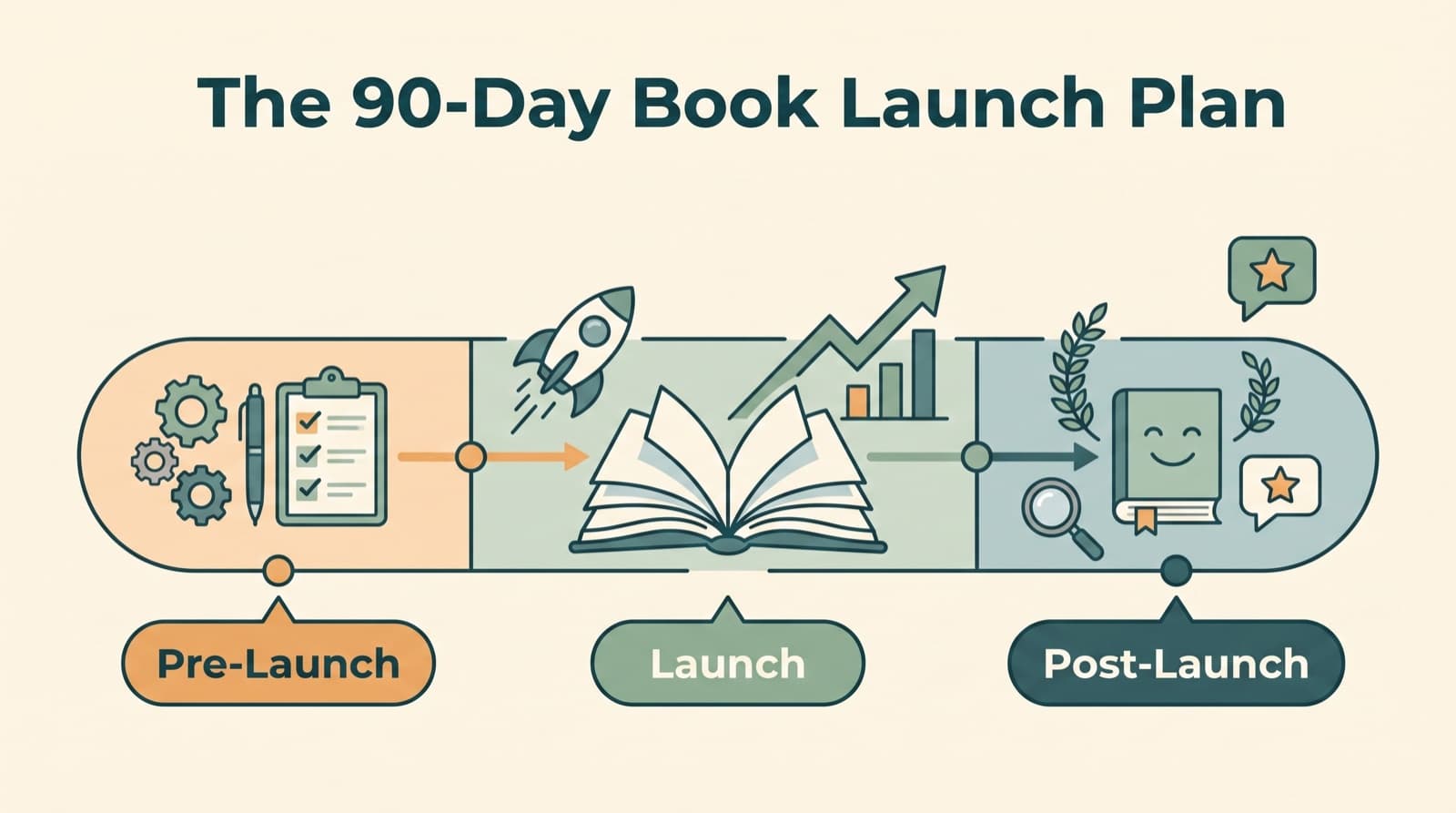
- The plan runs in four phases: foundation (Days 1 to 45), buzz and ARC (Days 46 to 75), launch week (Days 76 to 82), and post-launch momentum (Days 83 to 90 and beyond). Each phase has a single job and a clear outcome.
- Reviews are the engine. A book with fifty to a hundred honest reviews on launch day looks credible to readers and to the algorithms. Manufacturing that early review wave through an ARC campaign is the highest-leverage work most authors skip.
- Your audience is the multiplier. A primed email list and a launch team turn release day from a hope into a coordinated push. If you do not have a list, you borrow audiences through podcasts, newsletters, and paid ads.
- Paid ads have a job and a sequence. They build your list before launch, drive pre-orders during the runway, and scale sales after release once you know the page converts. They are not a substitute for the rest of the plan.
- AI collapses the production grind. Drafting the assets, cutting the clips, personalizing the outreach, and reformatting for every platform is exactly the repetitive work that an AI-first workflow turns from weeks into days, so your runway goes further.
- Post-launch is half the plan. The thirty days after release decide whether the book keeps selling or disappears. Treating launch week as the finish line is the most expensive mistake authors make.
Table of Contents
- Why Most Book Launches Fizzle
- How to Use This 90-Day Plan
- Phase 1: Pre-Launch Foundation (Days 1 to 45)
- Phase 2: Buzz and ARC (Days 46 to 75)
- Phase 3: Launch Week (Days 76 to 82)
- Phase 4: Post-Launch Momentum (Days 83 to 90 and Beyond)
- The Paid Ads Layer, Phase by Phase
- Where AI Earns Its Keep
- Metrics That Tell You It Is Working
- The Bottom Line
- Frequently Asked Questions
Why Most Book Launches Fizzle
Walk through a typical first-time launch and the failure points are obvious in hindsight.
The author finishes the book and, understandably, is exhausted by the writing. Marketing feels like a separate, distasteful job that can wait. So it waits. A week or two before release they realize they should probably tell people, post an announcement, ask a few friends to buy it, and brace for the magic. Release day comes. A small spike. Then silence, because there was never anything underneath the spike to sustain it.
The deeper issue is that this approach gets the order exactly backward. It treats the launch as the start of marketing when the launch should be the payoff of marketing that has already been running for weeks. Every system that drives a strong launch, the reviews, the primed audience, the coordinated team, the pre-orders, the ad campaigns that have already found the right readers, has to be built in advance. You cannot conjure fifty reviews on launch day. You cannot warm up an email list overnight. You cannot ask Amazon's algorithm to notice a book that sold eleven copies in its first week.
The competing advice does not help much either. Most book marketing timelines you will find are organized around the writing process: do this before you write, do that while you edit, do this six months out, three months out, one month out. That framing is fine for a leisurely traditional schedule, but it is vague where it matters. It tells you the season without telling you the day, and it almost never tells you who does what or what each step is supposed to produce. So authors read it, nod, and still have no idea what to actually do on a given Tuesday.
This plan fixes that. It is built backward from a fixed release day, broken into phases with hard day ranges, and every phase has a stated job and a stated outcome. The point is that you should never wonder what you are supposed to be doing. You look at the day, you look at the phase, and you execute.
How to Use This 90-Day Plan
A few ground rules before the phases.
First, this plan assumes the book itself is ready. The manuscript is final or nearly final, the cover is designed, and you have a firm release date roughly ninety days out. If those are not true yet, your first job is to lock them, because everything here is sequenced backward from a fixed launch date. A moving release date breaks the whole machine.
Second, the plan assumes you are bringing some audience, even a small one. If you already have an email list and a social following, the plan activates them. If you are closer to zero, the same phases still apply, but you lean much harder on the borrowed-audience tactics: the launch team, ARC outreach, podcast guesting, newsletter swaps, and paid ads. There is a dedicated answer to the no-audience case in the FAQ, and the principle runs through every phase: when you do not have your own audience, you systematically borrow other people's.
Third, every action below has an owner. For a solo author that owner is usually you, but naming it still matters, because the most common way these plans die is that a task belongs to no one and silently slips. If you work with a marketing partner, a virtual assistant, or an agency, assign the owner explicitly. Throughout, "You" means the author, "Team" means a launch team member or assistant, and "Ads" means whoever runs paid media, which might also be you.
Fourth, do not skip the foundation to get to the exciting parts. The launch week tactics only work because the foundation phase built the audience, the assets, and the reviews they depend on. A launch is a stacked structure. Pull the bottom out and the top has nothing to stand on.
Here is the whole plan at a glance before we go phase by phase.
| Phase | Days | The one job | Outcome you want |
|---|---|---|---|
| 1. Pre-Launch Foundation | 1 to 45 | Build the platform, audience, and assets | Converting book page, growing list, recruited launch team, ad pixel warming |
| 2. Buzz and ARC | 46 to 75 | Manufacture reviews and rising anticipation | 50 to 100 ARC readers lined up, pre-orders flowing, content scheduled |
| 3. Launch Week | 76 to 82 | Concentrate all demand into a tight window | Review wave live, rank spike, ads switched to buy-now, list mobilized |
| 4. Post-Launch Momentum | 83 to 90+ | Convert the spike into a sustained sales base | Reviews still climbing, profitable ads scaling, long-tail promo booked |
Phase 1: Pre-Launch Foundation (Days 1 to 45)
The job of the first forty-five days is unglamorous and decisive: build the platform, the audience, and the assets that every later phase will draw on. Nothing here looks like a launch. All of it determines whether the launch works.
Build the book page that converts. Before anything else, you need one place that turns interest into a sale. Whether that is your Amazon detail page, a page on your own site, or both, it needs a sharp cover, a description written to sell rather than summarize, your strongest early praise, and an unmistakable call to action. Spend real time on the description and the metadata. The exact keywords and categories you choose decide whether readers ever find the page in the first place, and this is the same discipline that makes Amazon Ads for Authors profitable later. Owner: You.
Set up the email list and start growing it now. Your email list will be the most reliable lever you pull on launch day, because it reaches people who already chose to hear from you. If you do not have one, set it up this week and give people a concrete reason to join: a free chapter, a prequel short, a companion resource, something genuinely worth an address. Add signup forms to your site, your social profiles, and your email signature, and start sending a short, useful note every week or two so the list is warm by launch, not cold. Owner: You.
Stand up a minimal author platform. You do not need to be everywhere. You need to be consistent in one or two places your readers actually are. Pick the platform that fits your book, set up a clean profile, and start showing up with content that is mostly useful or interesting and only occasionally promotional. For most authors right now, short-form video does a disproportionate amount of the discovery work, which is why it is worth learning what actually performs. Our guide to Instagram growth for authors covers the specifics. Owner: You.
Produce the core asset kit. A launch needs a fixed set of reusable assets, and building them now means you are not designing graphics at midnight during launch week. The starter kit: three to five quote cards, a short book trailer or teaser video, a set of social graphics in your launch look, a clean author photo and bio, and a one-page media sheet. This is exactly the kind of production that an AI-first workflow accelerates, and we get into that in the AI section. Owner: Team.
Recruit the launch team. This is the most important thing you do in Phase 1 and the thing most authors never do at all. A launch team is a group of readers, friends, and fans who agree in advance to receive an advance copy, post an honest review on launch day, and share the book with their own networks. Start a list now and begin inviting people: your most engaged email subscribers, friends and colleagues, readers who have replied to your posts, anyone who has ever told you they were excited for the book. You want this group identified and committed by the end of Phase 1 so the ARC campaign in Phase 2 has somewhere to go. Owner: You.
Warm up the ad pixel. If paid ads are part of your launch, and for most authors they should be, the time to start is not launch week. Begin running small audience-building or list-growth campaigns now so the platform learns who responds to your book and your pixel has data to optimize against by the time it matters. Even a modest budget spent early makes your launch-week ads dramatically more efficient. Owner: Ads.
By the end of Day 45 you should have a book page that sells, an email list that is growing and being nurtured, a consistent presence on one or two platforms, a finished asset kit, a committed launch team, and ad campaigns already gathering signal. None of it is visible to the outside world as a launch. All of it is load-bearing.
Phase 2: Buzz and ARC (Days 46 to 75)
Now the launch becomes visible. The job of this phase is to manufacture two things at once: a wave of early reviews lined up to go live on launch day, and rising public anticipation that makes the release feel like an event rather than a surprise.
Run the ARC campaign. This is the centerpiece of the entire ninety days. An advance review copy is a near-final version of your book that you put in readers' hands weeks early, with one clear ask: post an honest review the day the book goes live. The math is simple and brutal. A book that launches with fifty to a hundred reviews looks credible to new readers and gives Amazon's ranking systems something to work with. A book that launches with zero reviews looks like a gamble nobody wants to take first.
Send your ARC to a deliberately wide pool, because not everyone who receives one will follow through. Draw from your launch team, your most engaged subscribers, friends and colleagues, reviewers and book bloggers in your genre, relevant influencers whose audience matches your reader, and review communities. Make the ask explicit and easy: here is the copy, here is the review link, here is the date, here is exactly what would help. A realistic goal is to recruit enough ARC readers that fifty to a hundred reviews actually post in the launch window. Owner: You, with Team handling fulfillment and follow-up.
Turn on pre-orders and drive them. If your platform supports pre-orders, switch them on at the start of this phase and treat them as a live campaign, not a passive setting. Pre-orders give you a single, concrete call to action to point every piece of content at for the next month, and depending on your setup they can concentrate demand into your release window in ways that help your rankings. The mistake is flipping pre-orders on and then mentioning them once. Point everything at them, repeatedly. Owner: You.
Run the content engine on a calendar. Anticipation does not build by accident. Map a content calendar across the thirty days of this phase that mixes cover-adjacent posts, quote cards, behind-the-scenes glimpses, early review snippets as they arrive, and regular pre-order reminders. Schedule it in advance so you show up consistently without living inside your phone. Short clips and reels and shorts tend to do the heaviest discovery lifting here, so weight the calendar toward video the platforms are pushing. Owner: Team, with You supplying the raw material.
Book the borrowed-audience slots. The fastest way to reach readers who have never heard of you is to appear where they already are. Spend this phase lining up podcast appearances in your niche, guest spots in other people's newsletters, features on genre blogs, and any reader communities you can credibly join. You want these scheduled to land in the two to four weeks around launch so the timing compounds. A guest spot is worth more than a paid impression because the host's audience already trusts them, and that trust transfers. Owner: You.
Prime the launch team for the date. Stay in close contact with the team you recruited in Phase 1. Confirm they have the ARC, confirm they know the launch date, give them ready-to-use review links and shareable graphics, and make their job as close to one click as possible. The single biggest reason launch teams underdeliver is friction: people meant to help but the ask was vague or the link was buried. Remove every bit of that friction now. Owner: Team.
By the end of Day 75 the launch should feel inevitable rather than hopeful. You have a pool of ARC readers committed to reviewing, pre-orders accumulating, a month of content already scheduled, a calendar of podcasts and features pointed at launch, and a launch team that knows exactly what to do and when. The release is no longer a single risky moment. It is the visible peak of a curve you have been building for weeks.
Phase 3: Launch Week (Days 76 to 82)
If the first two phases were done well, launch week is mostly execution. The job now is concentration: pull every bit of demand you have been building into the tightest possible window, because a sharp spike of sales and reviews is what triggers visibility, and visibility is what brings in the readers who were never on your list to begin with.
A well-run launch week feels calm, almost anticlimactic, because the hard part already happened. Here is what each day is roughly doing.
| Day | Focus | Key actions | Owner |
|---|---|---|---|
| 76 (Mon) | Final prep | Confirm review links live, schedule launch emails, brief the team one last time | You / Team |
| 77 (Tue) | Team activation | Launch team posts reviews and shares; ads switch from pre-order to buy-now | Team / Ads |
| 78 (Wed) | Launch day | List email goes out, you post and engage all day, watch rank and reviews climb | You |
| 79 (Thu) | Sustain | Second wave of team shares, share early milestones and screenshots, reply to everyone | You / Team |
| 80 (Fri) | Borrowed audiences | Podcast episodes and newsletter features go live, amplify each one | You |
| 81 (Sat) | Social proof | Repost reader photos and reviews, run a giveaway tied to the launch | Team |
| 82 (Sun) | Reset | Review the numbers, note what worked, plan the post-launch push | You / Ads |
A few things matter more than the day-by-day grid.
The email to your list is the heaviest lever. When you tell your warm audience the book is live, with a single clear link and a reason to act now, that is the most concentrated burst of buying intent you control. Time it for launch day and consider asking your publisher or any partner with a list to send a blast as well. Owner: You.
Switch the ads, do not start them. Your ads should already be running from earlier phases. Launch week is when you change the message from "pre-order now" to "available now, get your copy," and when you lean into the budget because the page is converting and the social proof is live. Starting ads cold on launch day means paying to teach the algorithm something it should have learned weeks ago. Owner: Ads.
Engage rather than broadcast. On launch day your job is to be present. Reply to every comment, thank every share, repost reader photos, answer questions. The launch is a social moment, and the author who shows up and engages turns a transaction into a relationship that drives the next book too. Owner: You.
Stack the reviews on cue. This is the payoff of the ARC campaign. The reviews your readers post in this window are what make the book look established to the next wave of buyers and to the ranking systems. Keep the team moving, keep the links easy, and watch the review count climb. Owner: Team.
By the end of launch week you want a visible spike in rank, a credible wall of early reviews, profitable ads running on a converting page, and a launch team and email list that did their job. That is a successful launch. But it is not the finish line, which is exactly where most authors get it wrong.
Phase 4: Post-Launch Momentum (Days 83 to 90 and Beyond)
Here is the part the vague timelines barely mention and the part that separates a book that keeps selling from one that quietly vanishes. The launch spike is a burst of energy. The thirty days after it are when you decide whether that energy converts into a durable sales base or dissipates.
The job of this phase is to convert momentum into a system that keeps running after you stop pushing.
Keep the reviews flowing. Reviews do not stop mattering after launch week. They are the social proof that makes every future ad and every organic visit more likely to convert. Keep asking, gently and consistently: a line at the back of the book, a note to your list, a follow-up to ARC readers who have not posted yet. The goal is a review count that keeps climbing for months, not one that freezes at launch. Owner: You / Team.
Scale the ads that are working. By now you have real data: which audiences respond, which creative converts, what it costs to sell a copy. This is the moment to lean into Meta ads and Amazon ads that are profitable and cut the ones that are not. Post-launch is often when paid advertising becomes the steady engine that keeps the book selling long after the launch buzz fades, because the page is proven and the reviews are stacked. If you are unsure what to budget for this stage, our breakdown of how much book marketing costs maps the ranges. Owner: Ads.
Repurpose everything the launch produced. Launch week generated a pile of raw material: reader reactions, review quotes, podcast clips, your own posts, the milestones you hit. Do not let it expire. Cut it into clips, turn it into quote cards, fold the best lines into ads, and keep it circulating. The launch was content. Repurposing it is how you extend the runway for weeks at near-zero extra effort. Owner: Team.
Book the long tail. The podcasts, newsletter features, and promotions you could not fit into launch week become your post-launch calendar. Keep guesting, keep getting featured, and line up price promotions or seasonal pushes for the months ahead. A book does not need constant launches. It needs a steady drip of fresh visibility pointed at a page that now converts. Owner: You.
Do a real debrief. Around Day 90, look hard at the numbers. Which channels actually drove sales? Which content earned the most reach and the most conversions? What would you sequence differently next time? Write it down. Your next book launch should start from this one's hard-won lessons, not from a blank page. Owner: You / Ads.
By the end of the ninety days you should not have a launch that happened and ended. You should have a small machine: reviews still arriving, profitable ads running, content still circulating, and a calendar of visibility booked into the future. That is the difference between a book that had a good weekend and a book that keeps selling.
The Paid Ads Layer, Phase by Phase
Paid advertising runs underneath all four phases, and the most common mistake is treating it as a single launch-week event. It is not. It has a different job in each phase, and the job in each phase makes the next one cheaper and more effective.
The principle that runs through all of it: book advertising is fast, controllable, and scalable in a way that publicity and word of mouth are not. It gives you direct access to readers through platforms like Meta and Amazon, with precise targeting and immediate feedback. But it rewards sequence. Spend on the wrong job at the wrong time and you pay to learn lessons you should already have banked.
Here is how the ad layer maps to the phases.
| Phase | Ad job | What it does | Why the sequence matters |
|---|---|---|---|
| 1. Foundation | List growth and pixel warming | Builds your email list and teaches the platform who your reader is | Cheap early data makes every later campaign more efficient |
| 2. Buzz and ARC | Pre-order and awareness | Drives pre-orders and puts the book in front of new readers | Concentrates demand into the launch window and tests creative |
| 3. Launch Week | Conversion at scale | Switches to buy-now and leans into budget on a proven page | The page now converts and social proof is live, so spend works harder |
| 4. Post-Launch | Profitable scaling | Pours budget into the audiences and creative that sell | Real data means you scale winners and kill losers with confidence |
The thread through all four is that ads should never be cold when they matter most. By the time you want them converting at scale in launch week, they should already have months of learning behind them. That is why the foundation phase starts with small list-building campaigns rather than waiting. The author who starts ads on launch day is paying full price for an audience the platform does not understand yet. The author who started in Phase 1 is harvesting an audience the platform already learned to find.
A note on platforms. For most authors, Meta and Amazon are the workhorses. Meta finds readers by interest and behavior and is excellent for building lists and awareness. Amazon reaches people already in a buying mindset and is where conversion-focused spend tends to pay off, which is why the deep mechanics of Amazon Ads for Authors are worth learning properly. More advanced channels exist, but they reward experience and punish guesswork, so they are usually better handled once the fundamentals are working or with help from someone who runs them daily.
Where AI Earns Its Keep
A ninety-day plan with this many moving parts sounds like a lot of work, and historically it was. The reason a single author or a tiny team can now run a launch that used to need an agency is that the most time-consuming parts of it are exactly the parts AI is good at.
The thing to understand is what AI does and does not replace. It does not replace the strategy, the relationships, or the voice. It does not write a book that connects or build the genuine trust that makes a launch team show up. What it collapses is the production grind: the repetitive, time-eating tasks that sit between a good idea and a published asset.
Across the plan, that grind shows up everywhere.
In Phase 1, building the asset kit means drafting descriptions, generating quote card variations, producing a teaser, and writing the first round of social copy. That is days of work done by hand and hours of work with AI handling the first drafts and the variations while you direct and refine.
In Phase 2, the content calendar needs thirty days of posts, the ARC outreach needs personalized messages to dozens of reviewers, and the podcast pitches need tailoring to each host. AI drafts the personalization at scale so you are editing and sending rather than starting from a blank message every time.
In Phase 3 and Phase 4, the repurposing engine is almost entirely production work: pulling clip-worthy moments from a podcast, cutting them for each platform, turning review quotes into graphics, reformatting one asset into ten. This is the single biggest time sink in a modern launch, and it is the clearest case for an AI-first workflow, because the strategy stays human while the output scales.
This is the slant that separates a modern launch from the timelines written five years ago. The phases and the sequence are timeless. What has changed is that the runway now goes much further, because the production that used to eat your ninety days can be compressed into a fraction of it. The author who uses that leverage runs the same plan in less time, or a far more ambitious plan in the same time. The author who ignores it is doing the whole thing by hand against people who are not.
Metrics That Tell You It Is Working
You can run all four phases and still not know whether they are working unless you watch the right numbers. Most authors stare at one metric, the sales rank, and it is the one that tells you the least about whether the system underneath is healthy.
Here is what to actually watch, by phase.
During the foundation phase, the numbers that matter are leading indicators, not sales. Is your email list growing week over week? Are your social posts earning reach and engagement, or shouting into a void? Is your ad pixel gathering data and is your cost to acquire a subscriber reasonable? If these are moving, the foundation is solid even though no books have sold yet.
During the buzz and ARC phase, watch commitments and anticipation. How many ARC readers have actually confirmed? How many pre-orders are accumulating? Are your content pieces earning saves and shares, which signal they are traveling beyond your existing audience? Are your podcast and feature slots confirmed on the calendar? These tell you whether launch week will have anything to concentrate.
During launch week, watch the spike and the proof. Sales rank is finally meaningful here, but pair it with the review count climbing and the conversion rate on your page and ads. A rank spike with no reviews is fragile. A rank spike on top of a wall of reviews and a converting page is durable.
During post-launch, watch sustainability. Are reviews still arriving? Are your ads profitable, meaning the cost to sell a copy is below what the copy earns you? Is the sales line settling into a base above where it started, rather than collapsing to zero? This is the number that tells you whether you built a launch or a one-weekend event.
The purpose of measuring is not a prettier dashboard. It is to know, at each phase, whether to push harder or fix something before the next phase depends on it. Tying every action back to whether it actually moved a number is the whole point of proper analytics and reporting, and it is what lets your next launch start smarter than this one.
The Bottom Line
Most book launches fail for a reason that has nothing to do with the book. They fail because there was no plan, just a publish button and a hope. The author treated the launch as the start of marketing when it should have been the payoff of marketing that had already been running for weeks.
The launches that work are systems, built backward from a fixed release date and executed phase by phase:
- Build the foundation first. Days 1 to 45 are for the book page, the email list, the platform, the asset kit, the launch team, and the ad pixel. None of it looks like a launch. All of it decides the launch.
- Manufacture buzz and reviews. Days 46 to 75 are the ARC campaign, the pre-order push, the content calendar, and the borrowed-audience bookings. This is where you stack the reviews and anticipation that launch week will concentrate.
- Concentrate everything into launch week. Days 76 to 82 are mostly execution: the list email, the team activation, the ads switched to buy-now, and you showing up to engage. A good launch week feels calm because the work already happened.
- Convert the spike into a base. Days 83 to 90 and beyond keep reviews flowing, scale the ads that work, repurpose the launch content, and book the long tail. The post-launch phase is half the plan, not an afterthought.
- Run ads in sequence and let AI carry the grind. Ads have a different job in every phase, and the production work that used to eat your runway now compresses into a fraction of it.
Do this and a launch stops being a gamble you brace for. It becomes the predictable result of ninety days of sequenced work, with a book that keeps selling long after the launch week is over.
Aurelius Media runs AI-first book marketing for authors and publishers: launch strategy, ARC and review campaigns, audience building, and paid advertising on Meta and Amazon, with the production grind handled by an AI-first workflow so your runway goes further. You write the book. We build the launch that gets it found. If you want us to map a 90-day plan to your specific release date, book a free strategy call.
Frequently Asked Questions
When should I start marketing my book?
Earlier than feels comfortable, and ideally before the book is even finished. The 90-day window in this plan is the minimum runway you want for a launch with real momentum, and it assumes your manuscript and cover are already locked. If you can build your email list and author platform in the months before that, do it, because the single biggest predictor of a strong launch is the size and warmth of the audience you bring to day one.
Is 90 days enough time to market a book?
Yes, if you treat it as a system rather than a to-do list. Ninety days is enough to build a launch team, run an ARC campaign, prime an audience, and stack the first review wave that drives the algorithms. It is not enough to build an audience from zero, which is why the plan front-loads the work of activating whatever audience you already have and borrowing other people's. The shorter your runway, the more you lean on paid acquisition and existing relationships.
What is an ARC and why does it matter for a launch?
An ARC is an advance review copy, a near-final version of your book that you send to readers, reviewers, and influencers weeks before release so they can post reviews the moment it goes live. ARCs matter because a book with fifty to a hundred honest reviews on launch day looks credible to both new readers and to Amazon's ranking systems. A book with zero reviews looks like a risk. The ARC campaign is the single highest-leverage thing most authors skip.
How much should I spend on book launch marketing?
It depends entirely on your goals, your genre, and whether you are doing the work yourself or hiring help. You can run a disciplined 90-day launch on a few hundred dollars of ad spend plus your own time, or you can spend thousands on ads, publicity, and production. What matters more than the number is sequencing: spend on audience-building and reviews first, then scale paid ads only once you have a converting page and proof the book sells. We break the ranges down in our guide to what book marketing actually costs.
Do pre-orders actually help a book launch?
They help in two specific ways. Pre-orders let you concentrate demand, because in some setups all pre-order sales can count toward first-week or first-day rankings, which is what triggers bestseller visibility. They also give you a single clear call to action to point every piece of pre-launch content at, instead of telling people to remember you in two months. The catch is that pre-orders only work if you are actively driving people to them, so treat the pre-order as a campaign, not a passive setting you switch on.
What should I do on book launch day itself?
Far less than you would think, if the previous eighty-something days were done right. Launch day is mostly execution of things already prepared: the email to your list goes out, your launch team posts and reviews on cue, your ads switch from pre-order to buy-now, and you show up to engage rather than to scramble. A good launch day feels calm because the work that determines it happened weeks earlier. If launch day feels frantic, that is usually a sign the plan started too late.
How do I launch a book with no audience or email list?
You borrow audiences instead of relying on your own. Lean hard on a launch team recruited from wherever you can find readers, run an aggressive ARC campaign to manufacture early reviews, get yourself onto podcasts and into newsletters in your niche, and use paid ads to put a strong offer in front of cold readers who fit your book. You will not get the organic launch spike that authors with big lists enjoy, but a well-run ARC and review engine plus targeted ads can still produce a credible, sales-driving launch from a standing start.
Does book marketing stop after launch week?
No, and treating launch as the finish line is one of the most expensive mistakes authors make. The 90-day plan deliberately includes a full post-launch phase because the weeks after release are when you convert launch momentum into a sustainable sales base: keeping reviews flowing, scaling the ads that are working, repurposing launch content, and lining up the long tail of podcasts, promotions, and price campaigns. The launch creates the spark. The thirty days after it decide whether the book keeps selling or quietly disappears.