
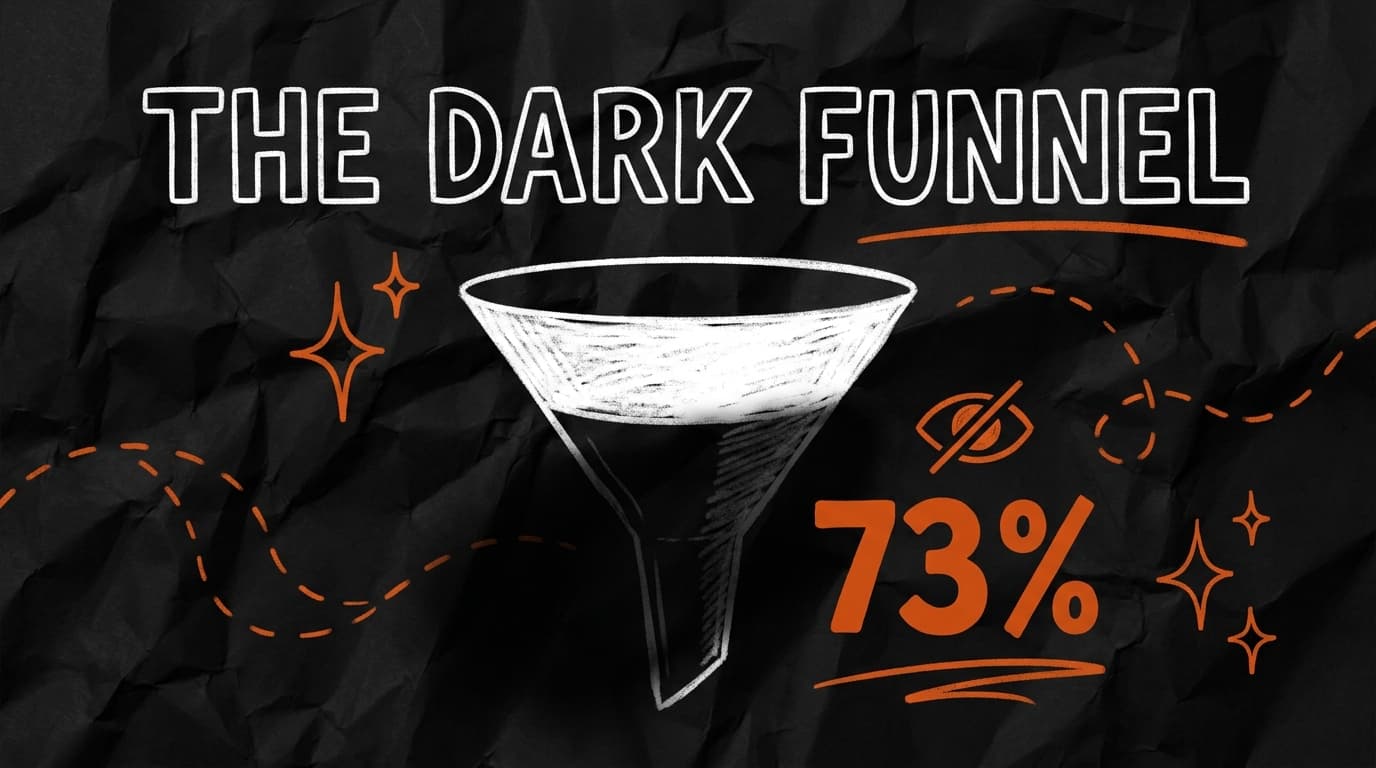
You can't win a race when you can't see 73% of the track.
That's roughly the position most marketers are in today. By the time a prospect fills out your form, books a demo, or replies to an email, the real decision is largely made — and it was made somewhere you couldn't watch. In a private Slack community. A WhatsApp thread with a former colleague. A podcast on a commute. A Reddit comment. A "hey, who do you use for this?" DM. And, increasingly, a ChatGPT conversation.
This invisible majority of the buyer's journey has a name: the dark funnel. It's where trust is actually built and shortlists are actually formed — and it barely shows up in your analytics. Gartner's research on the B2B buying journey found that buyers spend only about 17% of their time meeting with potential suppliers, and when split across several vendors, any single brand might get 5–6% of the buyer's attention directly. The other ~95% happens without you in the room.
Here's what's happening in the dark, why your reports keep crediting the wrong things, and — most importantly — how to influence and measure a journey you can't fully see.
In a Nutshell
- The dark funnel is the part of the buyer's journey that happens off your website and outside your analytics — private communities, DMs, word of mouth, podcasts, review sites, and AI assistants. Estimates put it at up to 73% of the journey.
- Dark social is a subset of it: shares and conversations that arrive with no referral data, so they get dumped into "direct traffic" and miscredited.
- Last-click attribution actively lies to you here. It hands all the credit to the final touch (often branded search or direct) and zero to the dark-funnel moments that did the real persuading.
- You can't track it perfectly — so stop trying. The winners shift from chasing perfect attribution to influencing the dark funnel and measuring it directionally.
- The highest-leverage fix is the simplest: self-reported attribution. Asking "How did you hear about us?" on your forms recovers signal no pixel can.
- AI assistants are the fastest-growing dark funnel. When ChatGPT or Perplexity recommends you inside a private chat, it's a high-intent touch you'll never see in GA — which makes getting cited by AI a dark-funnel strategy, not just an SEO one.
Table of Contents
- What the Dark Funnel Actually Is
- Dark Social: The Traffic That Lies About Where It Came From
- Why Your Attribution Is Quietly Wrong
- AI Assistants: The New Dark Funnel
- You Can't Track It — So Influence It Instead
- The One Fix Everyone Skips: Self-Reported Attribution
- How to Measure the Unmeasurable
- The Bottom Line
- Frequently Asked Questions
What the Dark Funnel Actually Is
The classic funnel assumes a tidy, trackable path: ad → click → landing page → form → sale. Every step leaves a footprint in your analytics, so you can optimize it.
The dark funnel is everything that path leaves out — the real-world, peer-to-peer, off-platform research that buyers actually trust. It includes:
- Private communities — Slack groups, Discord servers, WhatsApp and Telegram threads, subreddits.
- Word of mouth and DMs — "who do you use for X?" messages between peers, the single most persuasive touch in any journey.
- Podcasts, newsletters, and video — consumed passively, rarely clicked, never attributed.
- Review sites and forums — G2, Capterra, Reddit, where your reputation is decided without you.
- AI assistants — ChatGPT, Perplexity, Claude, and Gemini, increasingly the first place buyers go to ask for options.
None of these reliably pass referral data. So a buyer can spend weeks being influenced across half a dozen dark-funnel touches, then finally Google your brand name and click — and your analytics will proudly credit "branded search" for a sale that branded search had almost nothing to do with.
Dark Social: The Traffic That Lies About Where It Came From
Dark social is the most measurable-feeling part of the dark funnel, which makes it the most deceptive. It's any share that strips its referral source: a link pasted into a DM, an email, a Slack message, or a private group.
When someone clicks that link, your analytics see a visitor arriving with no referrer and file them under "direct traffic." Direct traffic is supposed to mean "typed your URL in directly" — but in reality a large and growing share of it is dark social: real referrals from real conversations, wearing a disguise.
This matters because it warps every decision you make from the data. You under-credit the content people actually share privately (it looks like it drives nothing), and you over-credit whatever happens to get the last click. You end up defunding the very things building your pipeline.
A quick gut check
If your "direct traffic" is large, growing, and includes landing pages deep in your site that nobody would ever type from memory, you're not looking at people typing your URL. You're looking at your dark social — proof the dark funnel is working, even though you can't see the path.
Why Your Attribution Is Quietly Wrong
Most analytics setups default to last-click attribution — 100% of the credit to the final touch before conversion. In a world where 73% of the journey is invisible, last-click isn't just imperfect; it's systematically misleading.
Picture a real path: a prospect hears you on a podcast, sees a founder's post reshared in a Slack group, asks a peer who vouches for you, reads a Reddit thread, then searches your brand and converts. Last-click gives all the credit to branded search and none to the podcast, the community, the peer, or the forum — the touches that actually did the persuading.
The danger isn't academic. Teams cut the "low-performing" channels (the dark-funnel influencers that don't get the last click) and double down on the "high-performing" ones (the last-click harvesters). Demand quietly dries up, because they defunded the part of the engine that creates it. This is the same trap as starving the top and middle of a content funnel — you keep what's easy to measure and kill what actually works.
AI Assistants: The New Dark Funnel
Here's the part that didn't exist a couple of years ago and is now the fastest-growing dark channel of all.
Buyers increasingly open their research not with Google but with a question to ChatGPT, Perplexity, Claude, or Gemini: "What are the best options for X?" The assistant returns a synthesized answer with a shortlist of recommended brands. If you're on that list, you've just received an extraordinarily high-intent touch — a trusted recommendation at the exact moment of consideration.
And you will never see it. There's no referrer, no click on your terms, no row in your analytics. The buyer simply emerges later, already aware of you, already half-sold, and converts through some trackable last touch that takes all the credit.
This reframes AI search entirely. Getting cited by AI assistants isn't a vanity SEO metric — it's dark-funnel demand generation. The brands that show up in those private answers are the ones that published clear, specific, citable content, especially at the decision stage. That's exactly what answer engine optimization and a real AI SEO strategy are for. In 2026, optimizing to be the answer AI gives is one of the most valuable dark-funnel moves available.
You Can't Track It — So Influence It Instead
The instinct is to try to illuminate the dark funnel with more tracking. Useful up to a point — but the bigger unlock is to accept you can't see all of it and focus on being present where it happens. A practical playbook:
- Show up in the communities your buyers trust. Be genuinely useful in the Slack groups, subreddits, and forums where your category is discussed — not as an ad, as a participant.
- Invest in founder-led and people-led content. People share and DM people, not brand pages. A founder or expert posting consistently feeds the dark funnel far better than a logo.
- Get on podcasts and into newsletters. High-trust, passively-consumed, endlessly shareable — the dark funnel's favorite formats.
- Own your reviews and category pages. When a buyer checks G2, Reddit, or asks an AI "is [you] any good?", make sure the answer they find is strong.
- Create decision-stage content worth sharing privately. A genuinely useful comparison or teardown gets pasted into DMs and group chats — which is the dark funnel doing your selling for you.
- Enable self-service research. Make pricing, comparisons, and proof easy to find without talking to sales, because most of the journey is now self-directed.
The throughline: you win the dark funnel by being so useful and so present that people carry you into the rooms you'll never enter.
The One Fix Everyone Skips: Self-Reported Attribution
If you do one thing after reading this, do this: add a "How did you hear about us?" field to your forms.
Self-reported attribution asks the buyer directly, capturing the signal that pixels and cookies structurally cannot — the podcast, the peer, the community, the AI chat. It's not perfect (people forget, or name the last thing they remember), but it recovers exactly the dark-funnel data your analytics throws away, and it's astonishingly cheap to implement.
Used alongside your analytics, it becomes a reality check. When self-reported attribution says 30% of your best customers "heard about you on a podcast" while your dashboard credits podcasts with near-zero, you've just found a channel you were about to defund — and a reason to double down instead. Pair it with disciplined analytics and reporting and you get a far truer picture than either source alone.
How to Measure the Unmeasurable
You'll never get a clean, deterministic ROI on the dark funnel. Chasing one is a trap. Instead, measure it the way you'd measure brand — directionally, with a basket of proxy signals:
- Self-reported attribution — your single best dark-funnel signal.
- Branded search volume — when dark-funnel influence grows, more people search your name. Rising branded search is a lagging indicator that your dark efforts are landing.
- Direct traffic trends (read as partly dark social) — growing direct traffic to deep pages signals private sharing.
- "Came in warm" rate — track how many leads arrive already aware and high-intent. A rising share means the dark funnel is pre-selling for you.
- Community and AI presence — monitor mentions in target communities and whether AI assistants recommend you for your category.
The mindset shift is everything: treat the dark funnel as revenue intelligence, not a measurement problem to solve. You're not trying to attribute every rupee — you're trying to confirm the engine is working and decide where to push.
The Bottom Line
The buyer's journey didn't get harder to influence — it got harder to see. The persuasion moved into private channels, peer conversations, and AI chats, and the analytics that ran marketing for two decades simply can't follow it there.
The losing move is to keep optimizing only the 27% you can measure, slowly defunding everything that actually drives demand because it doesn't show up in last-click. The winning move is to accept the dark, show up generously where your buyers actually talk, ask them directly how they found you, and measure your influence by the trail it leaves — branded search, warm leads, and the quiet growth of people who already know your name.
You can't see 73% of the track. But you can absolutely win the race — by running it where the buyers actually are.
Aurelius Media builds full-funnel growth and content strategies that work in the dark funnel as well as the trackable one — community, AI visibility, and demand that shows up "warm." If your pipeline is bigger than your attribution can explain, book a strategy call.
Frequently Asked Questions
What is the dark funnel?
The dark funnel is the portion of the buyer's journey that happens off your website and outside your analytics — private communities (Slack, WhatsApp, Discord), word-of-mouth and DMs, podcasts, newsletters, review sites, forums, and AI assistants. Research suggests up to 73% of the journey happens here, invisible to tracking, which is where much of the real trust-building and shortlisting occurs.
What's the difference between the dark funnel and dark social?
Dark social is a subset of the dark funnel. The dark funnel is the entire invisible journey (including podcasts, communities, word of mouth, and AI chats). Dark social specifically refers to shares and conversations that arrive with no referral data — a link pasted into a DM, email, or private group — which your analytics misfiles as "direct traffic."
Why does last-click attribution fail with the dark funnel?
Last-click attribution gives 100% of the credit to the final touch before conversion — usually branded search or direct traffic. But those final touches are often just the visible end of a long, invisible journey across podcasts, communities, peers, and AI chats. Last-click credits the harvester and ignores the influencers, leading teams to defund the channels actually generating demand.
How do you measure the dark funnel?
You measure it directionally, not deterministically. The best signals are: self-reported attribution ("How did you hear about us?"), branded search volume trends, direct traffic to deep pages (a proxy for dark social), the share of leads that arrive already warm, and your presence/recommendations in target communities and AI assistants. Treat it as revenue intelligence rather than a problem to attribute perfectly.
What is self-reported attribution and is it accurate?
Self-reported attribution asks buyers directly how they discovered you, usually via a "How did you hear about us?" field on your forms. It isn't perfectly accurate — people forget or name the most recent touch — but it captures dark-funnel signal that cookies and pixels structurally cannot, and used alongside analytics it reveals channels you'd otherwise under-credit and defund.
How do AI assistants like ChatGPT fit into the dark funnel?
AI assistants are the fastest-growing dark channel. When a buyer asks ChatGPT, Perplexity, or Gemini for recommendations and your brand is in the answer, that's a high-intent touch you'll never see in analytics — no referrer, no tracked click. Getting cited by AI assistants is therefore a dark-funnel demand-generation strategy, achieved through answer engine optimization and clear, citable decision-stage content.