
Michael Easter spent years studying why humans can't stop. Can't stop scrolling. Can't stop eating. Can't stop buying things they don't need at 2 AM.
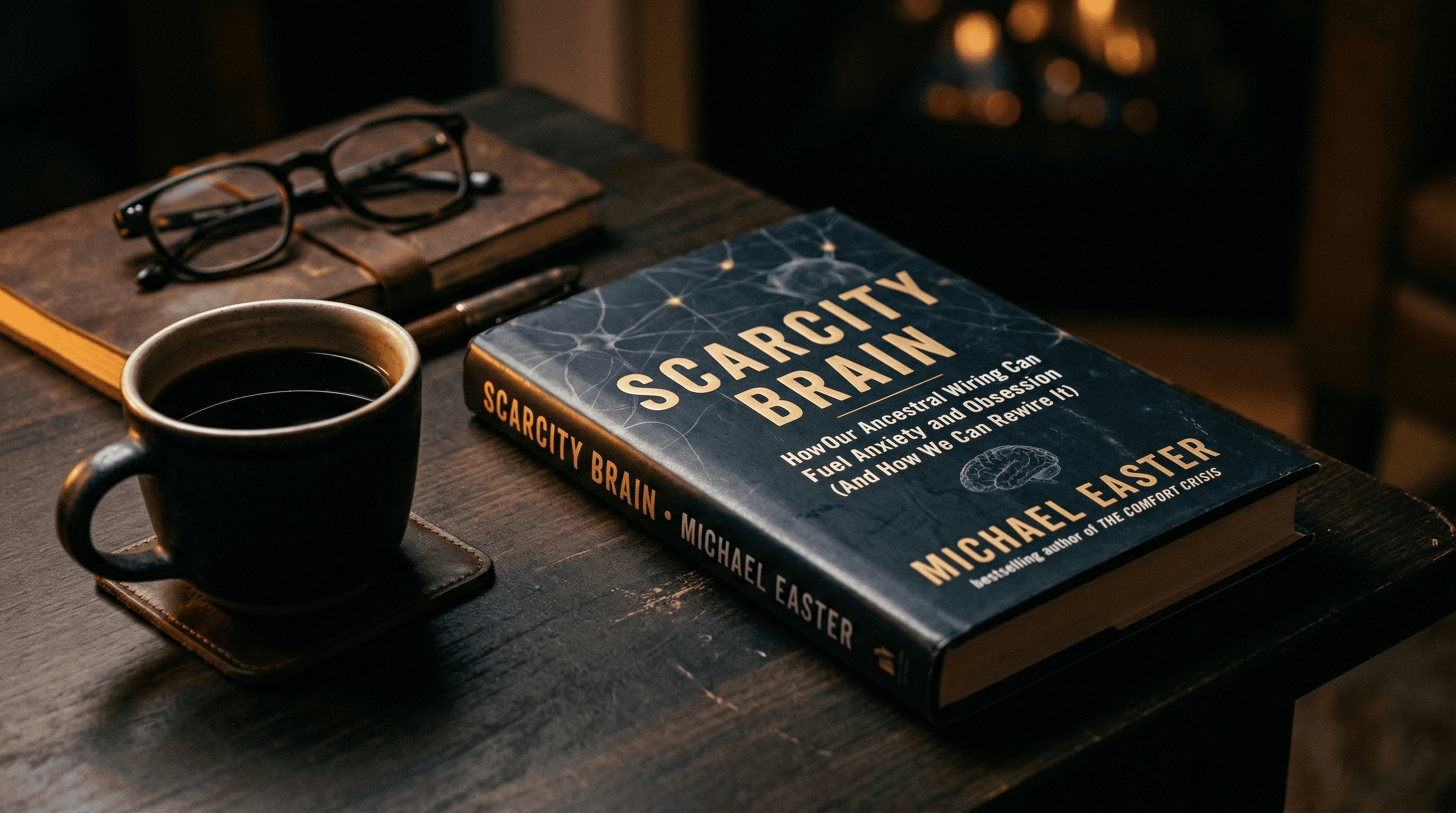
His answer is a 304-page book called The Scarcity Brain — and it wasn't written for marketers. It was written for people trying to escape the traps marketers build.
But here's the thing: if you flip the lens, this book is the most honest, research-backed breakdown of consumer psychology published in the last decade. Easter went to casinos, the Bolivian Amazon, Benedictine monasteries, and Iraq. He talked to slot machine designers, addiction psychiatrists, and the world's healthiest tribe. And what he found is a single mechanism — a 3-part loop — that explains nearly every compulsive human behavior.
Including the ones your customers exhibit every time they interact with your brand.
Here are 7 concepts from The Scarcity Brain that every marketer should understand — and how to use them without becoming the thing Easter warns people about.
In a Nutshell
- The "scarcity loop" is the engine behind every addictive product, platform, and campaign. It has 3 components: opportunity, unpredictable rewards, and quick repeatability. When all three are present, people can't stop. Remove one, and they can.
- Dopamine is not the pleasure chemical — it's the pursuit chemical. This changes everything about how you write copy, structure launches, and design landing pages. Anticipation converts. Satisfaction doesn't.
- "Free" content isn't free — it's the most expensive thing your audience consumes. The real cost is time, attention, and the growing anxiety of consuming without producing. Frame your paid offer as the exit, not another entry.
- Most marketing fails because it fights the brain instead of working with it. The brands winning in 2026 aren't the loudest. They're the ones that understand the mechanism — and design for it ethically.
Table of Contents
- The Scarcity Loop: The 3-Part Engine Behind Every Conversion
- Dopamine Is the Pursuit Chemical — Not the Pleasure Chemical
- The Near Miss Effect: Why "Almost" Converts Better Than "Easy"
- Losses Disguised as Wins: The Hidden Anchor in Every Pricing Page
- The 3 V's: How Snack Companies and SaaS Companies Use the Same Playbook
- Addition Bias: Why "Less" Is the Most Persuasive Word in Marketing
- Positive Loops: How to Build Habits That Help (Instead of Hooks That Trap)
1. The Scarcity Loop: The 3-Part Engine Behind Every Conversion
Easter's central framework is the scarcity loop — a 3-component cycle that he calls "the serial killer of moderation."
It goes like this:
- Opportunity: There's a chance to get something valuable — money, status, information, a deal.
- Unpredictable Rewards: You don't know if you'll get it, when you'll get it, or how much you'll get.
- Quick Repeatability: You can try again immediately, with almost zero friction.
When all three are present, the behavior becomes compulsive. This is why slot machines work. This is why social media works. And this is why some marketing campaigns are addictive while others get ignored.
What this means for marketers:
Every high-converting funnel you've ever seen has all three components baked in — whether the team designed it consciously or stumbled into it.
- Flash sales create opportunity (limited deal) + unpredictable rewards (different items on sale each time) + quick repeatability (one-click checkout).
- Email sequences that work create opportunity (valuable content) + unpredictable rewards (you never know which email will contain the breakthrough insight) + quick repeatability (next email arrives automatically).
- Product Hunt launches are pure scarcity loop: opportunity to discover a new tool, unpredictable quality/utility, instant click to the next one.
The lesson isn't "add all three to everything." It's: audit your funnel for which component is missing. If people visit your landing page but don't convert, ask: is the opportunity unclear? Are the rewards too predictable (boring)? Is there too much friction to take the next step?
One missing component collapses the entire loop.
2. Dopamine Is the Pursuit Chemical — Not the Pleasure Chemical
This is the most important insight in the book, and it overturns how most marketers think about desire.
Easter cites neuroscience research showing that dopamine fires during anticipation and pursuit — not during consumption or satisfaction. There's a separate "liking system" in the brain that handles actual pleasure. Dopamine is the wanting system. It makes you chase. It doesn't make you enjoy.
This is why people feel compelled to buy things they never use. The dopamine hit came from the wanting, not the having.
What this means for marketers:
Stop designing for the moment of purchase. Start designing for the moment before purchase.
- Curiosity gaps in subject lines trigger more dopamine than complete information. "The one channel we'd double down on in Q3" outperforms "Our Q3 Meta Ads Strategy Guide."
- Waitlists work not because of artificial scarcity, but because they extend the anticipation window — which is where dopamine actually fires.
- Mystery bonuses ("register and unlock a surprise resource") outperform fully disclosed bonuses — because unpredictability sustains the dopamine response.
- Launch countdowns aren't just urgency tactics. They're dopamine architecture. Every day of the countdown is another dopamine pulse.
The implication is counterintuitive: revealing everything upfront reduces desire. The brands that create the most compulsive engagement are the ones that always leave something unrevealed. Not because they're withholding value — but because the brain values the pursuit more than the destination.
3. The Near Miss Effect: Why "Almost" Converts Better Than "Easy"
Easter studied slot machines extensively for this book. One of the most powerful design elements in modern slots is the near miss — when two matching symbols land and the third is just barely off.
Rationally, a near miss is identical to any other loss. But neurologically, it registers more like a win. Near misses activate the same reward circuits as actual wins, and — critically — they motivate continued play rather than quitting. Slot machine designers deliberately engineer near misses at higher-than-random rates because they keep people pulling the lever.
What this means for marketers:
Show your prospect how close they already are to the result they want. The gap should feel small, not large.
- Instead of "Learn everything about AI marketing from scratch," try: "You already know 80% of this. Here's the 20% that separates amateurs from agencies."
- Instead of "Complete beginner course," try: "You've been using ChatGPT for a year — here's why your outputs still look generic, and the one workflow that fixes it."
- In pricing pages, show what they've already invested (time, existing tools, effort) and position your product as the final missing piece — not a whole new system.
The near miss effect works because the brain treats proximity to a goal as partial success. When someone feels like they're almost there, the motivation to close the gap is far stronger than the motivation to start from zero.
This is why "You're 90% of the way there" is more persuasive than "Here's everything you need."
4. Losses Disguised as Wins: The Hidden Anchor in Every Pricing Page
Slot machines routinely celebrate net losses. A player bets Rs 500, gets back Rs 300. The machine explodes with lights, sounds, and animations. The player's brain registers a "win" — even though they just lost Rs 200.
Easter calls these Losses Disguised as Wins (LDWs), and neuroscience research confirms that the brain processes them identically to actual wins. The celebration overrides the arithmetic.
What this means for marketers:
Every pricing page uses a version of this. And the most effective ones make the "loss" (the price) feel like a gain.
- Anchoring is the classic application: show the full price first (Rs 15,000), then the current price (Rs 4,999), and the brain processes the difference as a "win" — even though the customer is spending Rs 4,999.
- "What it replaces" framing works the same way: "This tool replaces your Rs 25,000/month agency retainer" makes the Rs 2,000/month subscription feel like Rs 23,000 in monthly savings. The expenditure is reframed as recovery.
- Free trial to paid conversion is the most elegant LDW in SaaS: the "loss" of the free tier is disguised as a "win" because they already have the product, the data, the integrations. Paying feels like protecting a gain rather than absorbing a cost.
The ethical line here matters. LDWs in slot machines are deceptive — the player is genuinely losing money. But in marketing, the principle applies ethically when the product genuinely delivers more value than its price. The "loss disguised as win" framing simply helps the buyer's brain catch up to the math their rational mind already knows.
5. The 3 V's: How Snack Companies and SaaS Companies Use the Same Playbook
Easter traces how the snacking industry (which barely existed before the 1970s) was deliberately engineered around three principles:
- Value: High caloric density for low cost. Maximum reward per rupee.
- Variety: Dozens of flavors and formats per brand. Something new every quarter.
- Velocity: Foods engineered to dissolve quickly — maximizing consumption speed and minimizing the "full" signal.
He argues that these 3 V's are the industrial-scale application of the scarcity loop: value = opportunity, variety = unpredictable rewards, velocity = quick repeatability.
What this means for marketers:
Look at any category-leading brand and you'll find the 3 V's:
| Snack Industry | SaaS | Content Marketing | |
|---|---|---|---|
| Value | Cheap calories | Free tier / low entry price | Free blog posts, guides |
| Variety | 47 chip flavors | Feature releases every sprint | New content formats, topics |
| Velocity | Dissolves in seconds | One-click signup, instant access | Auto-play, infinite scroll |
The insight isn't to blindly copy the snack industry. It's to audit which V is your weakest.
- If you have great value but no variety, your audience gets bored. (Same 3 blog topics for 18 months.)
- If you have variety but no velocity, your audience drops off at friction points. (Amazing features behind a 7-step onboarding flow.)
- If you have velocity but no value, your audience churns. (Easy to start, nothing worth staying for.)
Most marketing teams intuitively optimize for one V. The winners optimize for all three simultaneously.
6. Addition Bias: Why "Less" Is the Most Persuasive Word in Marketing
Easter cites research by engineering professor Leidy Klotz showing that humans instinctively default to adding when solving problems — even when subtraction is the better solution. In experiments, 100% of participants tried to fix a tilted Lego bridge by adding blocks, even when removing blocks was simpler and more effective.
This evolved when resources were scarce and accumulation was survival. But in modern life — and modern marketing — the addiction to "more" is often the problem itself.
What this means for marketers:
Your customer is drowning in options, features, subscriptions, and information. The most persuasive pitch in 2026 isn't "here's more." It's "here's less."
- "The only marketing tool you need" works because it promises subtraction — fewer tools, fewer dashboards, fewer logins.
- "Stop doing these 5 things" outperforms "Start doing these 10 things" because removal feels like relief, not effort.
- Apple's entire brand is built on addition bias reversal: fewer ports, fewer buttons, fewer choices. Every subtraction is positioned as elegance.
- In landing page design, removing a form field typically increases conversions more than adding a trust badge. Subtraction beats addition.
The deeper application: position your product as the thing that lets customers stop doing something painful — not start doing something new. "Stop manually tracking leads" beats "Start using our lead management platform." Same product. Dramatically different psychological frame.
Your audience's real desire isn't to add your product to their life. It's to subtract the problem that makes them need it.
7. Positive Loops: How to Build Habits That Help (Instead of Hooks That Trap)
Easter doesn't just explain how scarcity loops exploit people. He also shows how the same mechanism can be channeled into genuinely beneficial behaviors.
His examples: birding (unpredictable sightings + outdoor movement + easy to repeat), strength training (unpredictable progress + physical benefits + simple to do again), and Pokemon Go (variable rewards + walking + instant replay). The loop structure is identical to slot machines — but the outcomes improve people's lives instead of draining their wallets.
What this means for marketers:
The difference between a product that traps and a product that transforms is what happens inside the loop.
- Duolingo uses streaks (quick repeatability), XP variance (unpredictable rewards), and new lessons (opportunity) — but the outcome is language fluency, not addiction.
- Strava uses segment times (unpredictable — can you beat your PR?), social kudos (variable), and one-click activity start (velocity) — but the outcome is fitness.
- Notion's template gallery uses browsing (opportunity), template variety (unpredictable), and one-click duplication (velocity) — but the outcome is productivity.
The ethical question isn't whether you use loops. Everything uses loops. The question is: does your customer's life get better each time they complete a cycle?
If your user opens the app, sees a notification, scrolls for 20 minutes, closes it, and feels worse — that's an extractive loop. If they open the app, complete a task, see progress, and close it feeling accomplished — that's a generative loop.
The brands that will win the next decade aren't the ones with the most addictive hooks. They're the ones whose loops make customers genuinely more capable, more productive, or more connected each time around.
The Bottom Line
The Scarcity Brain isn't a marketing book. But it should be required reading for every marketer, growth lead, and product designer working in 2026.
Here's the uncomfortable truth Easter surfaces: every persuasion technique in modern marketing is a descendant of the same mechanism that makes slot machines addictive. The scarcity loop. The 3 V's. Losses disguised as wins. Dopamine-driven pursuit. Near misses. Addition bias.
The question isn't whether you use these principles — you already do, whether you've named them or not. The question is whether you use them to extract value from your audience or to create it.
Easter spent time with Benedictine monks who are among the happiest people studied by researchers. Their insight: happiness doesn't come from pursuing more. It comes from knowing what's enough.
The best marketing doesn't exploit the scarcity brain. It resolves it. It helps people find what's enough — and then delivers exactly that.
Build loops that leave your customers better off after each cycle, and you'll never have to manufacture urgency again. The product becomes its own engine.
Frequently Asked Questions
What is the scarcity loop?
The scarcity loop is a 3-part behavioral cycle identified by Michael Easter in The Scarcity Brain. It consists of: (1) an opportunity to gain something valuable, (2) unpredictable rewards — you don't know if, when, or how much you'll receive, and (3) quick repeatability — minimal friction to try again. When all three components are present, behavior becomes compulsive. It explains everything from slot machine addiction to social media scrolling to impulse buying.
How is the scarcity loop different from a habit loop?
The classic habit loop (cue → routine → reward) describes how behaviors become automatic. The scarcity loop specifically explains why certain behaviors become compulsive — the key difference is the unpredictability of rewards. Predictable rewards create habits. Unpredictable rewards create obsession. The scarcity loop is what happens when a habit loop gets weaponised with variable reinforcement.
Is it ethical to use scarcity loop principles in marketing?
The mechanism itself is neutral — it's the outcome that determines ethics. Easter distinguishes between extractive loops (slot machines, doomscrolling) and generative loops (exercise, learning). If completing a cycle of your product leaves the customer better off — more skilled, more productive, healthier — the loop is ethical. If it leaves them anxious, poorer, or worse off, it's not. The question isn't "should we use loops?" — everything uses loops. The question is "does our loop create or extract value?"
What is addition bias in marketing?
Addition bias is the human tendency to solve problems by adding things rather than removing them — even when subtraction is the better solution. In marketing, this means audiences are more persuaded by products that promise to remove complexity, tools, or effort than by products that promise to add new capabilities. "The only tool you need" (subtraction) outperforms "Another powerful tool for your stack" (addition) because subtraction promises relief from cognitive overload.
How does dopamine actually work in consumer behaviour?
Contrary to popular belief, dopamine is not the "pleasure chemical." It's the pursuit chemical. Dopamine fires during anticipation and chasing — not during consumption. This is why people feel compelled to buy things they never use, sign up for courses they never finish, and click "add to cart" at 2 AM. The wanting is where the neurological reward happens. The having is often an anticlimax. For marketers, this means the pre-purchase experience (countdowns, waitlists, teaser campaigns) drives more conversions than the post-purchase experience.