
A school launches Facebook and Instagram ads, and at first the numbers look wonderful. Leads pour in at a cost per lead that makes the principal smile. The admissions team starts calling. Then the picture sours. Half the numbers do not pick up. A third of the parents who do answer live two hours away, or want a grade the school does not offer, or were just curious and have no intention of switching schools this year, or next. By the time the season closes, the school has paid for hundreds of "leads" and enrolled almost none of them, and someone concludes that Meta ads do not work for admissions.
This is the most common way school advertising fails on Meta, and the diagnosis is almost always wrong. The platform works. Parents are there, the targeting is genuinely powerful, and the cost to reach a family is low compared with the value of enrolling one. What failed was not Meta. It was that nobody built the campaign around the only thing that matters, which is lead quality. The school optimized for cheap form fills and got exactly what it asked for: a flood of cheap, unqualified form fills.
This guide flips that. It is the parent-targeting playbook for schools on Facebook and Instagram, and lead quality is the spine of every section. We will cover why Meta is a demand-creation channel for admissions, who the parent buyer actually is and how to reach them, the creative that earns a parent's trust, the real choice between instant forms and landing pages, how to qualify leads so your team only works the ones worth working, and the speed-to-lead and WhatsApp follow-up that turns an enquiry into an admission. The goal is not more leads. It is the right leads, and a system that converts them.
In a Nutshell
- Meta is a demand-creation channel, not a demand-capture one. Parents on Facebook and Instagram are not searching for a school. You interrupt them, which means your job is to create interest, not just catch it. That is the opposite of Google Ads for school admissions, and the two work best together.
- Lead quality is the whole game. Cheap leads are easy. Qualified parents who can actually enrol are what you are really buying, and you have to engineer that quality into the campaign deliberately.
- Geography and parent demographics come first, lookalikes win. Target the real catchment, layer parent age bands, and let lookalike audiences built on your past enquiry and admission lists do the heavy lifting.
- Creative has to earn trust, not just attention. Parents are choosing where their child spends years of their life. Campus, outcomes, safety, values, fee clarity, and real proof matter more than clever copy.
- Instant forms and landing pages do different jobs. Forms maximize volume, pages maximize intent. Most schools should use both, matched to the funnel stage.
- Qualify inside the form, not after. Ask for locality, grade, and timeline so unfit leads filter themselves out before they ever reach your team.
- Speed-to-lead is half the result. A parent contacted in minutes converts. One contacted in days is usually gone. WhatsApp plus a same-day call is the standard to beat.
Table of Contents
- Why Meta Is a Demand-Creation Channel
- The Lead-Quality Problem, Stated Plainly
- Who the Parent Buyer Actually Is
- Parent Targeting That Works
- Creative That Earns a Parent's Trust
- Instant Forms vs Landing Pages
- Qualifying Leads Before They Reach Your Team
- Speed-to-Lead and WhatsApp Follow-Up
- The Admission-Season Funnel
- Measure Admissions, Not Form Fills
- The Bottom Line
- Frequently Asked Questions
Why Meta Is a Demand-Creation Channel
To run Meta ads well for a school, you have to be honest about what kind of channel it is, because almost every mistake schools make flows from misunderstanding this one thing.
When a parent types "best CBSE school near me" or "play school admission 2026" into Google, they are looking. They have already decided they want a school and they are comparing options with intent. Search advertising catches that intent. It is demand capture, and it is why Google Ads for school admissions tends to produce higher-intent enquiries out of the gate.
Meta is the opposite, and that is its strength, not its weakness. A parent on Facebook or Instagram is not searching for a school. They are watching a Reel, checking a community group, looking at photos from a cousin's wedding. Your ad arrives uninvited, in the middle of all that. You are interrupting. This means Meta does not catch existing demand, it creates new demand. It puts your school in front of a parent who was not actively looking, plants the idea, and gives them a reason to enquire before they have started a formal search at all.
That is enormously valuable, because the pool of parents actively searching at any moment is small, while the pool of parents who would consider a better school if shown one is large. Meta lets you reach families earlier, before a competitor's open house, before the decision is half-made. It is how you fill the top of the funnel rather than fight over the bottom of it.
But interruption comes with a cost, and the cost is exactly the lead-quality problem this guide is built around. Because you are reaching people who were not looking, a chunk of the interest you generate is shallow. Some of the parents who respond are mildly curious, not seriously shopping. Some are well outside your catchment. Some are reacting to a nice photo, not to a real intent to move their child. Demand creation always produces a wider, noisier top of the funnel than demand capture does. That is not a flaw in Meta, it is the nature of the channel, and the entire job of running it well is filtering that noise down to the parents who can and will enrol. Everything that follows is about that filtering. If you want a deeper look at why this happens, we have written separately on why your Meta leads are low quality.
The Lead-Quality Problem, Stated Plainly
Here is the trap, drawn out in full, because naming it precisely is what lets you avoid it.
Meta's lead-generation tools are designed to make submitting a form as effortless as possible. An instant form opens inside the app, pre-filled with the parent's name, email, and phone number pulled from their profile. Submitting takes one tap. By default, the campaign optimizes to get you the most of these submissions at the lowest cost. Meta is very, very good at this. Tell it you want cheap form fills, and it will deliver a torrent of them.
The problem is that "cheap form fill" and "parent who will enrol" are not the same thing, and often barely overlap. A frictionless one-tap form invites everyone: the parent forty kilometres outside your catchment, the one whose child is in a grade you do not teach, the one who tapped out of mild curiosity and forgot about it ten seconds later, the one who will not be ready to switch schools for two more years. Every one of those is a "lead" in your dashboard. None of them is an admission. Your cost per lead looks fantastic and your cost per enrolled student is a disaster, because the two numbers have almost nothing to do with each other.
This is the gap that breaks school campaigns, and it is worth seeing the failure clearly:
- Volume optimized, fit ignored. The campaign chases the cheapest possible submission, which is structurally the least qualified one.
- No qualification in the funnel. The form asks for nothing that would let an unfit parent screen themselves out, so they do not.
- Geography too loose. The targeting reaches well beyond the catchment, so a real share of leads could never realistically commute to the school.
- The platform learns the wrong lesson. With no signal about which leads were good, Meta keeps finding more of whatever is cheapest, which is more of the bad ones.
- Slow follow-up finishes the job. Even the genuinely interested parents go cold because nobody called them for two days.
The reframe that fixes all of this is simple to state and demands discipline to follow: you are not buying leads, you are buying qualified enquiries that can convert to admissions. The moment that becomes your real objective, every decision changes. You target tighter. You add qualifying questions that deliberately reduce volume. You optimize toward enquiries that became tours, not toward form fills. You build follow-up that moves in minutes. You accept a higher cost per lead in exchange for a far lower cost per admission. Lead quality is not a metric you check at the end. It is the design principle you build the whole campaign around from the first click.
Who the Parent Buyer Actually Is
You cannot target a parent well until you understand them, and school marketing has a habit of skipping straight to demographics without thinking about the human being behind them.
The parent choosing a school is making one of the highest-stakes, most emotional purchases of their life, and they know it. They are not buying a product, they are deciding where their child will spend years of childhood, who will shape them, and whether they will be safe and happy and well taught while doing it. The decision carries guilt, hope, social pressure, and real financial weight all at once. A parent comparing schools is asking, underneath everything, a single question: can I trust these people with my child? Every part of your campaign is either building that trust or failing to.
A few things about this buyer matter for how you reach them on Meta:
- They are local, and the catchment is real. A school is a daily commute, often twice a day, often with younger siblings in tow. A parent will not send a child across a city no matter how good the campus looks. Geography is not one targeting factor among many, it is the first and hardest constraint.
- They are usually a specific age, tied to the grade. A parent enquiring for nursery or kindergarten is a different person from one enquiring for senior school. Their age, their concerns, and the urgency of their decision all differ by the grade you are admitting.
- Often both parents decide, sometimes the extended family too. The form may be filled by one parent, but the choice is frequently shared, and in many Indian families grandparents weigh in. This is why trust, reputation, and proof matter so much: the ad has to convince a parent who then has to convince a spouse.
- They are price-aware but not only price-driven. Fees matter, and hiding them creates friction and wasted leads. But a parent who can afford the school is weighing safety, values, outcomes, and fit far more than they are hunting for the cheapest option.
- They move on a calendar. Admissions run in seasons. A parent enquiring in the active window is far more valuable than one idly curious in the off-season, and your spend and urgency should reflect that.
Hold this person in mind through the rest of the playbook. Every targeting choice, every image, every form question is really a question about this parent: does it reach them, does it earn their trust, and does it help the serious ones identify themselves while letting the unfit ones fall away. For the wider context of how this buyer behaves across channels in the Indian market, our guide to education marketing in India goes deeper.
Parent Targeting That Works
Now the mechanics. Meta gives you genuinely powerful tools to find this parent, and the way you stack them determines whether you get qualified enquiries or expensive noise. The order matters: geography first, parent demographics next, lookalikes as the quality engine, interests as a light optional layer, and exclusions to stop waste.
Geography, drawn to the real catchment. This is the single most important quality lever you have, and most schools set it too wide. Do not target a whole city or state. Draw a radius around the campus that matches how far families actually commute, often ten to fifteen kilometres in a city, sometimes tighter, and narrow to specific towns, neighbourhoods, or pin codes if you know where your families come from. Then exclude areas you cannot realistically serve. A tighter, honest catchment immediately raises lead quality, because it removes the largest single source of unfit leads, which is parents who could never get their child to your gate.
Parent demographics, tied to the grades you are admitting. Meta lets you target parents by the age band of their children. Use it. If you are filling nursery and kindergarten, reach parents of early-school-age children. If you are admitting for senior grades, shift the band accordingly. Layer the parent's own age, usually somewhere in the twenty-five to fifty range depending on the grade, so you are reaching adults who are plausibly making this decision now. This alone screens out a huge amount of mismatch.
Lookalike audiences, your highest-quality source. This is the lever that separates a good campaign from a guessing one. Upload your past enquiry list, and better still your list of actually admitted families, and let Meta build a lookalike audience: people who resemble those families in behaviour and profile. A lookalike built on admitted parents is modelled on the outcome you actually want, enrolment, not on a cheap form fill, which is exactly why it tends to be the single highest-quality audience you can run. The bigger and cleaner your source list, the better the match. This is also a strong reason to capture and organize every enquiry you have ever received: it is fuel for targeting.
Interests and behaviours, a light layer at most. You can add interests like education, private schooling, parenting, or specific curricula and boards. Used sparingly, they help. The mistake is stacking so many filters that the audience shrinks to nothing and Meta cannot optimize. Geography plus parent demographics plus a good lookalike is usually a stronger, cleaner audience than an elaborate interest stack. Treat interests as a gentle nudge, not the foundation.
Exclusions, to stop paying for the wrong people. Exclude current families, since you are not advertising to people already enrolled. Exclude parents who have already submitted a form, so you do not annoy and re-pay for the same lead. These small exclusions quietly protect budget and improve the experience.
The thread running through all of it is the same: every targeting decision is a quality decision. A wider audience buys you more leads and worse ones. A tighter, evidence-based audience buys you fewer leads and far better ones. Build around quality, and let volume be the thing you scale once quality is proven. If you want this set up and managed properly, it is a core part of how we run Meta ads for clients.
Creative That Earns a Parent's Trust
Targeting puts your ad in front of the right parent. Creative decides whether they trust you enough to act, and for a school that bar is high. A parent is not clicking a sale, they are starting to imagine handing you their child. Generic, stocky, salesy creative does not just convert poorly, it actively signals "do not trust this place." The creative that works speaks to what a parent actually weighs.
Build your creative around the things parents genuinely care about:
- The campus, shown for real. Use actual photos and video of your school, not stock images of anonymous smiling children. A parent wants to see the building their child will walk into, the classrooms, the playground, the labs, the faces. Real footage of campus life, even if it is not slick, beats polished stock every time, because it is the truth and parents can tell.
- Outcomes, made concrete. Parents are buying their child's future. Show it. Board results, where you can speak about them honestly, university placements, competition wins, the specific things your school helps children become. Concrete beats vague: a real achievement lands harder than "holistic excellence."
- Safety, signalled clearly. For many parents, especially of younger children, safety is the first concern and sometimes the deciding one. Show it without making it grim: supervised play, secure campus, caring staff, small classes where a child is known and not lost in a crowd.
- Values and culture. Parents are choosing an environment that will shape their child's character, not just their marks. If your school stands for something, discipline, faith, creativity, kindness, curiosity, show it through real moments rather than slogans.
- Fee clarity, handled honestly. Hiding fees feels clever and backfires. It attracts parents who cannot afford the school and waste your team's time, and it loses parents who can but distrust the secrecy. You do not need to plaster a price on the image, but being upfront, even signalling a range or fee bracket, qualifies parents before they enquire and lifts the quality of everyone who does.
- Proof, from real families. Nothing builds trust like another parent. A short testimonial clip from a current parent, in their own words, on camera, is among the most powerful creative a school can run. Parents trust parents far more than they trust the school talking about itself.
A few craft notes that matter on Meta specifically. Lead with the parent's concern, not your school's feature list: "A school where your child is actually known" beats "Now offering the Cambridge curriculum." Keep the primary text short, because most parents read on a phone and the first line is what they see. Use one clear call to action, "Book a campus tour" or "Register for our open house," rather than a vague "Learn more." Caption your videos, because most parents watch with the sound off. And run several creatives, not one, so Meta can find which campus photo, which testimonial, which headline resonates with your specific local audience, then concentrate budget on the winners.
The deeper point is that creative is a quality filter too. Honest, specific, trust-building creative attracts serious parents and quietly repels the merely curious. Vague, hype-driven creative does the reverse: it pulls a big, shallow audience that fills your form and never enrols. What you say, and how truthfully you say it, shapes who responds.
Instant Forms vs Landing Pages
Once a parent is ready to act, you have a real strategic choice about where they land, and it has direct consequences for lead quality. The two options are Meta's instant forms and your own landing page, and they sit at opposite ends of a trade-off between volume and intent.
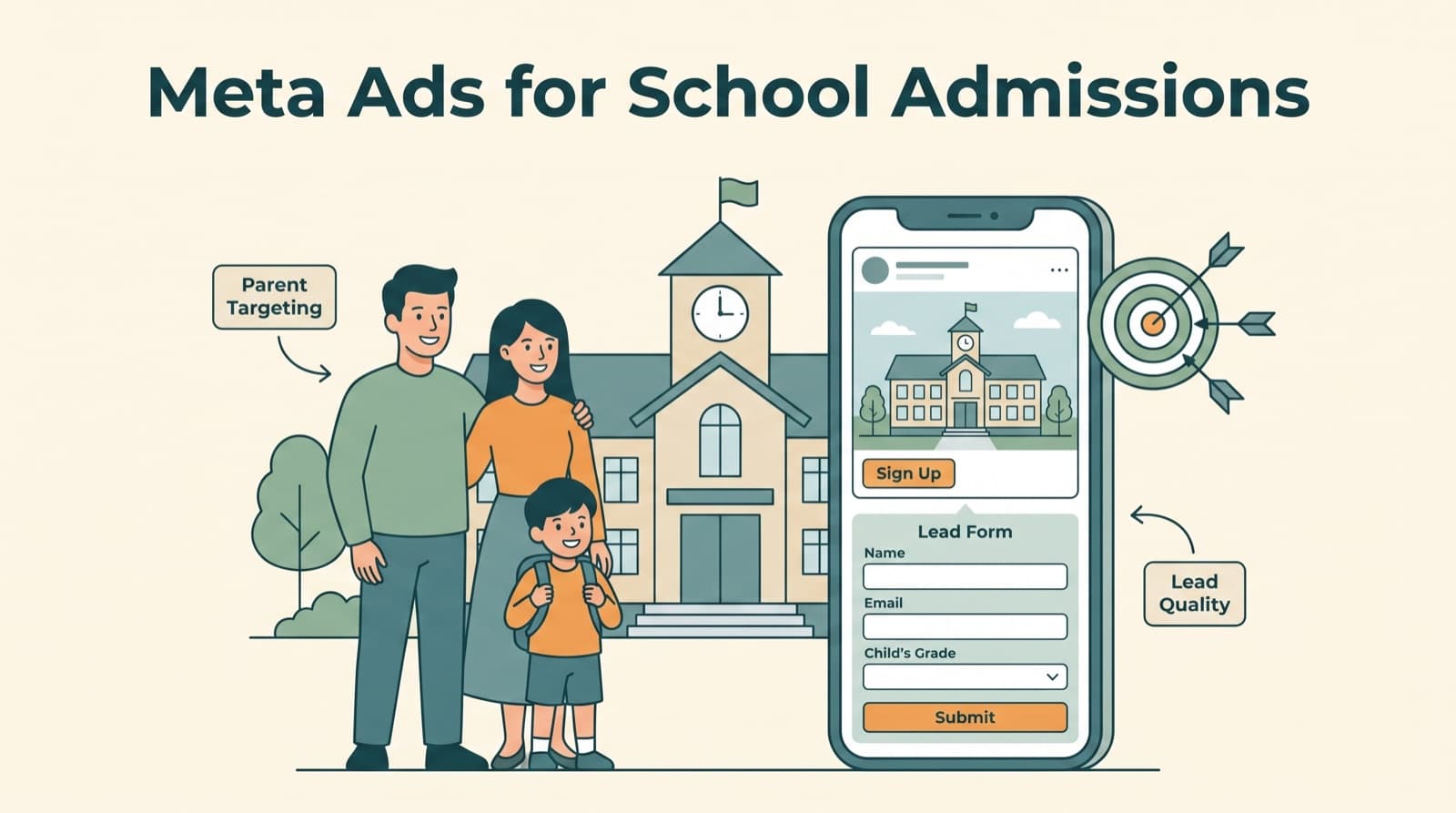
Instant forms open inside Facebook or Instagram. The parent never leaves the app. Their name, email, and phone pre-fill from their profile, and submitting takes a tap or two. The advantage is obvious: almost no friction, so volume is high and cost per lead is low. The disadvantage is the flip side of the same coin: almost no friction, so intent can be low. A parent can submit before they have really thought about it, which is exactly how you collect a pile of shallow leads. Instant forms are excellent for top-of-funnel capture, for open-house registration, and for reaching parents who would never bother clicking through to a website on their phone.
Landing pages send the parent to your own site, where they read more and fill a form there. This adds friction: a click, a page load, a form on a small screen. That friction lowers volume, and that is not entirely a bad thing. The parents who push through are, by definition, more motivated. They wanted to see more and were willing to work a little for it. A landing page also lets you do things an instant form cannot: tell a fuller story, show more proof, state fees and programmes clearly, and capture richer information. It demands that your page actually converts, which means strong, honest copy and a clear next step, but when it does, the enquiries tend to be warmer.
Here is how to think about choosing, with quality as the deciding factor:
| Instant forms | Landing pages | |
|---|---|---|
| Friction | Very low, one or two taps | Higher, click plus page plus form |
| Volume | High | Lower |
| Intent per lead | Lower, easy to submit casually | Higher, parent worked to get there |
| Best for | Awareness, open-house sign-ups, mobile-first reach | High-intent campaigns, retargeting, richer qualification |
| What it asks of you | Qualifying questions inside the form | A page that genuinely converts |
The honest answer for most schools is not one or the other, it is both, matched to the stage of the funnel. Use instant forms to capture broad interest and fill open houses, where volume is genuinely useful and you qualify inside the form. Use a landing page for your high-intent and retargeting campaigns, where you want fewer, more serious enquiries and the space to tell a fuller story. Then judge each not by cost per lead but by which one produces enquiries that become tours and admissions. Sometimes the lower-volume, higher-friction path wins on the only metric that counts.
Qualifying Leads Before They Reach Your Team
This is the heart of the whole playbook, the section that turns lead quality from a complaint into a system. The single most effective thing you can do to fix bad leads is to make unfit parents screen themselves out before a human ever calls them. You do this with qualification, and most of it happens inside the form itself.
Meta's instant forms let you add custom questions beyond the pre-filled contact details, and the higher-intent form setting adds a confirmation step that makes a parent pause before submitting. Both are quality levers, and the questions you choose are how you separate a real enquiry from noise. The three that matter most for a school map exactly to the ways an unfit lead slips through:
- Locality. Ask where the family lives, as a dropdown of the areas you serve or a simple question about their neighbourhood. A parent outside the catchment either self-selects out or flags themselves clearly so your team does not waste a call. Geography is the biggest source of bad leads, and one question catches most of it.
- Grade or year of admission. Ask which class or grade the child is entering, as a dropdown. This instantly filters parents looking for a grade you do not offer, and it tells your team exactly which child they are talking about before they pick up the phone. It also lets you route nursery enquiries differently from senior-school ones.
- Timeline. Ask when they are looking to admit: this season, next year, just exploring. A parent ready for the current cycle is worth an immediate call. A parent "just exploring" two years out is worth a nurture sequence, not a hot follow-up. Knowing the difference is the difference between a focused team and an exhausted one.
You can add a light fourth, such as "What would you most like to know?" or "Are you interested in a tour, the prospectus, or fee details?", which both qualifies and tells your team how to open the conversation. Resist going further. Every extra question lowers completion, and the goal is not the longest form, it is the form that filters precisely while still getting submitted. Ask only what changes how you treat the lead.
There is a genuine tension here, and you should hold it consciously. Each qualifying question reduces volume, because some parents will not bother. That is the point. You are trading raw volume for fit, accepting fewer leads in exchange for ones your team can actually convert. The instinct to keep forms ultra-short to maximize submissions is exactly the instinct that produces the flood of useless leads in the first place. A school chasing enrolments, not dashboard numbers, should welcome the questions that thin the herd, because the parents who remain are the ones worth your team's time.
Two more layers of qualification sit outside the form. First, feed Meta the truth about which leads were good. When you mark enquiries that became tours or admissions and pass that signal back to the platform, Meta's optimization shifts from finding cheap form fills to finding people who resemble parents who actually enrolled. This is the quietest, most powerful quality improvement available, and most schools never turn it on. Second, qualify again on first contact: a fast call or message confirms locality, grade, and seriousness in thirty seconds and lets your team sort hot from cold before investing real effort. Qualification is not one gate, it is a series of them, and each one raises the quality of what survives.
Speed-to-Lead and WhatsApp Follow-Up
You can target perfectly, build trustworthy creative, and qualify rigorously, and still waste all of it by following up slowly. Speed-to-lead is not a minor operational detail. It is roughly half of whether your campaign produces admissions, and it is the place schools most reliably fall down.
Understand the psychology. A parent who fills a Meta form did so on impulse, mid-scroll, in a moment of interest that the platform deliberately engineered to be frictionless. That interest is real but fragile. It fades by the hour. A parent contacted within a few minutes is still in the moment: they remember the ad, the interest is warm, they will talk. The same parent contacted two days later has moved on. They may have forgotten they filled the form, enquired with three other schools in the meantime, or simply cooled off. The lead did not get worse. Your delay made it worthless.
So the standard to build toward is fast, multi-channel contact, and in markets like India that means leaning hard on WhatsApp:
- An instant automated WhatsApp message. The moment a parent submits, a friendly automated WhatsApp reaches them: a thank-you, a line about what happens next, maybe a prospectus or a tour link. It lands while they still remember enquiring, and WhatsApp is where Indian parents actually read messages, far more reliably than email. This first touch, in seconds, holds the parent's interest until a human can take over.
- A personal phone call the same day, ideally within minutes. Automation opens the door, a human walks them through it. An admissions counsellor calling quickly, warm and ready with the parent's grade and locality already in hand from the form, converts at a completely different rate than a call two days later. This is where the qualifying questions pay off: the counsellor opens already knowing who they are talking to.
- A follow-up sequence for the ones who do not answer. Many parents will not pick up first time. A planned sequence of WhatsApp messages, a second call, and a reminder before any booked tour keeps the lead alive without nagging. Most enquiries that convert need more than one touch, and a system makes sure none slips through.
- Different speeds for different temperatures. The timeline question tells you who is hot. A parent admitting this season gets an immediate call. A parent "just exploring" gets a gentler nurture: useful content, open-house invitations, the occasional check-in, until their timeline arrives. Treating both the same either burns out your team on cold leads or lets hot ones cool.
The uncomfortable truth is that the best ad campaign in the world cannot survive a follow-up process measured in days. Schools routinely spend real money generating qualified enquiries and then let them rot in a spreadsheet someone downloads every Monday. Connecting your Meta leads to instant notification, an automated WhatsApp touch, and a same-day human call is not an add-on to the campaign. It is the part of the campaign that turns spend into students. If the leads are good and the follow-up is fast, the system works. Get either wrong and it does not.
The Admission-Season Funnel
Everything so far comes together in a funnel that runs across your admission season rather than a single always-on campaign. A school's demand is seasonal and a parent's decision unfolds in stages, so your Meta strategy should move through stages too: awareness, registration, and retargeting, weighted to the calendar.
Awareness, at the top. Early in the season, and ahead of it, run creative that builds familiarity and trust without asking for much: campus footage, student moments, a parent testimonial, a glimpse of outcomes and values. This is pure demand creation. You are putting your school on the mental shortlist of parents who were not yet searching, so that when they do start deciding, you are already a name they trust. Video and Reels carry this stage well, and Instagram placements shine here. The aim is not leads yet, it is to be known.
Registration and enquiry, in the middle. As the season opens, shift weight to direct response: instant-form lead ads and open-house or campus-tour registration campaigns, all carrying your qualifying questions. This is where the warmed audience from the awareness stage converts, and where lookalikes from your admitted-family lists do their best work. An open house is a particularly strong offer because it asks for a real, dated commitment, which itself qualifies: a parent who registers to physically visit on a specific Saturday is a meaningfully more serious lead than one who tapped a form. Promote it hard, and use the registration as the qualification.
Retargeting, to close. Some parents visit your website or landing page, engage with an ad, or start a form and never finish. These are your warmest people, and they are the highest-return audience on Meta by a wide margin, because they have already shown interest and just need a reason to take the next step. Retarget them with the proof that closes: a parent testimonial, an open-house reminder, fee clarity, a deadline as the window narrows. A parent who looked at your admissions page and then sees a testimonial and an "applications close soon" nudge is a parent on the edge of enquiring. Retargeting is where you push them over it.
Weight all of this to the calendar. Spend and urgency should rise through the active enquiry and open-house windows and through application deadlines, and fall in the off-season, where retargeting and light awareness are usually enough to keep the school present without burning budget. A funnel that respects the season, building awareness ahead of it, capturing enquiries during it, and retargeting to close as deadlines approach, produces dramatically better results than flat spending that ignores how parents actually decide. This staged, season-aware approach is central to how we run education marketing for schools.
Measure Admissions, Not Form Fills
The last piece, and the one that protects everything else, is measuring the right thing. A school that judges its Meta ads by cost per lead is measuring the metric most likely to mislead it, because the cheapest leads are structurally the worst ones. Optimize toward cost per lead and you will reliably make the lead-quality problem worse, congratulating yourself on falling numbers while admissions stay flat.
Measure down the funnel instead, all the way to the outcome that pays for the school:
- Cost per lead is fine as a starting reference, but never as your verdict. A low cost per lead can hide a campaign that produces nothing but unfit parents.
- Cost per qualified enquiry is far more honest. Of the leads you got, how many passed your locality, grade, and timeline filters and were worth a real conversation? This is the number that tells you whether targeting and creative are actually working.
- Cost per tour or open-house attendance moves you closer to truth. A parent who physically shows up has demonstrated serious intent, and the cost to produce one is a strong signal of campaign health.
- Cost per application and cost per admission are the metrics that matter most. These connect ad spend to enrolled students, which is the only outcome that funds the school. Compared with the tuition value of a single child, even a high cost per admission is usually a bargain, which is the real argument for the channel.
- Lead quality by source. Which audiences, creatives, and forms produced enquiries that became admissions, not just the most form fills? This is where you learn what to scale and what to cut, and it is only visible if you track quality through the funnel rather than stopping at the lead.
The work that makes this possible is connecting your ad data to your admissions pipeline, so you can see which campaign a tour or an admission actually came from, and feeding that truth back into Meta so it optimizes toward parents who enrol rather than parents who tap. This closes the loop that most schools leave open. When the platform knows which leads became students, it goes and finds more parents like them, and the whole system compounds: better data produces better targeting produces better leads produces better data. Measuring admissions instead of form fills is not just honest reporting. It is the mechanism that makes the campaign get smarter every season instead of repeating the same expensive mistake.
The Bottom Line
Meta ads work for school admissions. What fails is the instinct to chase cheap leads, which the platform will happily hand you by the hundred, none of which enrols. The schools that win on Facebook and Instagram do one thing differently: they build the entire campaign around lead quality instead of lead volume.
Here is the whole playbook, distilled:
- Treat Meta as demand creation. You are interrupting parents who were not searching, so your job is to create trust and interest, and to filter the noise that interruption always produces, not just to catch cheap form fills.
- Target the real parent. Geography first, drawn to the true catchment, then parent demographics tied to the grades you admit, then lookalikes built on your admitted families, which are your highest-quality source by far.
- Make creative earn trust. Real campus, concrete outcomes, visible safety, honest fees, and proof from real parents. Honest creative attracts serious parents and repels the merely curious.
- Match forms and pages to the funnel. Instant forms for volume and open houses, landing pages for intent and retargeting, judged by admissions rather than cost per lead.
- Qualify before your team gets involved. Locality, grade, and timeline questions inside the form let unfit parents screen themselves out, and feeding enrolment data back to Meta teaches it to find better leads.
- Follow up in minutes, not days. A WhatsApp touch in seconds and a same-day human call is half the result, and the place most schools quietly lose.
- Measure admissions, not form fills, so the system gets smarter every season instead of optimizing toward its own worst leads.
Do that, and Meta stops being a channel that floods you with useless names and becomes what it should be: a steady, controllable engine that puts your school in front of the right parents and turns their interest into enrolled children.
Aurelius Media runs education marketing for schools and education brands, including Meta and Google ad strategy, parent targeting, creative, lead qualification, and the fast WhatsApp follow-up that turns enquiries into admissions. You run the school. We make sure the right parents find it and enrol. If you want us to look at where your admissions ads or your lead follow-up are leaking, book a free strategy call.
Frequently Asked Questions
Why are my school Meta ads getting so many low-quality leads?
Almost always because the campaign is optimized for cheap form fills, not for parents who can actually enrol. Instant forms with pre-filled fields make it effortless for anyone to submit, including people far outside your catchment, parents looking at a grade you do not offer, and curious tyre-kickers with no intention to move schools. The fix is not to abandon the format, it is to qualify inside it: add locality, grade, and timeline questions, switch the form to the higher-intent setting, tighten your geography to the real catchment, and feed Meta conversion data on which leads became tours and admissions so it learns to find more of them. Quality is something you engineer into the campaign, not something the platform hands you.
Are instant forms or landing pages better for school admissions?
They do different jobs, so the honest answer is often both. Instant forms live inside Facebook and Instagram, pre-fill the parent's details, and convert at high volume because there is almost no friction, which makes them ideal for top-of-funnel enquiry capture. A landing page asks more of the parent: a click, a load, and a form on your own site, which lowers volume but raises intent because only motivated parents finish. A practical setup is instant forms for broad awareness and open-house registration, and a landing page for high-intent campaigns and retargeting, where you want fewer, more committed enquiries. Test both against admissions, not against cost per lead.
How do I target the right parents on Facebook and Instagram for a school?
Start with geography, because a school is a local business. Draw a radius or pick the towns and pin codes your families realistically commute from, and exclude areas you cannot serve. Then layer parent demographics using Meta's parent age-band options so you reach adults with children near the grades you are admitting. Add a light layer of education and parenting interests if it helps, but do not over-stack filters until the audience is tiny. The highest-quality targeting usually comes from lookalike audiences built on your past enquiry and admission lists, because they mirror families who already chose you. Geography plus parent demographics plus a good lookalike beats a clever interest stack almost every time.
What is a lookalike audience and why does it matter for schools?
A lookalike audience is one Meta builds by finding people who resemble a list you upload, such as your past enquiries or, better, your actual admitted families. It matters for schools because it shifts targeting from guesswork to evidence. Instead of guessing which interests signal a serious parent, you hand Meta the profile of families who genuinely enrolled and ask it to find more like them. Lookalikes built on admitted families, not just leads, tend to be the single highest-quality source of new enquiries, because they are modelled on the outcome you actually want, which is enrolment, rather than on a cheap form fill.
How fast do I need to follow up with a Meta lead?
Within minutes, not days. A parent who fills a form on Facebook was interested in that moment, often while scrolling on their phone, and that interest cools fast. A lead contacted in the first few minutes is far more likely to talk, book a tour, and remember you than one you call two days later, by which point they may have enquired with three other schools or forgotten they filled the form at all. In markets like India, a fast WhatsApp message plus a phone call the same day is the difference between a campaign that books tours and one that just collects names. Speed-to-lead is not a nice-to-have, it is half the result.
How much should a school budget for Meta ads?
Enough to gather real data on quality, spent steadily and concentrated around your admission season rather than smeared evenly across the year. A modest daily budget is plenty to start learning which audiences and creatives produce enquiries that actually convert, and you can scale once you know what works. The number that matters is not your cost per lead, it is your cost per qualified enquiry and ultimately your cost per admission, which is almost always low compared with the tuition value of a single enrolled child. Budget around the calendar: heavier during enquiry and open-house pushes, lighter or retargeting-only in the off-season.
Do Meta ads work better than Google ads for school admissions?
They do different jobs, and most schools need both. Google captures parents who are already searching for a school, which is high intent but limited to existing demand. Meta creates demand by putting your school in front of parents who were not searching at all, which is how you reach families earlier and fill the top of the funnel. Think of Google as harvesting intent and Meta as generating it. The strongest admissions engines run them together: Meta builds awareness and captures enquiries, Google catches the parents that awareness sends searching, and retargeting closes the ones who hesitated.
Should schools advertise on Instagram as well as Facebook?
Yes, and the good news is you do not run them separately. Meta serves your ads across Facebook and Instagram from the same campaign, and parents move between both. Facebook still skews to the parent age range you want and remains strong for lead forms, while Instagram and its Reels placement are excellent for campus footage, student moments, and the kind of warm visual storytelling that builds trust before a parent enquires. Let Meta distribute across placements, watch which ones produce qualified enquiries rather than just cheap clicks, and weight your creative toward the formats each placement rewards.