
If you run marketing for a school, college, university, or coaching institute in India, you already know the rhythm. Two months of frantic spending around admissions season. Ten months of silence. A board meeting in July where someone asks why the cost-per-enrolled-student went up again.
This is the wrong shape of a marketing function for education.
Indian education is a ₹13.7 lakh crore market growing at 13% annually (IBEF, 2026). Private K-12 enrollment crossed 47% in 2025. Higher education will need to add 10 million seats by 2030. The demand is structural, the buyer (parents and aspiring students) is highly searchable, and the product (a seat in a good institution) is something families plan their entire year around.
So why do most institutions still treat marketing like a seasonal expense?
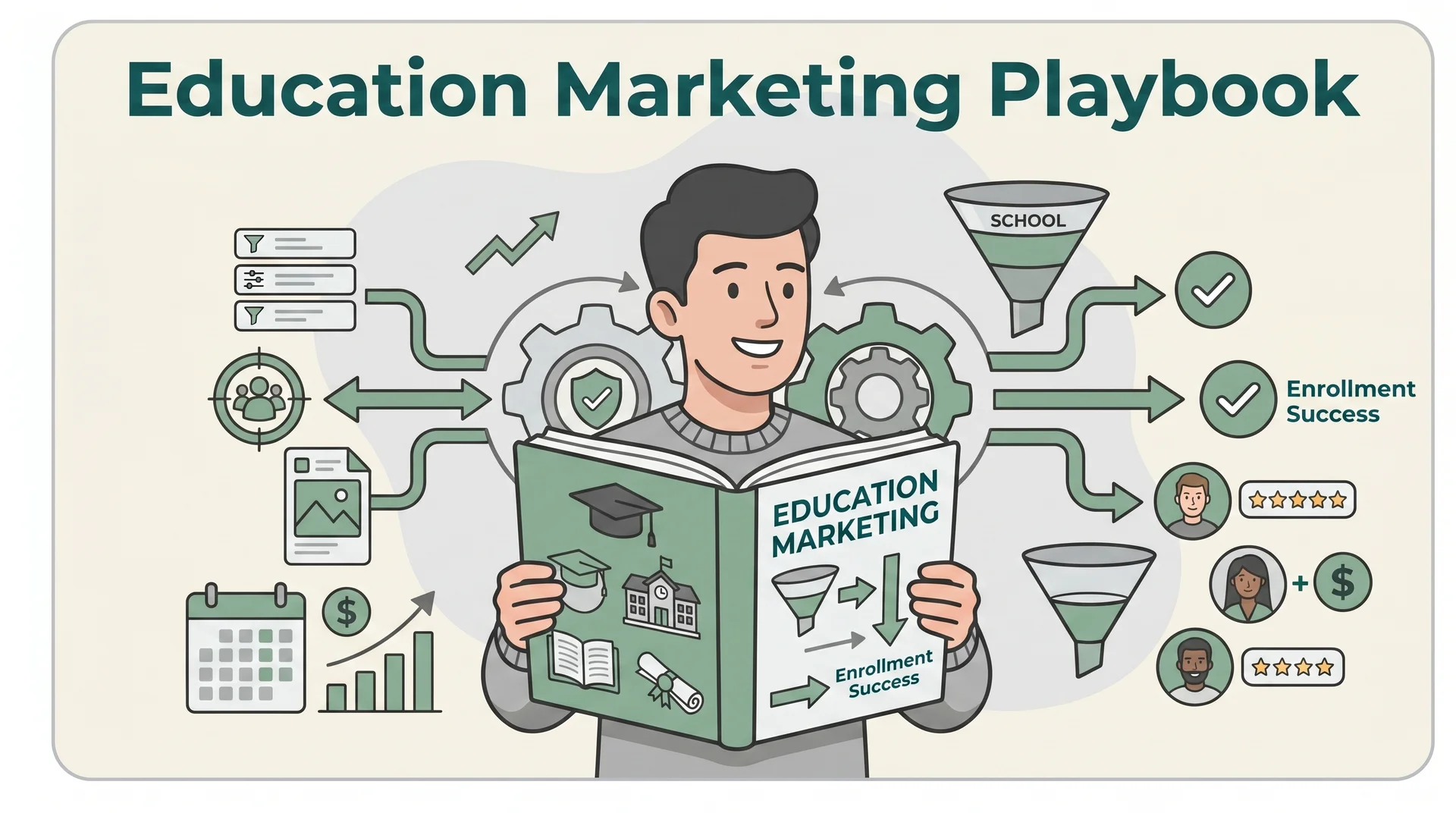
This guide is the playbook I wish existed when I started working with education clients. It covers what actually works in 2026 — parent persona targeting, year-round content, the procurement cycles for institutional buyers, and the cost-per-enrollment math that makes a marketing budget defensible. No fluff. No "build your brand on Instagram" platitudes that mean nothing in a board meeting.
In a Nutshell
-
Education marketing in India is a year-round engine, not an admissions-season sprint. Institutions that market only between January-April waste 60-70% of available demand. In Bangalore, Google Trends data for "best schools in [city]" starts rising from October, with double peaks in December and February — months before most schools open the application window.
-
The buyer is a committee, not a person. For K-12, the real decision-maker is the mother (in 78% of households, LSE/Centre for Civil Society survey, 2025). For higher education, the influence shifts to fathers and the student. For coaching institutes, peer pressure inside Class 10/11 student groups outweighs parental input. Your messaging needs four variants, not one.
-
Cost per enrollment is the only metric that matters. Cost per inquiry, click-through rate, and form-fills mislead institutions into optimising the wrong number. A ₹150 inquiry that doesn't enroll is more expensive than a ₹1,500 inquiry that does.
-
Geo-fencing around feeder schools is the highest-ROI tactic most institutions ignore. A 1.5km radius around the top 20 feeder schools in your city reaches 80% of qualified families at 30% of the cost-per-thousand of broad city targeting.
-
Open Day funnels are where most enrollment is won or lost. The gap between "registered for Open Day" and "attended Open Day" is where Indian institutions burn the most pipeline — typically 40-60% drop-off. A WhatsApp + email reminder sequence cuts this by half.
-
Parents trust other parents 3x more than institutions. Reviews, alumni testimonials, and parent video stories outperform brand-led content by 2-3x in conversion rate (Education Times Trust Index, 2025). Most institutions don't capture or surface these systematically.
-
Coaching institutes operate on a completely different funnel. They sell to students directly, peer pressure compounds, and the competitive set is regional. Generic education marketing playbooks fail for them.
Why Most Indian Education Marketing is Broken
Walk into any private school's marketing meeting in March, and the conversation is identical: "Our admissions are down. We need to spend more on Google and Facebook ads."
This is exactly the wrong response. Spending more in March doesn't fix a marketing function that's been off for nine months.
The structural problems most Indian institutions have:
Problem 1: They market when budgets allow, not when buyers search
The Indian admissions calendar is not what most institutions think it is. Parents don't decide schools in February. They start researching in October of the previous year — four to six months before the actual application window opens.
Google Trends data for "best schools in [city]" shows clear seasonality, and the curve varies by city. In Bangalore, search volume starts rising from October, with double peaks in December and February. Other metros like Delhi, Mumbai, Gurgaon, and Pune show similarly front-loaded curves, with parental research starting 4-6 months before applications open. The application surge in February-March happens because that's when schools take applications — not when parents are deciding.
If your marketing is loudest in February-March, you're competing with every other school for an audience that has already decided somewhere else.
Problem 2: They confuse awareness with intent
Most institutional ad accounts I audit are full of broad awareness campaigns — "Quality Education in [City]," "Top-Ranked CBSE School," generic billboards on highways. These campaigns generate impressions and brand recall but almost zero qualified inquiries.
What actually generates inquiries:
- Specific program-level landing pages ("PGDM Marketing in Bengaluru," "CBSE School Admissions 2026 in Sector 50 Gurgaon")
- Bottom-funnel queries ("school admission near me," "best engineering colleges Bangalore 2026")
- Open Day registration campaigns with date and venue specificity
- Comparison content ("DPS Sector 45 vs Pathways Aravali — Honest Comparison")
This is performance marketing, not awareness marketing. The two require different teams, different budgets, and different KPIs.
Problem 3: They optimize for inquiries, not enrollments
A typical school dashboard tracks: ad impressions → website visits → form fills. This is a vanity funnel.
The funnel that matters:
- Ad impression (top of funnel)
- Website visit (interest)
- Inquiry submitted (consideration)
- Phone call answered (qualification)
- Open Day registered (intent)
- Open Day attended (high intent)
- Application started (committed)
- Application completed (decision)
- Fee paid / seat confirmed (enrollment)
The drop-off between stages 3-5 (inquiry → registered) is where most marketing teams stop measuring. The drop-off between 5-6 (registered → attended) is where most enrollment is actually lost. The drop-off between 6-9 (attended → enrolled) is where institutional sales teams either close or fumble the deal.
If you're not measuring all nine stages, you don't know what's broken.
Problem 4: They run identical campaigns across very different institution types
A K-12 school targeting Class 1 admissions has nothing in common with a B-school targeting MBA applicants, which has nothing in common with a coaching institute targeting JEE aspirants. They have:
- Different decision-makers (parents vs students vs both)
- Different sales cycles (3 months vs 6 months vs 12-18 months)
- Different decision criteria (proximity, philosophy vs ranking, ROI vs success rate, faculty)
- Different channels (parent communities, search, peer recommendations, YouTube)
Yet most agencies run essentially the same Meta/Google playbook across all three.
The 2026 Indian Education Marketing Playbook
Here's how a year-round admissions engine actually works.
Step 1: Map your real buyer journey
Before any spend, get clarity on:
| Institution type | Primary decision-maker | Key influencers | Deciding criteria | Search peak | Application window |
|---|---|---|---|---|---|
| K-12 (private) | Mother (78%) | Father, child, neighbours, alumni parents | Proximity, philosophy, peer group, fees | Oct-Feb (Bangalore peaks Dec & Feb) | Feb-Apr |
| K-12 (international/IB) | Both parents | Education consultants, alumni networks | Curriculum, university outcomes, infrastructure | Aug-Oct | Sep-Feb |
| UG colleges | Student + father | Mother, school teachers, ranking lists | Ranking, placements, fees, location | Mar-Jun | May-Jul |
| MBA / B-schools | Student | Alumni network, ranking sites, peer pressure | ROI, placements, faculty, brand | Year-round (peaks May-Jun, Oct-Nov) | CAT-Feb (varies) |
| Coaching (JEE/NEET) | Student + parents | Peer group, school teachers, results history | Selection rate, faculty stars, results history | Mar-May, Oct | Year-round |
| Online certifications | Student/professional | Peer group, LinkedIn, alumni outcomes | Certificate value, course rigor, instructor brand | Year-round | Year-round |
This isn't a static document. Re-validate each year using actual inquiry data — who filled the form, who decided, who paid.
Step 2: Build a year-round content engine
Monthly publishing cadence for a serious institution:
- 2 program-level landing pages per quarter (long-form, specific, conversion-optimised)
- 1 alumni success story per month (video preferred, includes parent quote)
- 2 educational/parent-helpful blog posts per month (e.g. "How to Choose Between CBSE and ICSE in 2026")
- 1 admissions FAQ post per quarter (FAQ schema, AEO-optimised)
- 1 comparison post per quarter (your school vs nearest competitor — yes, name them)
Why comparison content is the highest-ROI educational SEO play: parents Google "School A vs School B" before deciding. If your competitors don't have these pages and you do, you control the narrative. If both of you don't have them, third-party review aggregators do — and those rank for your brand name.
Step 3: Run geo-fenced acquisition campaigns
For K-12 and UG admissions specifically:
- Identify your top 15-20 feeder schools (the schools your students come from in the previous level — for a Class 11 program, the schools sending Class 10 students).
- Pull a 1.5-2km radius around each feeder school in Meta and Google Ads geo-targeting.
- Layer demographic targeting (parent age range, household income proxies via interests).
- Run different creatives per micro-zone — a Sector 50 Gurgaon parent doesn't respond to the same creative as a DLF Phase 5 parent.
This single tactic typically reduces cost-per-qualified-inquiry by 40-60% versus broad city targeting.
Step 4: Build an Open Day machine
Open Days (and their B-school equivalent, Info Sessions) are where commitment is forged. The Open Day funnel:
- Awareness ads drive registration (CPL target: ₹150-500 for mid-range K-12, ₹400-1,200 for premium K-12, ₹500-1,500 for UG/MBA)
- Confirmation email + WhatsApp within 60 seconds of registration
- 3-day-out reminder (email + WhatsApp), with parking, agenda, and what-to-bring
- Day-before reminder (WhatsApp only — higher open rate)
- Same-day morning reminder (WhatsApp)
- Post-event thank-you with application link (within 24 hours)
- 48-hour follow-up call from admissions counsellor
- 7-day-out application reminder if no application started
Institutions that run this full sequence see Open-Day-to-application conversion of 35-50%. Institutions running only steps 1-2 see 8-15%.
Step 5: Measure cost per enrolled student, not cost per inquiry
This is the single biggest mindset shift required. Set up tracking so that every paid campaign can attribute back to enrollment.
Required infrastructure:
- CRM (LeadSquared and Zoho dominate Indian education — both have admissions-specific workflows; a properly-structured Google Sheet is fine for early-stage institutions still using paper forms) capturing source, campaign, and ad of every inquiry
- Phone tracking numbers per channel (CallHippo, Exotel) so phone-call inquiries attribute correctly
- Offline conversion uploads to Google Ads and Meta Ads — when a student enrolls, their original ad source gets credit and the algorithms optimise toward enrollment-likely audiences
- Source-tagged Open Day registration so attendance and post-event conversion can be traced to channel
Most Indian institutions don't have this stack. The ones that do consistently show 30-50% lower cost-per-enrolled-student within six months of implementation.
Step 6: Capture and surface social proof
Trust is the deciding factor in education. Most institutions hide their best assets:
- Alumni achievements: most schools have "Alumni Hall of Fame" pages buried under About sections. Make them sortable, searchable, and date-stamped. Each profile is an SEO asset.
- Parent video testimonials: 60-90 second videos shot on phones are higher-converting than studio-produced content. Aim for 1 per month.
- Faculty profiles: every teacher with a degree, publication, or training credential gets a Person-schema'd profile page. Builds topical authority and AEO citations.
- Year-on-year academic results: published prominently, with year-over-year comparison.
- Placement reports (for higher ed): downloadable PDFs with specific company names, packages (ranges, not individual figures), and roles.
Step 7: Specialise channel mix by institution type
| Institution type | Primary channels | Secondary | Don't bother |
|---|---|---|---|
| K-12 (private/CBSE/ICSE) | Meta Ads (parent targeting), Google Search Ads, WhatsApp Business, hyperlocal SEO | Print (community magazines), parent influencers | LinkedIn, Twitter |
| K-12 (international) | Google Search, Meta, education consultant referrals | LinkedIn (for expat parents), YouTube (campus tours) | Print, TikTok |
| UG colleges | Google Search Ads, Meta Ads, YouTube, college-counsellor partnerships | LinkedIn, content marketing, ranking-list SEO | Print, TV |
| MBA/B-schools | Google Search Ads, LinkedIn Ads, Quora marketing, alumni LinkedIn outreach | Meta retargeting, podcast sponsorships, YouTube | Print, hyperlocal |
| Coaching (JEE/NEET) | YouTube (student channels), Instagram Reels (results posts), Meta, school tie-ups | Google Search, WhatsApp groups, Telegram channels | |
| Online certifications | LinkedIn Ads, Google Search, YouTube, instructor-LinkedIn-posts | Meta retargeting, Twitter, Reddit | Print, TV |
The biggest mistake institutions make is running the same channel mix across all of these.
Channel-Specific Playbooks
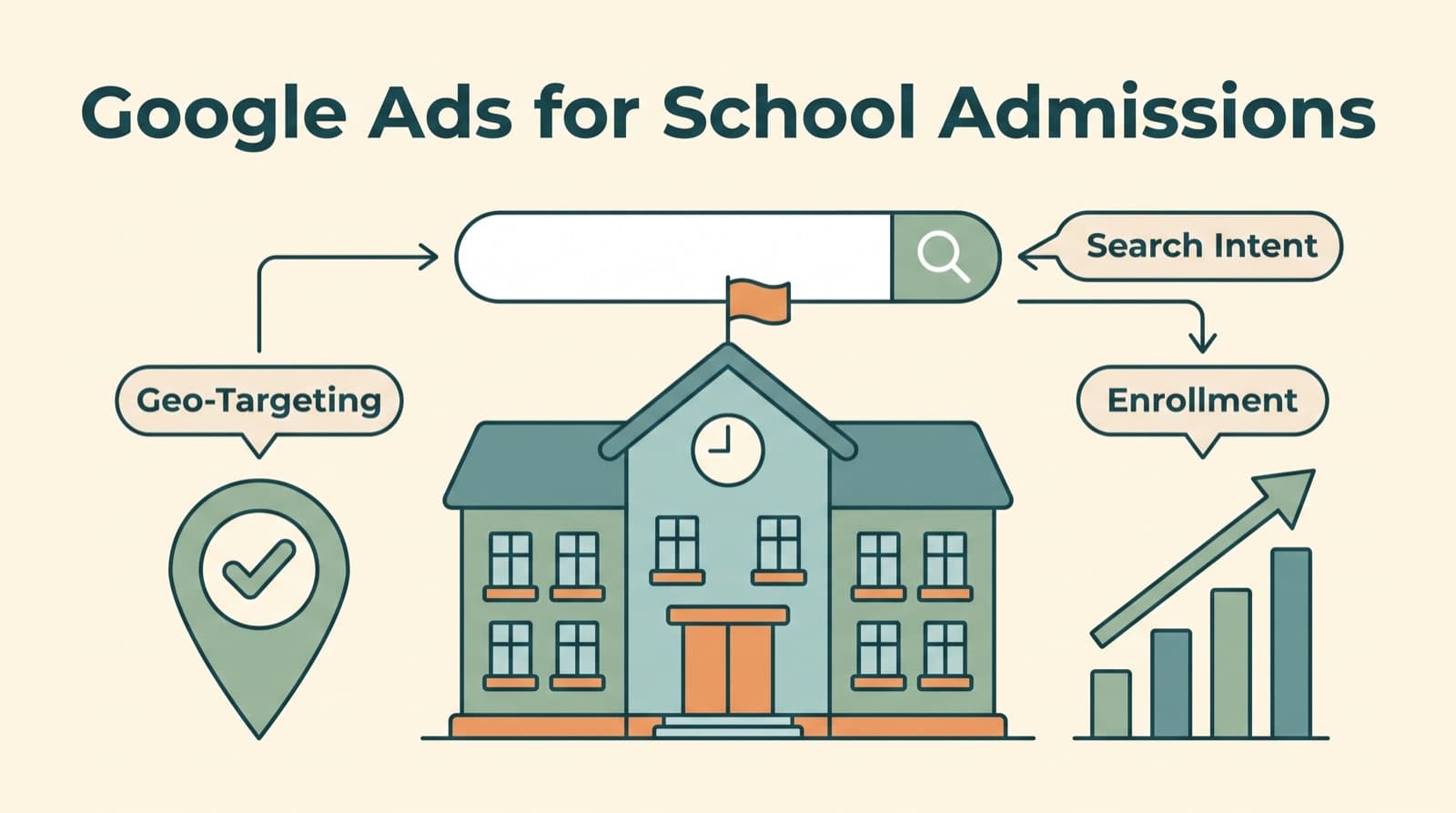
Google Ads for Indian Education
The single highest-intent search behaviour in education is "[program name] in [city] 2026". These queries should be 60-70% of your search budget.
Account structure that works:
- Brand campaigns: Defending your name. 5-10% of budget. Always-on.
- Program × City campaigns: One ad group per program-city combination ("MBA in Pune," "International School in Whitefield"). 50-60% of budget.
- Competitor campaigns: Bidding on competitor names where allowed. Aggressive ad copy showing differentiation. 5-10% of budget.
- Generic high-intent campaigns: "Best schools near me," "Top engineering colleges in India 2026." 10-15% of budget.
- Display retargeting: Past visitors, past inquirers who didn't enroll. 5-10% of budget.
Performance Max should be used cautiously — it can over-spend on brand searches you'd already win organically. Use it only after the structure above is mature.
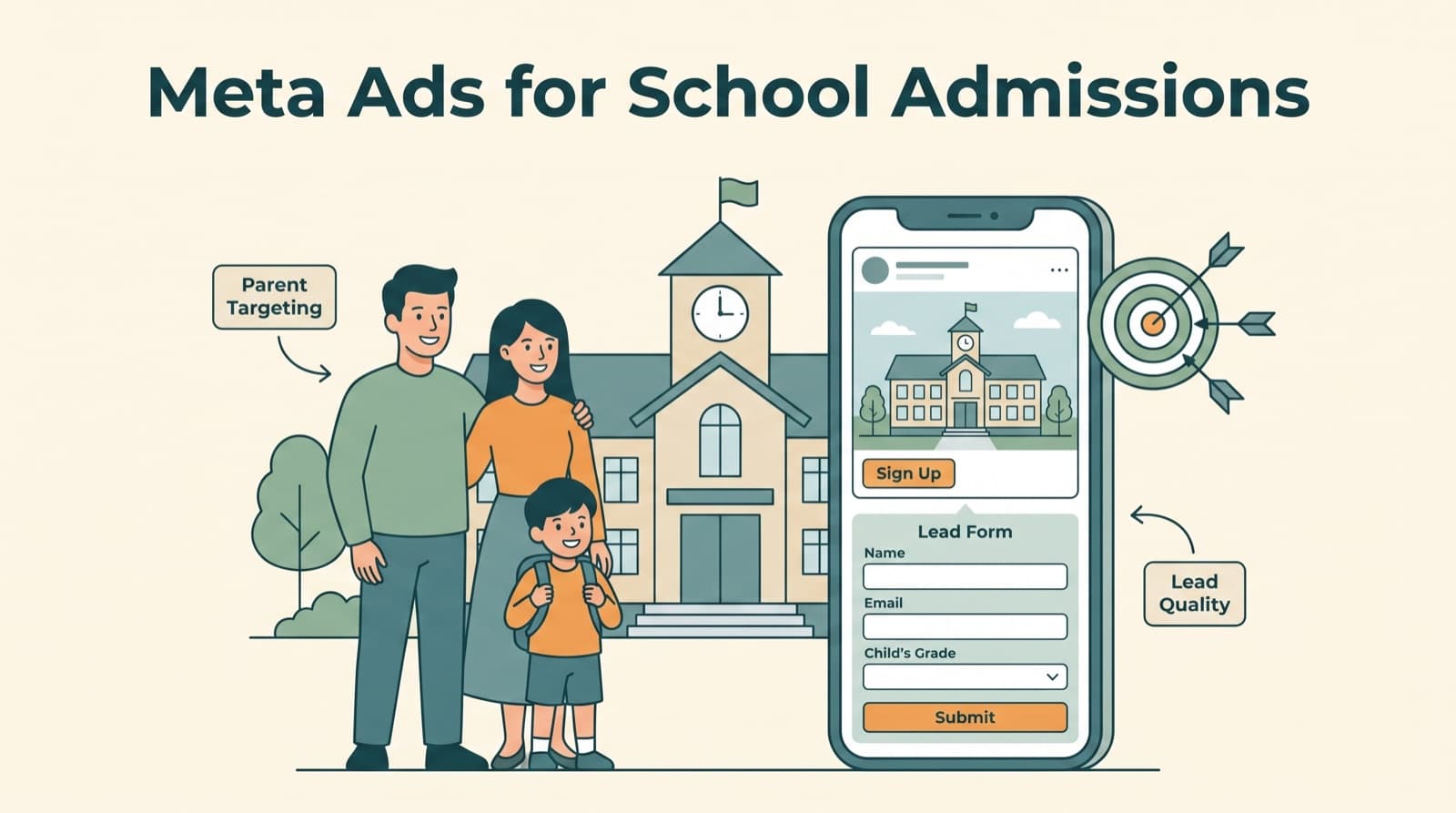
Meta Ads for Indian Education
Meta excels at parent persona targeting that Google can't match. Five proven campaign types:
- Open Day registration campaigns (geo-fenced, parent-targeted, lead form ads)
- Program announcement campaigns (video creative, link clicks to program page)
- Alumni story campaigns (video, with student name + university outcome, retargeted at look-alikes)
- Comparison campaigns ("Why parents are choosing [your school] over [competitor]" — works only if defensible)
- Application-window urgency campaigns (last 30 days before deadline, retargeting only)
Avoid generic awareness video ads with feel-good music and shots of students laughing. They're indistinguishable from every other school's ads.
Hyperlocal SEO
For K-12 and coaching institutes, the queries that matter are:
- "best CBSE school in [neighbourhood]"
- "JEE coaching near me"
- "international school in [pin code area]"
To rank:
- Google Business Profile — claimed, verified, complete with hours, phone, photos, posts every 2 weeks
- Local landing pages — one per neighbourhood you serve (e.g.,
/schools/sector-50-gurgaon) - Local schema —
EducationalOrganizationschema with address, geo-coordinates, contact, openingHours - Reviews on Google + JustDial + Sulekha — actively requested from current parents
- Local backlinks — get listed on neighbourhood community sites, RWA sites, local school directories
Email + WhatsApp Nurture
Education sector email open rates in India are 32-38% — higher than any other vertical. Don't waste this asset.
Sequence structure for K-12:
- Day 0: Welcome + virtual tour link
- Day 2: Curriculum philosophy (one-page PDF)
- Day 5: Day-in-the-life video (60-90 seconds)
- Day 8: Alumni story (text + photo)
- Day 12: Open Day invitation
- Day 15: FAQ document (PDF)
- Day 20: Application reminder
- Day 28: Personal call from counsellor
- Day 35: Final reminder before window closes
WhatsApp parallel sequence sends 2-3 high-priority messages only — Open Day reminder, application deadline, counsellor introduction.
Cost Benchmarks for Indian Education Marketing in 2026
These are ranges from agency engagements and published industry data. Your numbers will vary by city, brand, and category.
| Institution type | Cost per inquiry | Cost per Open Day attendee | Cost per enrolled student | Marketing as % of fees |
|---|---|---|---|---|
| K-12 (Tier 1 cities, premium) | ₹400-1,200 | ₹800-2,500 | ₹15,000-50,000 | 3-7% |
| K-12 (Tier 2 cities, mid-range) | ₹150-500 | ₹400-1,200 | ₹6,000-20,000 | 4-8% |
| K-12 (international / IB) | ₹1,000-2,000 | ₹2,500-5,000 | ₹30,000-80,000 | 2-5% |
| Higher ed (private UG) | ₹600-1,500 | ₹1,200-3,000 | ₹25,000-90,000 | 5-12% |
| MBA (top-200 B-schools) | ₹750-1,500 | ₹2,000-4,000 | ₹50,000-2,50,000 | 6-15% |
| Coaching (JEE/NEET, premium) | ₹500-1,500 | n/a | ₹8,000-25,000 | 4-10% |
| Online certifications (₹50K+) | ₹400-1,500 | n/a | ₹3,000-12,000 | 8-25% |
If your numbers are 1.5-2x worse than these ranges, the issue is rarely budget. It's almost always funnel architecture, attribution, or channel mismatch.
What's Changing in 2026
Three structural shifts every Indian education marketer needs to know:
1. AI Overviews are now answering "best schools in [city]" queries
Google's AI Overviews now appear on roughly 25% of education-related searches in India (Conductor 2026 AEO/GEO Benchmarks Report). This means:
- Your school can be cited as a recommendation by Google's AI without ever being clicked
- Competitor schools that haven't structured their data well are getting invisible in AI answers
- Reviews, structured data (
EducationalOrganizationschema), and consistent NAP (Name-Address-Phone) information across the web are now ranking factors for AI citations
2. Parent search is increasingly AI-mediated
Parents are now using ChatGPT, Perplexity, and Gemini to research schools — especially urban, English-educated parents in Tier 1 cities. They're asking:
- "Compare DPS RK Puram and Modern School Vasant Vihar for Class 1 admission"
- "Best IB schools in Bengaluru with strong music program"
- "What's the actual placement rate at NMIMS Mumbai vs Symbiosis Pune"
Whichever school's reviews, alumni content, and curriculum documentation is most accessible to LLMs wins these conversations. This is where Answer Engine Optimization for education becomes critical. We've covered the underlying framework in our AI SEO strategy guide — the same principles apply directly to institutions competing for AI-generated school recommendations.
3. Short-form video is now table stakes for student-facing institutions
For coaching institutes, online certifications, and increasingly UG/MBA programs, Instagram Reels and YouTube Shorts are no longer optional. They're how the buyer (the student) actually discovers and evaluates options. Institutions that aren't producing 8-12 short-form videos per month for student audiences are invisible to a meaningful segment of demand. (For the algorithm specifics, see our Instagram growth strategy guide — written for authors but the platform mechanics are identical.)
Getting Started: A 90-Day Plan
If you're inheriting a broken education marketing function, here's how to fix it in three months:
Days 1-30: Foundation
- Audit current spend by channel and attribute to enrollments (not inquiries)
- Build the buyer-journey map for your specific institution type
- Set up CRM, phone tracking, offline conversion upload
- Refresh Google Business Profile and
EducationalOrganizationschema - Identify top 15-20 feeder zones / source schools / target pin codes
Days 31-60: Acquisition engine
- Restructure Google Ads into program × city campaigns
- Launch geo-fenced Meta Ads campaigns around feeder zones
- Build 4-6 program-specific landing pages
- Implement Open Day funnel (registration → 5-touch reminder → post-event)
- Start the year-round content calendar (alumni stories, comparison posts, FAQ)
Days 61-90: Optimisation + measurement
- Weekly reporting on the 9-stage funnel
- Cost-per-enrolled-student tracking by source
- A/B test creative variants in Meta, ad copy in Google
- Identify top 3 highest-converting source-creative-message combos and double down
- Review attribution weekly, kill bottom-quartile spend
By Day 90, you should have a clear picture of which channels deliver enrollment ROI and which don't — and you should never again have to guess in a March board meeting.
Final Thought
Indian education has structural tailwinds — 250 million students under 24, growing private spend on quality education, and a generation of parents willing to invest more per child than any previous one.
The institutions that win this decade aren't the ones with the highest marketing budgets. They're the ones running the most disciplined year-round acquisition engines. The ones that measure cost-per-enrolled-student instead of cost-per-click. The ones that treat parents as a four-stage decision committee, not a single click on a banner ad.
If you're running marketing for a school, college, university, or coaching institute and any of this resonates: we work with education clients across India to build exactly this kind of admissions engine. Book a 30-minute audit call and we'll show you what's leaking in your funnel — no pitch, just a working diagnosis you can implement with or without us.
Or if you want to dig deeper, see our EdTech Marketing playbook for the digital-first education side, and the Education Marketing service page for the institutional admissions side.
Aurelius Media is a performance marketing agency working with education and EdTech brands across India. We've built admissions engines for K-12 schools, B-schools, online certification platforms, and coaching institutes. Founder Ayush Pant has 20+ years in digital marketing across 25+ countries.