
You already know you should be showing up in AI search. The harder question is the one almost nobody can answer: are you?
Right now, somewhere, a buyer is asking ChatGPT "what's the best [your category]?" and getting a confident answer with a shortlist of brands. Maybe you're on it. Maybe a competitor is. Maybe the AI is recommending someone who barely exists. You have no idea which — because there's no click, no referrer, no line in Google Analytics. The most important moment in the modern buyer's journey happens entirely in the dark.
This is the measurement gap of 2026. Teams have rushed to optimize for AI search, but most are flying blind on whether any of it is working. And you can't improve what you can't measure. So before another quarter of guessing, here's how to actually measure AI search visibility — the metrics that matter, what you can track yourself for free, and where tools earn their keep.
In a Nutshell
- Traditional SEO metrics don't capture AI search. Rankings and clicks measure a blue-link world; AI answers are zero-click, and GA4 literally cannot see what happens inside a ChatGPT conversation.
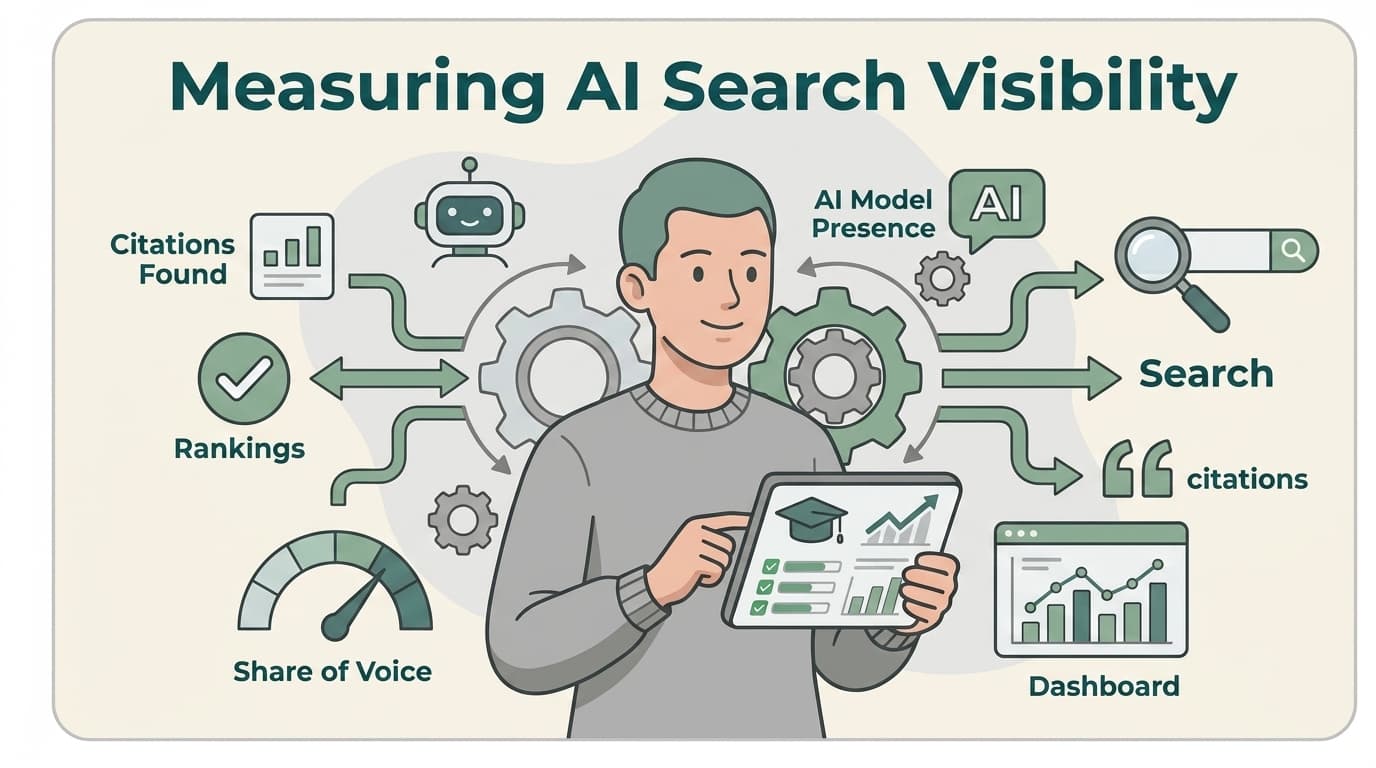
- Measure six things: citation rate, mention rate, share of voice, prompt coverage, sentiment, and the recommendation position within answers.
- It all starts with a prompt set — a fixed list of buyer-intent questions you test repeatedly. Without one, you're not measuring; you're anecdote-collecting.
- You can measure a surprising amount for free: manual prompt testing, AI referral traffic via a GA4 custom channel, branded-search lift in Search Console, server-log bot crawls, and self-reported attribution.
- Tools automate scale. Platforms like Profound, Peec AI, and Otterly track mentions across engines daily — worth it once manual testing can't keep up.
- Report 5 core metrics monthly and treat the trend, not any single snapshot, as the truth. AI answers are non-deterministic, so direction beats precision.
Table of Contents
- Why Traditional SEO Metrics Miss AI Search
- Mentions vs Citations vs Recommendations
- The Six Metrics That Actually Matter
- Start With a Prompt Set (Everything Depends on This)
- What You Can Measure Yourself, For Free
- What Tools Automate (and When You Need Them)
- The 5 Metrics to Report Every Month
- From Measurement to Action
- The Bottom Line
- Frequently Asked Questions
Why Traditional SEO Metrics Miss AI Search
For twenty years, SEO measurement rested on two numbers: where you rank, and how many clicks you get. Both are increasingly blind to where discovery actually happens.
When someone asks ChatGPT for a recommendation, there is no ranking — there's a synthesized answer that may name you, cite you, or ignore you. There's usually no click either; the user gets what they need inside the conversation. And critically, GA4 cannot see any of it. Analytics only registers a visit if someone leaves the AI and lands on your site, and even then the referrer is frequently stripped, dumping the visit into "direct" — the same blind spot we covered in our piece on the dark funnel.
So a brand can be the single most-recommended option in its category across ChatGPT and Perplexity and see almost nothing in its standard dashboards. Rankings and clicks aren't wrong — they're just measuring a world that's shrinking. Measuring AI visibility means tracking a different thing entirely: whether the machines that now mediate buying decisions know, trust, and recommend you.
Mentions vs Citations vs Recommendations
Before metrics, get the vocabulary straight — because these three are not the same thing, and conflating them is the most common measurement mistake.
- Mention: the AI names your brand in its answer ("options include X, Y, and Z"). Awareness-level presence.
- Citation: the AI links to your content as a source. This is the citation that can also drive referral traffic, and it signals the model trusts your page enough to attribute to it.
- Recommendation: the AI actively endorses you ("for most teams, X is the best choice"). The highest-value outcome — you're not just present, you're the answer.
A serious measurement program tracks all three separately. Being mentioned among ten options is very different from being the recommendation, and your reporting should never blur them into a single vanity "we showed up" number.
The distinction that changes strategy
If you're frequently mentioned but rarely recommended, you have a differentiation/proof problem, not an awareness problem. If you're rarely mentioned at all, you have a presence problem. The metrics below tell you which fight you're actually in.
The Six Metrics That Actually Matter
Here's the core scorecard for AI search visibility.
| Metric | What it answers | How it's measured |
|---|---|---|
| Mention rate | How often are we named at all? | % of your prompt set where the brand appears |
| Citation rate | How often is our content the source? | % of answers that link to your pages |
| Share of voice | How do we compare to competitors? | Your mentions ÷ total brand mentions across the prompt set |
| Prompt coverage | How broad is our presence? | Which buyer questions / topics you appear for vs. don't |
| Sentiment & accuracy | How are we described? | Tone of the mention + whether the facts about you are correct |
| Recommendation position | Are we the answer or an also-ran? | Where you fall in the answer (top pick vs. buried in a list) |
Two of these get overlooked and shouldn't. Sentiment and accuracy matter because an AI confidently describing you wrongly is worse than silence — and it's fixable once you spot it. And prompt coverage matters because it turns measurement into a map: it shows you exactly which buyer questions you own and which you're invisible for, which is where your next content goes.
Start With a Prompt Set (Everything Depends on This)
You cannot measure AI visibility by occasionally typing your brand into ChatGPT. That's an anecdote. Measurement requires a prompt set — a fixed, repeatable list of the questions your buyers actually ask — that you run on a schedule and track over time.
Build it from real buyer intent, across the funnel:
- Category questions: "best [category] tools," "top [category] agencies in India"
- Problem questions: "how do I fix [the problem you solve]"
- Comparison questions: "X vs Y," "alternatives to [competitor]"
- Use-case questions: "[category] for [specific audience or scenario]"
Aim for a few dozen prompts that genuinely reflect how people describe their needs — not internal jargon. This set becomes the denominator for every metric above (mention rate, share of voice, prompt coverage all measure against it), so it has to be stable. Add to it deliberately, and resist the urge to cherry-pick prompts you already win. The prompts you lose are the entire point.
One more wrinkle: AI answers are non-deterministic — ask the same question twice and you may get different brands. So sample each prompt multiple times and across the major engines (ChatGPT, Perplexity, Google AI Overviews, Gemini), and read the rate, not a single result.
What You Can Measure Yourself, For Free
You don't need to buy a platform to start. A surprising amount is measurable with tools you already have:
1. Manual prompt testing. Run your prompt set by hand across ChatGPT, Perplexity, and Google AI Overviews. Log, for each: were you mentioned? Cited? Recommended? Were the facts right? A simple spreadsheet, refreshed monthly, gives you real trend data. Tedious, but free and honest.
2. AI referral traffic in GA4. When AI does send a click, capture it. Create a custom channel group / segment that isolates referrals from chatgpt.com, perplexity.ai, gemini.google.com, and similar. Without this, those visits get buried in generic referral or direct traffic. It under-counts (most AI influence is click-less) but the trend is a useful proxy — and pairs well with disciplined analytics and reporting.
3. Branded search lift in Search Console. AI discovery often shows up later as a branded search — someone hears about you from an AI, then Googles your name. Rising branded-search impressions in GSC is a lagging signal that your AI presence is growing.
4. Server-log bot crawls. The AI crawlers (GPTBot, PerplexityBot, Google-Extended) hit your site to ingest content. Tracking their crawl frequency in your server logs tells you which pages the models are actually reading — a leading indicator of future citations.
5. Self-reported attribution. Add "How did you hear about us?" to your forms. When buyers start writing "ChatGPT" or "AI," you have direct, click-less evidence of impact no pixel could capture.
Together, these five give you a credible baseline before you spend a rupee on tooling.
What Tools Automate (and When You Need Them)
Manual measurement breaks down once your prompt set grows, you want daily data, or you need to track competitors at scale. That's when dedicated AI-visibility platforms earn their cost. The category includes tools like Profound, Peec AI, Otterly AI, Promptwatch, and broader SEO suites adding AI tracking such as SE Ranking and Semrush.
What they do that you can't easily do by hand:
- Run large prompt sets across multiple engines daily, automatically.
- Compute mention rate, citation rate, share of voice, and sentiment over time.
- Track competitors alongside you, so share of voice is real, not estimated.
- Alert you to new mentions, lost citations, or accuracy problems.
A useful distinction when choosing: the market splits into monitoring-only tools (they report trends and share of voice) and optimization-enabled platforms (they also prescribe what to fix). Buy monitoring when you just need visibility into the trend; buy optimization when you need the tool to tell your team where to act. Either way, the tool is only as good as the prompt set you feed it — the methodology above still comes first.
Don't tool before you measure
Run a manual prompt set for a month first. You'll learn what "good" looks like for your category, build a sane prompt list, and walk into any tool demo knowing exactly what you need — instead of paying for dashboards you won't read.
The 5 Metrics to Report Every Month
For a clean monthly report that a founder or client will actually read, track these five — each as a trend line, not a one-off number:
- Share of voice — your mentions vs. competitors across the prompt set. The single best headline metric.
- Mention rate — % of prompts where you appear at all (presence).
- Citation rate — % of answers sourcing your content (trust + referral potential).
- Prompt coverage — how many buyer topics you appear for (breadth, and your content roadmap).
- AI referral traffic + branded search — the downstream, click-based proxies from GA4 and GSC.
Add a short qualitative note on sentiment/accuracy — any case where an AI described you wrongly is a priority fix. And always report the direction over 2–3 months, because a single month's non-deterministic snapshot will lie to you.
From Measurement to Action
Measurement only matters if it changes what you do. The point of the prompt-coverage map is to expose the buyer questions you're invisible for — and those become your content priorities. Low mention rate says publish more (and better) decision-stage content. Strong mentions but weak recommendations says strengthen your proof and differentiation. Wrong facts says fix the sources the models are reading.
That's where this connects to the other half of the work: once you can see your AI visibility, our AI SEO strategy guide covers how to actually improve it — the content and off-site signals that get you cited and recommended, and the related discipline of answer engine optimization. Measurement is the steering; strategy is the engine. You need both, and most teams have neither pointed in the right direction.
The Bottom Line
AI search broke the old scoreboard. Rankings and clicks still matter, but they no longer tell you whether the systems mediating modern buying decisions know and recommend you — and that's an increasingly large share of the game.
The fix isn't complicated, just deliberate: build a prompt set from real buyer questions, track six metrics against it (mention rate, citation rate, share of voice, prompt coverage, sentiment, and recommendation position), start with the free methods you already have, and add tooling when scale demands it. Then watch the trend, not the snapshot.
Do that, and "are we visible in AI search?" stops being a shrug and becomes a number you can move. In a channel this important and this invisible, the brands that measure it will quietly outcompete the ones still guessing.
Aurelius Media helps brands measure and grow their visibility across AI search and traditional channels — turning the invisible parts of the funnel into something you can actually report on and improve. If you want to know exactly where you stand in ChatGPT and Perplexity today, book a strategy call.
Frequently Asked Questions
How do I measure AI search visibility?
Build a prompt set — a fixed list of buyer-intent questions — and run it regularly across ChatGPT, Perplexity, Google AI Overviews, and Gemini, recording whether your brand is mentioned, cited, or recommended. Track six metrics against that set: mention rate, citation rate, share of voice, prompt coverage, sentiment/accuracy, and recommendation position. Start manually in a spreadsheet, then automate with a tool once scale demands it.
Can Google Analytics track AI search visibility?
Only partially. GA4 can't see what happens inside an AI conversation — most AI influence is click-less, and when clicks do occur the referrer is often stripped into "direct" traffic. You can capture some AI referral traffic by creating a custom channel that isolates referrers like chatgpt.com and perplexity.ai, but treat it as an under-counting proxy, not a complete measure.
What's the difference between a mention and a citation in AI search?
A mention is when the AI names your brand in its answer. A citation is when the AI links to your content as a source (which can also drive referral traffic and signals the model trusts your page). A recommendation is when the AI actively endorses you as the best option. Track all three separately — being mentioned among ten options is very different from being the recommendation.
What is a prompt set and why does it matter?
A prompt set is a fixed, repeatable list of the questions your buyers actually ask — category, problem, comparison, and use-case queries. It's the foundation of AI visibility measurement because it's the denominator for your metrics: mention rate, share of voice, and prompt coverage are all measured against it. Without a stable prompt set, you're collecting anecdotes, not data.
Do I need a paid tool to measure AI visibility?
Not to start. Manual prompt testing, a GA4 custom channel for AI referrals, branded-search tracking in Search Console, server-log bot-crawl monitoring, and self-reported attribution will give you a credible baseline for free. Paid tools like Profound, Peec AI, or Otterly become worth it when your prompt set grows, you want daily data, or you need to track competitors at scale.
Why do AI visibility results change every time I check?
AI answers are non-deterministic — the same prompt can return different brands on different runs. That's why you should sample each prompt multiple times and across several engines, and report the rate and the trend over 2–3 months rather than any single snapshot. A one-off result will mislead you in both directions.