
Someone in your market just opened ChatGPT and typed, "what's the best [your category] for a company like mine?"
In about four seconds, they got a confident answer naming three or four brands, with a sentence on why each is a good fit. They didn't scroll a search page. They didn't click ten blue links. They got a shortlist — a recommendation — and that shortlist will shape who they trial, who they email, and who they buy from.
If your brand was on it, you just won high-intent demand for free. If it wasn't, you were invisible at the exact moment of decision — and you'll never see it happen in any analytics dashboard.
This is the new shelf space, and it doesn't work like SEO. You can't bid your way onto the list, and ranking #1 on Google doesn't guarantee a thing — analyses suggest around 90% of ChatGPT citations come from outside Google's top 20 results. Getting recommended by ChatGPT is its own discipline. Here's how it actually works, and how to become the brand it names.
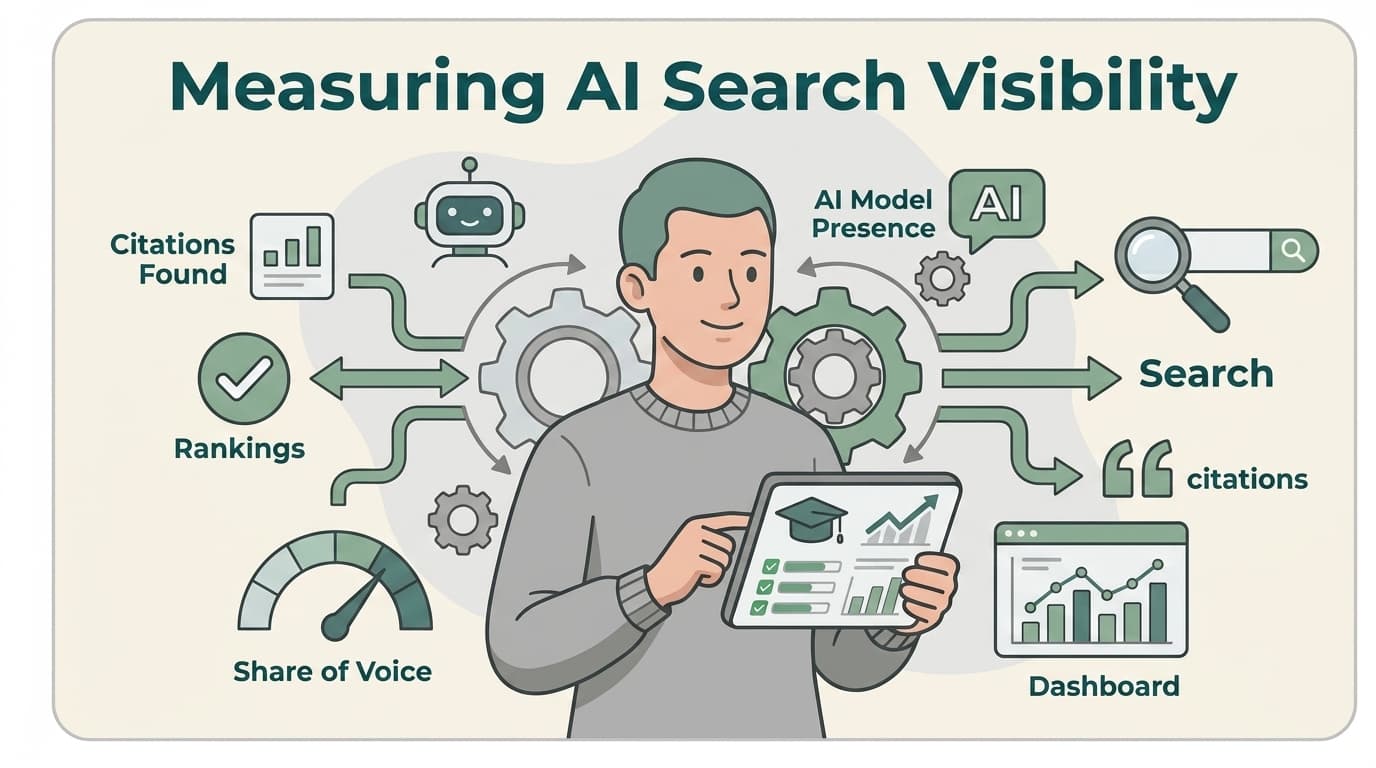
This is the recommendation-specific playbook. For the broader framework behind AI visibility, see our AI SEO strategy guide; to track whether any of this is working, see how to measure AI search visibility.
In a Nutshell
- ChatGPT recommends brands by consensus. It surfaces the names that appear consistently across many trusted third-party sources — not the brand that shouts loudest on its own website.
- The 9% problem: analyses find roughly 91% of AI answers cite third-party sources, so your own site accounts for only ~9% of how AI talks about you. Off-site presence is the game.
- It's worth more than it looks. AI-referred traffic has been measured converting around 14.2% versus 2.8% for Google organic — roughly 5× the value of a normal click.
- Comparison content wins. "X vs Y" and "best [category]" articles are the single most-cited format (~32.5% of AI citations), because that's literally what recommendation queries ask for.
- Be an unambiguous entity. Consistent brand information, schema, and earned encyclopedic/review presence help AI know who you are and what you're for.
- Lead with the answer. Around 44% of LLM citations come from the first 30% of a page — your opening lines are prime citation real estate.
- It's measurable and auditable. You can see who ChatGPT recommends today, reverse-engineer why, and close the gap.
Table of Contents
- How ChatGPT Actually Decides What to Recommend
- Mention → Citation → Recommendation: The Ladder
- The 9% Problem: Why Off-Site Is Everything
- Win the Comparison Query
- Become an Unambiguous Entity
- Make Your Own Content Citable
- The Playbook: Step by Step
- How Each AI Platform Differs
- How to Measure It
- Common Mistakes
- The Bottom Line
- TL;DR Cheat Sheet
- Frequently Asked Questions
How ChatGPT Actually Decides What to Recommend
ChatGPT's recommendations come from two layers, and you need to influence both.
Layer 1: Training data. The model was trained on a vast snapshot of the web, which baked in associations between brands and categories. This layer favors high-authority, encyclopedic sources — which is why Wikipedia is one of ChatGPT's most-cited influences. If the open web consistently described you as a leader in your category before the training cutoff, that association is already inside the model.
Layer 2: Live retrieval (browsing). When ChatGPT browses the web to answer a current question, it pulls and synthesizes live sources — and here the signals are different. Content structure, comprehensiveness, and semantic relevance matter more than traditional authority. This is the layer you can influence now, and it's why brands can move into recommendations far faster than old-school SEO timelines suggested.
Underneath both layers sits the thing that actually drives recommendations: consensus. ChatGPT doesn't recommend the brand with the best landing page. It recommends the brand that the web agrees is a good answer — the one mentioned, reviewed, compared, and discussed consistently across many independent sources. When ten trusted sites all name you for a use case, the model treats that as fact and repeats it. When only your own site says it, the model discounts it.
That single insight reframes everything: getting recommended by ChatGPT is less about optimizing your website and more about engineering what the rest of the web says about you.
Mention → Citation → Recommendation: The Ladder
"Showing up in ChatGPT" isn't one thing — it's a ladder with three rungs, and you want the top one.
- Mention — ChatGPT names your brand among options. Presence, but not preference.
- Citation — ChatGPT links to your content as a source. It trusts your page enough to attribute to it.
- Recommendation — ChatGPT actively endorses you as a (or the) best choice. This is the rung that drives revenue.
Most "AI visibility" advice gets you onto the first rung. Getting to the third — being the recommended option — requires the consensus and comparison signals this guide is about. Track the three separately; being one of ten options is a completely different outcome from being the answer. (We break down how to measure each in our guide to measuring AI search visibility.)
The 9% Problem: Why Off-Site Is Everything
Here's the statistic that should reorganize your entire approach: analyses of AI answers find that roughly 91% of the sources cited are third-party — meaning your own website accounts for only about 9% of what AI says about your brand. The other 91% comes from Reddit, review sites, industry publications, comparison articles, and forums.
Most marketers spend 100% of their effort on the 9% they control and 0% on the 91% that actually decides recommendations. Flip that ratio.
Where the recommendations actually come from:
- Reddit and communities — one of the most-cited sources across AI platforms (analyses put it around 21% of Google AI Overview citations and far higher on Perplexity). Authentic, genuinely helpful participation in the subreddits where your category is discussed plants the mentions AI later repeats. (Gaming it backfires — more on that below.)
- Review and comparison sites — G2, Capterra, and category-specific review platforms are exactly the "consensus" signals AI trusts for "best X" answers.
- Industry publications — coverage in the trade press your category reads (a guest byline, a quote, an original-data story) is third-party validation AI weights heavily.
- Listicles and "best of" roundups — being included in the "top [category] in [year]" articles that already rank is one of the fastest routes onto a recommendation shortlist.
- Wikipedia and knowledge bases — earned, not bought (see mistakes).
The reframe
You don't get recommended by ChatGPT by writing more pages on your own site. You get recommended by becoming the brand the rest of the web independently keeps naming for your category. Your site is the 9%; your reputation across everyone else's sites is the 91%.
This is also why getting recommended is worth the effort: AI-referred visitors have been measured converting at roughly 14.2% versus 2.8% for Google organic — about 5× the value per visit — because the AI has already pre-qualified and pre-sold them. It's the highest-intent traffic on the internet, arriving warm. (Much of this journey is invisible — it's the dark funnel in action.)
Win the Comparison Query
If there's one content format that maps directly to recommendations, it's the comparison. Analyses consistently find comparison articles are the single most-cited content type in AI answers (around 32.5% of citations) — because "what's the best X" and "X vs Y" are recommendation queries, and comparison content answers them in the exact shape the model wants to reuse.
Two moves here:
1. Own the "X vs Y" and "alternatives to X" content for your category. Honest, specific, genuinely useful comparisons — including where competitors are stronger — are catnip for AI citation. The intellectual honesty signals trustworthiness (Claude reportedly gives a citation boost to content that acknowledges trade-offs), and the structure is directly liftable into an answer.
2. Get into the third-party "best [category]" roundups. The listicles that rank for "best [your category]" feed AI recommendations directly. Earning inclusion (through outreach, data, or genuine merit) puts you on the shortlist the model is reading from. Prioritize "problem" and "recommendation" query types — they have lower competition and the highest buying intent.
This is where being a great content strategy operator pays off twice: the same comparison content that ranks in Google gets lifted into ChatGPT's recommendations.
Become an Unambiguous Entity
ChatGPT can't confidently recommend a brand it can't confidently identify. "Entity recognition" — the AI knowing exactly who you are, what you do, and who you're for — is foundational.
- Organization schema — define your brand entity with name, URL, logo, social profiles, and a clear description, consistently across your site.
- Consistent information everywhere (NAP). Your name, positioning, and details should be identical across your site, Google Business Profile, LinkedIn, Crunchbase, review sites, and directories. Contradictions create doubt; consistency creates confidence.
- Earn encyclopedic and review presence. A Wikipedia entry, Crunchbase profile, and G2/Capterra listings act as anchor facts the model trusts. Earn them through real coverage — don't fake them.
- Be specific about your niche. "Marketing agency" is too generic to recommend. "AI-powered performance marketing agency for funded Indian startups" is an entity ChatGPT can confidently match to a specific query. Precision is recommendability.
The clearer and more consistent your entity is across the web, the more accurately — and confidently — AI platforms will represent and recommend you.
Make Your Own Content Citable
The 9% you control still matters — it's often the page that confirms what the other sources hint at. Make it maximally liftable:
- Lead with the direct answer. Put your clearest, most complete answer to the page's core question in the first 40–60 words. Analyses find about 44% of LLM citations come from the first 30% of a page — your intro is prime citation real estate, not a warm-up.
- Use structured formatting. Bulleted lists, numbered steps, tables, and clear headings are consistently among the most-cited formats; one analysis of 10,000 queries found pages with structured lists, quotes, and statistics had 30–40% higher visibility in AI responses.
- Be specific and verifiable, not superlative. Vague claims and superlatives ("the best," "revolutionary," "world-class") get filtered out. Specific, checkable claims ("cut reporting time by 40%," "managed ₹X in ad spend across 25+ countries") get cited.
- Keep it fresh. Updated statistics and recently-revised pages are favored — AI bots disproportionately pull from content updated within the past year.
These are the same habits that make product-led content work and that power a real programmatic SEO program: specific, structured, genuinely useful.
The Playbook: Step by Step
A concrete sequence to become the recommended brand in your category:
- Build your prompt set. List the 15–30 real questions a buyer asks ChatGPT at the decision point — "best [category] for [use case]," "[competitor] alternatives," "[category] for [your vertical]."
- Audit who's recommended now. Run those prompts through ChatGPT (and Perplexity, Google AI Mode). Record which brands get named and — crucially — which third-party sources are cited as the basis.
- Reverse-engineer the sources. The domains feeding your competitors' recommendations are your target list: the listicles, review sites, subreddits, and publications you need presence on.
- Earn third-party coverage. Pursue inclusion in the "best [category]" roundups, secure reviews on G2/Capterra, contribute genuinely on Reddit/Quora, and land industry-press mentions and guest bylines. This is the 91% work — and the slowest, highest-leverage part.
- Build comparison and recommendation content on your own site — honest "X vs Y," "alternatives," and "best [category] for [vertical]" pieces that AI can lift.
- Strengthen your entity — schema, consistent info, earned encyclopedic/review presence.
- Re-audit and measure quarterly. Track movement up the mention → citation → recommendation ladder.
Start with steps 1–3 this week. The audit alone usually reveals exactly which three or four third-party sources are deciding your category's recommendations.
How Each AI Platform Differs
"AI search" isn't monolithic — the platforms cite differently, so a recommendation strategy should account for each:
- ChatGPT leans on encyclopedic authority from training (Wikipedia prominent) plus structured, comprehensive live sources. ~90% of its citations sit outside Google's top 20.
- Perplexity is heavily community-driven — Reddit is one of its top sources — and citation-forward by design.
- Claude uses Brave Search, cross-verifies sources carefully, skews toward a professional/B2B user base, and rewards substantive, well-sourced content (including content that honestly states trade-offs). Strong G2/Wikipedia/editorial presence carries extra weight here.
- Google AI Overviews favor pages already ranking in traditional search, with Reddit and YouTube heavily cited — so classic SEO still feeds this one.
The common thread across all four: third-party consensus and structured, specific, trustworthy content. Optimize for that and you improve everywhere at once, then tune per-platform from there.
How to Measure It
You can't improve what you don't track, and AI recommendations are trackable — directionally. Build a fixed prompt set, run it regularly across the platforms, and record your mention rate, citation rate, share of voice vs competitors, and recommendation position. Set up a GA4 channel to catch AI referral clicks (from chatgpt.com, perplexity.ai, etc.), watch branded-search lift, and add "How did you hear about us?" to your forms to catch the click-less influence.
Because AI answers are non-deterministic, read the trend, not any single result. We cover the full methodology — metrics, tools, and prompt sets — in how to measure AI search visibility.
Common Mistakes
- Only optimizing your own site. The 9% trap. If you're not building third-party presence, you're ignoring 91% of how AI decides.
- Paying for a Wikipedia page. It gets reverted, and it can backfire. Earn the secondary-source coverage that makes an organic entry possible instead.
- Gaming Reddit. Astroturfing is detected and punished by communities (and increasingly by the models). Participate genuinely or not at all.
- Superlatives over specifics. "The best, most innovative platform" is exactly what gets filtered. Replace it with verifiable numbers.
- Treating it as one-and-done. Citation behavior shifts fast — ChatGPT's Reddit citation share swung from ~60% to ~10% of prompts in two weeks in late 2025. Audit quarterly, not annually.
- Measuring nothing. If you can't see who's recommended today, you're guessing.
The Bottom Line
Getting recommended by ChatGPT isn't a hack and it isn't traditional SEO. It's the work of becoming the brand the web genuinely agrees is a good answer for your category — then making that consensus easy for a model to find, trust, and repeat.
Engineer the 91%: earn third-party mentions, reviews, and comparison-content inclusion across the sources AI actually reads. Make your own 9% maximally citable: lead with the answer, be specific and structured, keep it fresh. Become an unambiguous entity. And measure your way up the mention → citation → recommendation ladder.
The brands doing this now are claiming the highest-intent shelf space on the internet before their competitors realize it exists. The recommendation is the new #1 ranking — and unlike Google, the window to win it cheaply is still open.
TL;DR Cheat Sheet
- ChatGPT recommends by consensus — the brand the web consistently names, not the loudest website.
- 91% of AI citations are third-party. Your site is ~9%. Spend accordingly.
- Comparison content ("X vs Y," "best [category]") is the most-cited format — own it and get into others' roundups.
- Be an unambiguous entity: schema, consistent info, earned Wikipedia/G2/Crunchbase, a specific niche.
- Make your pages citable: answer in the first 40–60 words, use lists/tables/stats, be specific not superlative, keep fresh.
- Run the playbook: prompt set → audit who's recommended → reverse-engineer their sources → earn coverage → build comparison content → measure.
- AI traffic converts ~5× better than organic — a recommendation is worth chasing.
- Audit quarterly — citation behavior changes fast.
Frequently Asked Questions
How do I get my brand recommended by ChatGPT?
Become the brand the web consistently names for your category. ChatGPT recommends by consensus, and roughly 91% of AI citations come from third-party sources — so the highest-leverage work is earning mentions, reviews, comparison-article inclusion, and community presence across the sites AI reads (Reddit, G2, industry publications, "best of" roundups). Then make your own content citable (answer-first, structured, specific) and strengthen your entity (schema, consistent info, earned encyclopedic/review presence).
Why does ChatGPT recommend competitors but not me?
Almost always because the third-party web names them more consistently for your category. Run your top buyer prompts through ChatGPT and note which sources it cites — those listicles, review sites, and forums are deciding the recommendation. If competitors appear there and you don't, that's the gap to close, not your own website.
Does ranking #1 on Google get me recommended by ChatGPT?
Not reliably. Analyses suggest around 90% of ChatGPT citations come from outside Google's top 20 results — ChatGPT uses different signals (consensus, structure, third-party trust) than Google's ranking algorithm. Google AI Overviews lean more on traditional rankings, but ChatGPT specifically does not, so you need a dedicated approach.
How long does it take to get recommended by ChatGPT?
The live-retrieval layer can change within weeks once you earn fresh third-party coverage and publish citable content, so movement on current queries can be relatively fast. Deeper assets like an earned Wikipedia entry can take 12–24 months. Audit quarterly, because citation behavior shifts quickly.
Is getting recommended by ChatGPT worth it?
Yes — it's some of the highest-intent traffic available. AI-referred visitors have been measured converting around 14.2% versus 2.8% for Google organic (roughly 5× the value per visit), because the AI has effectively pre-qualified and pre-recommended you at the moment of decision.
Should I pay for a Wikipedia page to get cited?
No. Paid Wikipedia editing typically gets reverted and can backfire, because the editorial community reliably detects conflict-of-interest edits. The durable path is earning the secondary-source coverage (press, reviews, mentions) that makes a legitimate organic entry possible over time.
How do I measure whether ChatGPT is recommending my brand?
Build a fixed set of buyer-intent prompts and run them regularly across ChatGPT, Perplexity, and Google AI Overviews, recording whether you're mentioned, cited, or recommended, plus your share of voice versus competitors. Pair that with a GA4 channel for AI referral traffic and self-reported attribution. See our full guide to measuring AI search visibility for the methodology and tools.