

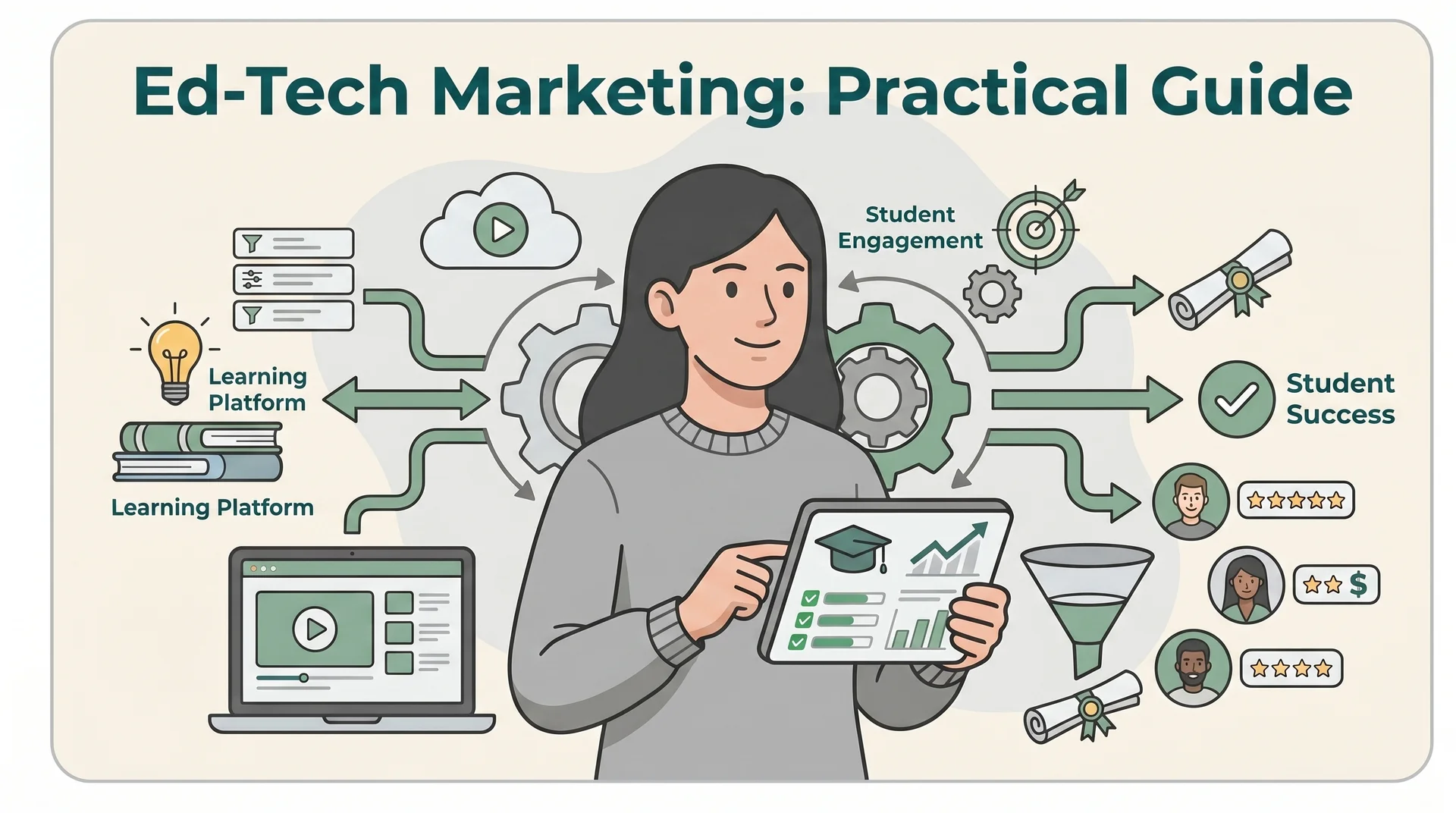
An EdTech marketing agency is a growth partner that understands the structural differences between education technology and every other product category — and builds acquisition strategies around those differences. Not every digital marketing agency qualifies. Most don't.
The problem isn't that bad agencies lie about their EdTech experience. It's that they genuinely believe that "we've run paid campaigns for B2C apps" translates to "we can grow your EdTech platform." It doesn't. The enrollment funnel in EdTech — especially for B2B institutional sales — behaves like no other vertical in performance marketing.
I've seen well-funded EdTech companies burn six-figure budgets on agencies that confidently pitched them "SaaS growth playbooks" and delivered CAC that made unit economics impossible. I've also seen companies 10× their trial-to-paid conversion rate simply by switching to a partner that understood the funnel mechanics specific to education.
This guide gives you the seven questions that expose which side of that divide an agency sits on — and what good answers actually look like.
Why Generic Agencies Fail EdTech
Before we get to the questions, it helps to understand what makes EdTech structurally different from other SaaS or D2C categories.
The EdTech Funnel Gap is the conversion cliff between free trial and paid enrollment that plagues almost every EdTech platform. In consumer SaaS, the gap is mostly psychological — does the user believe the product is worth paying for? In EdTech, that gap has structural causes that no amount of retargeting can fix:
-
Learning requires sustained effort. A user who signed up excited on Monday may not log back in until Thursday. The "aha moment" in EdTech often requires 3-7 sessions, not one. Agencies that optimize for trial-to-Day-1 activation are solving the wrong problem.
-
B2B EdTech has procurement calendars. Institutional buyers — schools, universities, corporate L&D teams — have budget windows tied to fiscal calendars, department head approvals, and sometimes legislative funding cycles (ESSER grants, Title I allocations in the US, state education budgets in India). Running Google campaigns in October for a product that procurement won't approve until Q1 is money incinerated.
-
The buyer is rarely the user. In B2B EdTech, teachers evaluate, IT approves, administrators decide, and procurement writes the cheque. These four stakeholders have radically different concerns. A generic agency that builds creative for "the decision-maker" will produce content that resonates with no one.
-
Trial-to-paid drop-off is structural, not attitudinal. Users often abandon trials not because they don't like the product, but because the trial period doesn't align to a natural teaching or learning cycle. Agencies that respond to churn with "better onboarding emails" miss this entirely.
A strong EdTech marketing agency understands all four dynamics and builds around them. Here's how to find out if the agency you're evaluating does.
The 7 Questions
Question 1: Do you have EdTech-specific CAC benchmarks?
What a weak answer sounds like: "Yes, we track CAC across all our clients and can benchmark against industry averages. CAC varies a lot depending on channels — typically $50–$200 for B2C apps."
What a strong answer sounds like: "EdTech CAC varies significantly by segment. B2C SaaS and online learning platforms average $273 (First Page Sage, 2026). B2B EdTech selling to institutions averages $1,424. Higher education is even higher — $2,000+ for full-cycle institutional deals. We'd want to understand your segment, ACV, and payback target before setting CAC goals, because the benchmarks are meaningless without that context."
Why it matters: An agency that gives you a generic CAC range doesn't understand that a $50 CAC is catastrophic for a $2,000 ACV institutional deal and perfectly acceptable for a $199/year consumer subscription. Their benchmarks reveal whether they've actually run EdTech campaigns — or just digital campaigns in general.
Question 2: Can you show enrollment funnel case studies — not just lead generation results?
What a weak answer sounds like: "We ran a campaign for an EdTech client and generated 2,400 leads in 90 days at a $12 CPL."
What a strong answer sounds like: "For one client, we built a three-stage enrollment funnel: awareness through YouTube pre-roll targeting teachers by subject; mid-funnel lead capture via a free lesson pack; bottom-funnel demo request for the institutional buyer. CPL was $28, but trial-to-paid was 34% — 2.4× the previous agency's result. The key was aligning the nurture sequence to the school district's procurement calendar, not the academic calendar."
Why it matters: Lead generation in EdTech is cheap and nearly useless as a standalone metric. A 2,400-lead campaign that converts at 0.8% to paid seats is worse than a 400-lead campaign that converts at 12%. Any agency can buy leads. EdTech-specific agencies optimize the full funnel from awareness to enrollment to renewal.
Question 3: How do you handle trial-to-paid drop-off?
What a weak answer sounds like: "We'd run retargeting ads to bring trial users back and optimize the onboarding email sequence."
What a strong answer sounds like: "First, we'd segment why trial users aren't converting. Is the trial period too short for a full learning cycle? Are institutional users waiting for a budget window? Are teachers interested but blocked by IT approval? Each of these requires a different intervention. Retargeting is usually the last resort — if someone dropped off because procurement requires a 6-week approval process, retargeting them on Instagram doesn't solve that problem."
Why it matters: This question most directly tests whether the agency understands The EdTech Funnel Gap. The right answer starts with diagnosis, not tactics. An agency that leads with retargeting has a tactics-first mentality — exactly the wrong starting point for a structurally complex funnel.
Question 4: What specific channels do you run for EdTech, and how does channel mix change by segment?
What a weak answer sounds like: "We run Meta, Google, and LinkedIn depending on budget. Meta is usually most cost-effective for B2C, LinkedIn for B2B."
What a strong answer sounds like: "For B2C EdTech (consumer online learning), Meta and YouTube are typically the primary acquisition channels — Meta for interest and lookalike targeting, YouTube for long-form product demos that build enough trust for a trial opt-in. Google Search becomes critical at scale for branded and high-intent queries. For B2B EdTech, LinkedIn is effective for enterprise, but Google Display and YouTube targeting teachers and administrators by job title often outperforms LinkedIn on CPL. We'd also look at subject-specific communities, teacher Facebook Groups, and education conference sponsorships depending on ACV."
Why it matters: Channel mix in EdTech is specific to buyer profile and sale complexity in ways that don't apply to SaaS broadly. An agency that gives generic channel guidance — LinkedIn = B2B, Meta = B2C — has a template mindset rather than a vertical-specific one.
Question 5: Do you serve both B2C and B2B EdTech — and what changes between them?
What a weak answer sounds like: "Yes, we've worked with both."
What a strong answer sounds like: "B2C EdTech (parent/student-facing, consumer subscription) and B2B EdTech (institutional, district-wide) are essentially different businesses. B2C requires emotion-forward creative, trial friction removal, and rapid iteration on performance data — cycles of 1–2 weeks. B2B requires stakeholder mapping, multi-touch attribution across a 6–18 month cycle, and content built for the evaluator (teacher), the approver (IT), and the buyer (administrator) simultaneously. We run both, but we staff them differently. If a client straddles both segments, we build separate funnel architectures for each."
Why it matters: Agencies that conflate B2C and B2B EdTech will build strategies that serve neither well. The answer should show they've thought about the segment boundary — and have clear operating models for each side of it.
Question 6: How do you price — percentage of spend, flat retainer, or performance-based?
What a weak answer sounds like: "We're flexible! We can do retainer, percentage of spend, or whatever works for you."
What a strong answer sounds like: "Our standard model is a flat retainer covering strategy, creative, and management — we find percentage-of-spend creates the wrong incentives, where the agency benefits from spending more regardless of efficiency. For early-stage EdTech with limited budget, we start with a minimum engagement that covers at least one full learning cycle (typically 60–90 days) because EdTech conversion timelines mean 30-day trials produce misleading results. We don't do performance-only models for EdTech because the conversion window is too long to attribute correctly in a short engagement."
Why it matters: Pricing structure reveals incentives. An agency on percentage-of-spend has a direct incentive to increase budget, not increase efficiency. A strong EdTech agency should be able to articulate why their pricing model aligns with your enrollment outcomes — and should warn you about the minimum engagement required to see statistically meaningful EdTech funnel data.
Question 7: Do you have content and SEO capability — or only paid media?
What a weak answer sounds like: "We're primarily a paid media agency, but we work with your content team or can refer you to an SEO partner."
What a strong answer sounds like: "Content is the highest-ROI long-term channel in EdTech, and it directly amplifies paid performance. Teacher communities, parent Facebook Groups, and institutional buyers all start with organic research before responding to paid ads. We integrate content and SEO strategy into every paid engagement — not as an add-on, but because the editorial calendar informs the paid creative strategy, the landing page messaging, and the retargeting segments. Our EdTech clients who combine SEO-first content with paid typically see 40–60% lower blended CAC within 12 months than paid-only approaches."
Why it matters: EdTech buyers are research-intensive. They read comparisons, seek recommendations from other teachers, and evaluate social proof through case studies and outcomes data before committing to a trial. An agency that can only reach them through paid ads is missing 60%+ of the touchpoints that actually drive enrollment decisions.
Scoring Rubric
Use this table during your evaluation calls. Score each question 1–3 and total at the end.
| Question | 1 — Weak | 2 — Adequate | 3 — Strong |
|---|---|---|---|
| CAC benchmarks | Generic $50–200 range | Mentioned segment variation | Specific B2C/B2B/HE benchmarks with context |
| Enrollment case studies | Lead volume metrics only | Includes conversion rates | Full funnel: awareness to paid, with calendar context |
| Trial drop-off | Retargeting + onboarding emails | Mentions segmentation | Starts with diagnosis, names structural causes |
| Channel specificity | LinkedIn = B2B, Meta = B2C | Some EdTech channel nuance | Segment-specific channel mix with reasoning |
| B2C vs B2B | "We've worked with both" | Describes the difference | Separate funnel architectures, different timelines |
| Pricing model | "We're flexible!" | Explains their model | Explains incentive alignment + warns about EdTech timelines |
| Content + SEO | Paid only | Has a referral partner | Integrated content and paid strategy with EdTech data |
Score interpretation:
- 17–21: Strong EdTech specialist. Worth a detailed scope conversation.
- 11–16: Adequate with gaps. Clarify which gaps matter most for your segment.
- 7–10: Generic agency. Will likely underperform on EdTech-specific funnel dynamics.
What This Looks Like in Practice
At Aurelius Media, we've built enrollment funnels for EdTech platforms across India and Southeast Asia — from early-stage platforms cracking their first 1,000 users to funded companies scaling across multiple markets.
A few patterns that recur:
Institutional EdTech (B2B): A higher-education platform saw 67% lower CPL after we rebuilt Google Search campaigns around procurement calendar seasonality — running heavier in Q4 (when budgets are being allocated for the next academic year) and pulling back in summer (when decision-makers are unavailable). Simple calendar insight, significant CPL impact.
Consumer online learning (B2C): A learning SaaS reduced trial-to-paid drop-off from 8.2% to 19.4% after we identified that most trial abandonments happened between Days 4–7 — the exact window when users hit the first difficult concept. Repositioning the nurture sequence around that friction point (rather than Day 1 excitement) moved conversion more than any paid optimization.
Test-prep EdTech: A test-preparation platform saw a 3.4× improvement in retargeting efficiency after we segmented by exam date proximity — treating "exam in 60 days" users fundamentally differently from "exam in 8 months" users in creative and landing page strategy.
None of these insights came from running standard playbooks. They came from understanding that EdTech has structural funnel dynamics that require diagnosis before tactics.
The Bottom Line
An agency that can generate 10,000 leads for an EdTech company but doesn't understand procurement calendars will consistently disappoint. An agency that understands The EdTech Funnel Gap will build strategies that survive contact with your actual conversion timeline.
The seven questions above are designed to expose that difference in a 60-minute call. Score each answer. Probe on the ones where you get weak responses. And look for the agency that pushes back on unrealistic timelines — because an EdTech specialist knows that measuring campaign success in 30 days is like judging a teacher by their first week's lesson plan.
If you're evaluating partners and want a benchmarked read on your current funnel, book a free EdTech marketing audit →
For a deeper look at EdTech marketing strategy — CAC benchmarks, channel mix by segment, and retention frameworks — read our EdTech Marketing Practitioner's Guide. And if you're building an organic acquisition engine alongside paid, our AI SEO strategy guide covers the content and entity frameworks that drive citation in EdTech research queries.
Frequently Asked Questions
What does an EdTech marketing agency actually do?
An EdTech marketing agency builds and manages the full growth funnel for education technology companies — from awareness and lead generation to trial conversion and enrollment. This includes paid media (Meta, Google, YouTube, LinkedIn), SEO and content strategy, email and SMS nurture sequences, landing page optimization, and analytics. What differentiates an EdTech-specialist agency from a generalist is understanding the structural funnel dynamics specific to education: longer conversion timelines, procurement calendar dependencies, multi-stakeholder buying committees, and the trial-to-paid drop-off patterns unique to learning products.
How much does an EdTech marketing agency cost in India?
EdTech marketing agency retainers in India typically range from ₹80,000–₹2,50,000/month for mid-tier agencies and ₹2,50,000–₹8,00,000/month for full-service growth agencies with EdTech specialization. Boutique freelancers start around ₹30,000–₹80,000/month. These ranges cover strategy and management only — media spend (what you pay Google, Meta, etc.) is typically separate. For a realistic budget, most EdTech platforms at growth stage need a combined retainer + media spend of ₹3,00,000–₹12,00,000/month to run a meaningful full-funnel program.
How long before an EdTech marketing agency produces results?
Paid media campaigns typically show lead flow and CPL data within 30 days, but EdTech-specific conversion metrics — trial-to-paid, enrollment rate, CAC relative to LTV — require at minimum 60–90 days to measure accurately. This is because EdTech trials often span 14–30 days, institutional purchase decisions take 6–18 weeks, and at least one procurement cycle needs to complete before you can evaluate funnel efficiency. Agencies that promise EdTech results in 30 days either don't understand the funnel or are reporting vanity metrics that don't reflect enrollment outcomes.
Should I hire an EdTech specialist agency or a general digital marketing agency?
For early-stage EdTech with a simple B2C model and a short trial-to-paid cycle, a strong general agency can work. For B2B EdTech selling to institutions, funded platforms with more than $500K/year in marketing spend, or companies where trial-to-paid conversion is the core business problem, an EdTech specialist significantly outperforms. The structural differences in procurement calendars, multi-stakeholder creative, and The EdTech Funnel Gap require vertical-specific expertise that generalists rarely develop. The cost of using the wrong agency isn't the retainer — it's the six months of misaligned campaigns.
What is The EdTech Funnel Gap?
The EdTech Funnel Gap is the conversion cliff between free trial and paid enrollment that exists for structural reasons specific to education products. Unlike SaaS where trial drop-off is primarily psychological, EdTech drop-off is often caused by: trial periods misaligned with natural learning cycles, procurement timelines at institutional buyers, the fact that the evaluator is not the approver, and the effort required for learning creating non-linear activation patterns. Agencies that treat EdTech trial drop-off as a standard SaaS churn problem will optimize for the wrong interventions.
What channels work best for EdTech marketing?
Channel effectiveness depends heavily on segment. For B2C EdTech (consumer subscriptions), Meta and YouTube are the primary paid channels. For B2B EdTech (institutional), Google Display and YouTube targeting teachers and administrators by job title often delivers better CPL than LinkedIn alone. SEO and content marketing is the highest-ROI long-term channel for both segments — EdTech buyers conduct extensive research before converting, and organic presence at that research stage significantly reduces blended CAC. The worst channel strategy is treating EdTech like a standard B2C app and running Meta-only.
How do I verify whether an EdTech agency is actually a specialist?
Ask for EdTech-specific CAC benchmarks by segment — they should know B2C SaaS averages ~$273, institutional B2B averages ~$1,424+. Ask for case studies that show full-funnel metrics: not just lead volume or CPL, but trial-to-paid conversion and enrollment rates. Ask how they handle procurement calendar seasonality for institutional clients. Ask specifically about their framework for trial-to-paid drop-off — a specialist will have a diagnostic approach that goes beyond retargeting. Finally, ask how they measure success at 30 days versus 90 days — a genuine EdTech specialist will tell you 30 days is too early to evaluate EdTech funnel performance.


